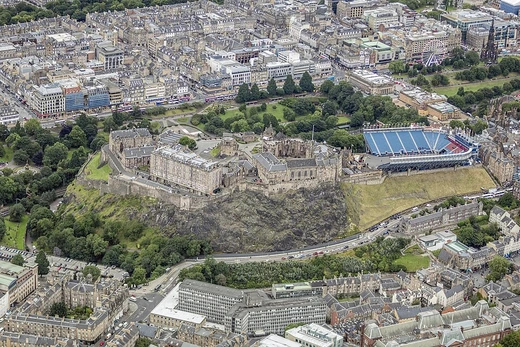
Old and New Towns of Edinburgh
Medieval Old Town and Georgian New Town, a UNESCO site.
The Old and New Towns of Edinburgh form a UNESCO World Heritage Site in the capital of Scotland. The Old Town, with its medieval layout and historic buildings like Edinburgh Castle and St Giles' Cathedral, contrasts with the Georgian New Town built in the 18th and 19th centuries. Together they represent a significant urban landscape that has been managed by Edinburgh World Heritage since 1999.
Quick Facts
- Location
- Edinburgh, Scotland
- Unesco designation
- World Heritage Site
- Management body
- Edinburgh World Heritage (since 1999)
- New town construction period
- 18th and 19th centuries
Facts from the source article.
Did You Know?
- The city is nicknamed Auld Reekie, Scots for Old Smoky, from the smoke-covered Old Town.
- The root of the city's name, 'Edin', derives from Eidyn, the name for the region in Cumbric, the Brittonic Celtic language formerly spoken there.
- The City of Edinburgh Council constitutes one of the 32 council areas of Scotland following local government reorganisation in 1996.
History
The earliest signs of people living in the Edinburgh area come from a Mesolithic camp at Cramond, dating to around 8500 BC. Later, Bronze Age and Iron Age settlements left traces on Castle Rock, Arthur's Seat, Craiglockhart Hill, and the Pentland Hills. When the Romans reached Lothian near the end of the 1st century AD, they met a Brittonic Celtic tribe they called the Votadini. This group later became the Gododdin kingdom in the Early Middle Ages, with Castle Rock—likely the stronghold of Din Eidyn—as its main center. The medieval Welsh poem Y Gododdin tells of a war band from across the Brittonic world gathering in Eidyn before a doomed raid, possibly around 600 AD. In 638, forces loyal to King Oswald of Northumbria besieged the Gododdin stronghold, and Lothian came under Angle control. This lasted until about 950, when King Indulf, son of Constantine II, saw the fortress—called oppidum Eden in the 10th-century Pictish Chronicle—handed over to the Scots. It mostly stayed under Scottish rule after that. King David I founded the royal burgh in the early 12th century on Crown land, though the exact charter date is unknown. The first written proof of the medieval burgh is a royal charter from around 1124–1127, where David I granted a toft in his burgh of Edenesburg to the Priory of Dunfermline. During the 12th century, heavy demand for wood left the land around Edinburgh nearly treeless, forcing the burgh to burn peat for fuel. During the Wars of Scottish Independence, Edinburgh was mostly under English control from 1291 to 1314 and again from 1333 to 1341.
Geography
Edinburgh sits on the southern edge of the Firth of Forth, within Scotland’s Central Belt. Its centre lies about two and a half miles southwest of Leith’s shoreline and twenty-six miles inland from the North Sea coast at Dunbar. The city is often described as resting on seven hills—Calton Hill, Corstorphine Hill, Craiglockhart Hill, Braid Hill, Blackford Hill, Arthur’s Seat, and Castle Rock—a feature that invites comparisons to Rome’s seven hills. Squeezed between the Firth of Forth to the north and the Pentland Hills to the south, Edinburgh spreads across terrain shaped by ancient volcanic activity and heavy glaciation. Between 350 and 400 million years ago, volcanic eruptions and faulting created tough basalt plugs, like Castle Rock. When glaciers advanced, this hard rock split the ice, protecting softer stone behind it and leaving a one-mile-long tail of debris to the east—a classic crag-and-tail formation. On the crag’s north side, glacial carving dug a deep valley that later held the now-drained Nor Loch. Arthur’s Seat is the eroded stump of a Carboniferous volcano, scoured by a glacier moving west to east. That erosion exposed rocky crags on the west and swept glacial deposits eastward, forming the Salisbury Crags. Other hills, such as Calton Hill and Corstorphine Hill, also resulted from glacial erosion.
Demography
Edinburgh’s population skews notably young: nearly one in five residents is in their twenties, and just over fifteen percent are in their thirties—the highest share of any Scottish city. Between 2001 and 2011, the percentage of residents born in the UK dropped from 92% to 84%, while the proportion identifying as White Scottish fell from 78% to 70%. Of those born in the UK, roughly 335,000 (83%) were born in Scotland, and about 58,000 (14%) came from England. Around 16,000 people, or 3.2% of the city, are of Polish descent. Non-White residents now make up 15.1% of the population (77,800 people), up from 8.2% in 2011 and 4% in 2001. The largest Non-White group is Asian, numbering about 44,000. Within that group, Chinese-descent residents are the biggest sub-group at 15,076 (2.9% of the total), followed by Indian-descent residents at 12,414 (2.4%), and Pakistani-descent residents at 7,454 (1.5%). Though only 2,685 people (0.5%) are of Bangladeshi descent, Edinburgh has the highest count and proportion of this group in Scotland. Nearly 12,000 residents were born in African countries, mainly Nigeria and South Africa (2.3%), and over 13,000 were born in the Americas. By 2022, 23.5% of Edinburgh’s residents were born outside the UK, up from 15.9% in 2011 and 8.3% in 2001.
Culture
The city hosts a series of festivals between the end of July and early September each year. The best known are the Edinburgh Festival Fringe, the Edinburgh International Festival, the Edinburgh Military Tattoo, the Edinburgh Art Festival, the Edinburgh International Book Festival, and the Edinburgh International Film Festival. The longest established are the Edinburgh International Festival and the Edinburgh International Film Festival, both first held in 1947. The Edinburgh Fringe, which began as a programme of marginal acts alongside the official festival, has become the world's largest performing arts festival. Comedy has become one of the mainstays of the Fringe, with many comedians getting their first break there, often by being chosen to receive the Edinburgh Comedy Award. The Edinburgh Military Tattoo occupies the Castle Esplanade every night for three weeks each August, with massed pipe bands and military bands drawn from around the world. Performances end with a short fireworks display.
More in World Heritage Sites in Scotland
Spotted an error? Know more?
Reader corrections go straight into our review queue. Suggest an edit · How this site is sourced