Mistapew
A spirit-being across Cree-Montagnais-Naskapi cultures, known as 'big man'.

Alarichall · CC0
Mistapew (also spelled Mista´peo, Mištapew, or Mishtapew; from Plains Cree *mistâpêw*, ᒥᐢᑖᐯᐤ, pronounced [ˈmɪs.tɑːˌpeːw]; plural *mistâpêwak*) is a spirit-being recognized across the Algonquian-speaking Cree, Montagnais, and Naskapi cultural continuum. The word combines the augmentative prefix *misti-* ("big, great") with the noun *nâpêw* ("man"), so it literally means "big man."
Evidence about what people believed regarding Mistapew before Euro-Canadian colonialism deeply altered Indigenous cultures is incomplete. In 2006, scholars John S. Long, Richard J. Preston, and Cath Oberholzer noted that the available ethnographic fragments come from different times and sources, making it hard to reconstruct religious concepts from such different viewpoints as Christian and traditional Indigenous. Language barriers, differing worldviews, and conflicting purposes have created a tangled history of misunderstandings and mixed behavior. Traditional ideas about Mistapew shifted during the twentieth century, but stories about this figure remain part of Indigenous North American traditional and popular culture in the twenty-first century.
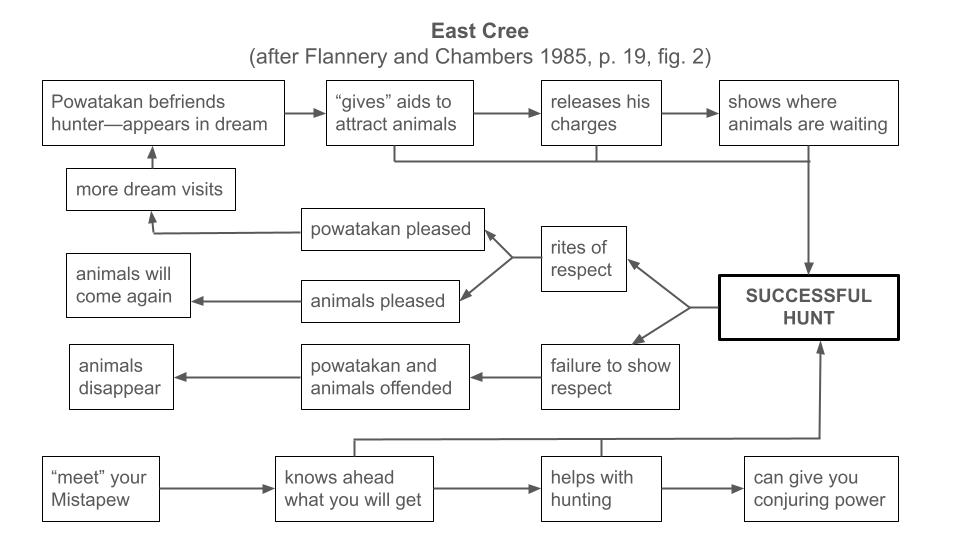
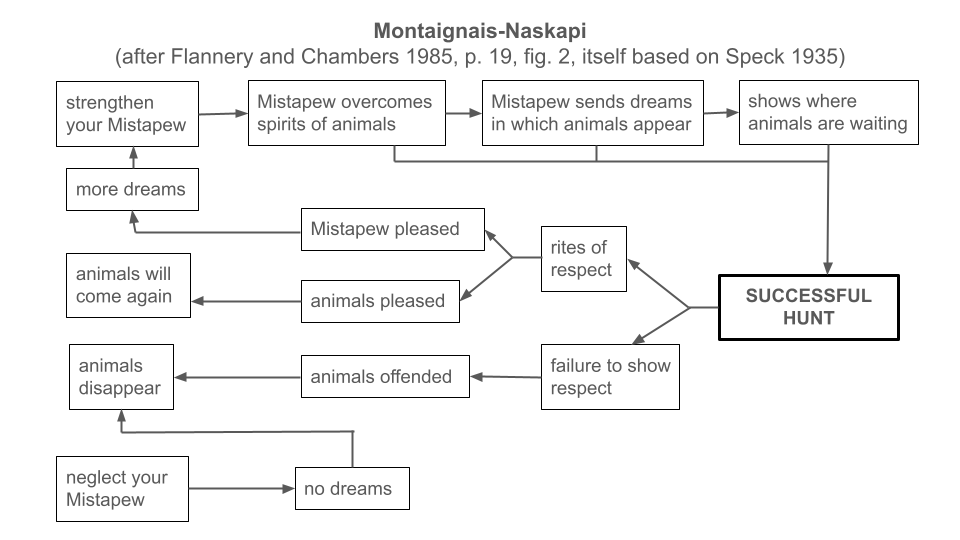
In Innu and Naskapi cultures, anthropologist Frank Speck wrote in 1935 that Mistapew referred to the human soul in its active, animate state. According to Speck, a hunter’s success in avoiding sickness, feeding his family, living longer, and building a good reputation depended on living in harmony with the requirements and prohibitions of his "Great Man." Speck also noted that in some stories Mistapew could eat humans, which he saw as similar to the Witigo. Regina Flannery later used a flow diagram to illustrate the role of Mistapew in hunting beliefs, based on Speck’s reports.
Among East Cree-speaking communities around James Bay—specifically in Waskaganish (then called Rupert House), Eastmain, Fort George, and Mistassini—Flannery conducted fieldwork in the 1930s and 1940s. She found that in these cultures, Mištapew was not a hunter’s own spirit but a spirit ally the hunter might meet while awake to seek wisdom. Other spirits, called *powatakanak*, could visit in dreams, but Mištapew appeared during waking hours. Mištapew played a key role in the shaking tent ceremony, which provided divinatory information about hunting. In this ceremony, a ritual specialist entered a small, specially built tent while the audience sat outside.
- Etymology
- Compound of augmentative prefix misti- 'big, great' and noun nâpêw 'man', meaning 'big man' (Plains Cree forms).
- In innu and naskapi cultures (1935)
- Denoted 'the human soul in its animate, active state'; hunter's success depends on harmony with his 'Great Man'.
- In east cree cultures (1930s–1940s)
- Not a hunter's own spirit, but a spirit ally encountered while awake; featured in the shaking tent ceremony as host or master of ceremonies.
- In swampy cree cultures
- Constellation classically known as Orion is named Mistapew; a story involves a giant, seven brothers, and the first sweat lodge (Corona Borealis).
- In plains cree cultures
- Teacher of the fourth law (honesty); also called 'Sabe' or 'Bigfoot'; described as a kind, honest being that heals and gives freely.
- In the rocky mountains
- Known as MISTAPEW (MISTAHE NAPEW, 'Giants'); generally seen as benevolent and friends of mankind; offspring of spirits and humanity; overseers of the earth and guardians of mankind.
Lore & Background
According to anthropologist Frank Speck in a 1935 publication, in Innu and Naskapi cultures the word Mistapew denoted 'the human soul in its animate, active state', and the hunter's success depended on harmony with his 'Great Man'. Speck noted that in some stories Mistapew can eat humans, perceiving similarity to Witigo. In East Cree cultures, Regina Flannery's fieldwork in the 1930s and 1940s found Mištapew was not a hunter's own spirit but a spirit ally encountered while awake, distinct from other spirit-beings (powatakanak) that visited in dreams. Mištapew featured prominently in the shaking tent ceremony, where the ritual specialist was said to turn into Mištapew, who then hosted spirits and conveyed their messages. A myth recorded by Flannery tells of a man named Čowa who attempted the shaking tent ceremony for the first time; Mištapew visited him with instructions that, when disobeyed, led to starvation until Čowa was taught skills and admonished. By the 1960s, beliefs in powatakanak fell away, but the idea of Mištapew lasted, with the term extended to cover 'the general notion of spirits believed in by the Cree but not the Whites'.
Reader's Guide
Mistapew's significance and legacy are documented across multiple Cree and related cultures, though evidence before colonial contact is patchy. In East Cree communities, the figure served as a moral teacher and ceremonial host, as shown in the Čowa story, which functioned both as an explanation of how conjuring began and as a lesson to obey instructions from Mištapew. By the 1960s, as subsistence hunting declined, beliefs in other spirits faded but Mistapew persisted, becoming a general term for spirits distinct from those of non-Indigenous people. In Plains Cree cultures, Mistapew is identified as the teacher of honesty, one of seven laws handed down by the Creator, and is described as a kind, honest being that heals and gives freely. In the Rocky Mountains, Mistapew are seen as benevolent giants, offspring of spirits and humanity, who withdrew from the living world to sleep in natural features; tradition holds that the End Times draw near when they allow themselves to be seen again. In the twenty-first century, Mistapew appears in Indigenous-authored fiction, including children's books and the Misewa Saga series, indicating ongoing cultural relevance.
Did You Know?
- Mistapew is a compound of misti- 'big, great' and nâpêw 'man', meaning 'big man'.
- In East Cree cultures, the ritual specialist in the shaking tent ceremony was said to turn into Mištapew.
- The constellation classically known as Orion is named Mistapew in Swampy Cree tradition.
- In Plains Cree cultures, Mistapew is the teacher of the fourth law, honesty, and is also called 'Sabe' or 'Bigfoot'.
Gallery
Frequently Asked Questions
Who is Mistapew?
Mistapew is a spirit-being recognized across the Algonquian-speaking Cree, Montagnais, and Naskapi cultural continuum. The name translates to "big man" in Plains Cree, and the being is understood differently depending on which community is describing it.
What does the name Mistapew mean?
The word is a compound of the augmentative prefix misti-, meaning "big" or "great," and the noun nâpêw, meaning "man," so it literally conveys "big man." In Plains Cree the plural form is mistâpêwak.
What is Mistapew's role in hunting?
Among Innu and Naskapi speakers, Mistapew was understood as the human soul in its active, animate state, and a hunter's success hinged on staying in harmony with this inner "Great Man." In East Cree tradition the being functioned differently: it was a spirit ally met while fully awake rather than one's own soul.
How does Mistapew feature in ceremony?
In East Cree practice documented in the 1930s and 1940s, Mistapew served as the host or master of ceremonies during the shaking tent ritual. The spirit-being was treated as a present, guiding participant rather than an abstract or purely internal concept.
How much do we actually know about pre-colonial beliefs about Mistapew?
The surviving record is fragmentary, and scholars have pointed out that much of what is documented reflects post-contact conditions rather than fully pre-colonial understandings. What we have comes largely from ethnographic fieldwork carried out in the early-to-mid twentieth century across several Algonquian language groups.
More in Legendary Creatures of the Indigenous Peoples of North America 1-24
Spotted an error? Know more?
Reader corrections go straight into our review queue. Suggest an edit · How this site is sourced