Little people (mythology)
Diminutive beings in Native American folklore, often hairy and horned.

Internet Archive Book Images · No restrictions
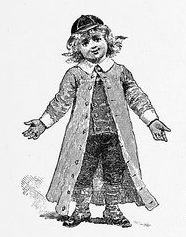
Little people are a class of diminutive, often supernatural beings found in the folklore of many cultures worldwide, including those of Native Americans. In North America, numerous Indigenous nations tell legends of a race of 'little people' who lived in woods near sandy hills and sometimes near rocks along large bodies of water, such as the Great Lakes. These beings are notable for their widespread presence across tribes and for the varied, sometimes contradictory, accounts of their nature and behavior.
- Common descriptions
- hairy-faced dwarfs
- Petroglyph features
- horns on their head, traveling in groups of 5 to 7 per canoe
- Reported locations
- Pryor Mountains of Montana and Wyoming (fairy rings), Spirit Mound, South Dakota
- Associated water body
- Great Lakes
- Mentioned by
- Lewis and Clark in their journals
- Tribal names
- Canotila (Lakota), Mannegishi (Cree), Memegwesi (Anishinaabe), Nimerigar (Shoshone), Nirumbee (Crow), Pukwudgie (Wampanoag), Yunwi Tsunsdi (Cherokee), and others
Lore & Background
The Native peoples of North America told legends of a race of 'little people' who lived in the woods near sandy hills and sometimes near rocks located along large bodies of water, such as the Great Lakes. Often described as 'hairy-faced dwarfs' in stories, petroglyph illustrations show them with horns on their head and traveling in a group of 5 to 7 per canoe. The Pryor Mountains of Montana and Wyoming are said to house 'fairy rings.' Other legends say the little people, if seen by an adult human, would beg them not to say anything of their existence and would reward those who kept their word by helping them and their family out in times of need. From tribe to tribe there are variations of what the little people's mannerisms were like, and whether they were good or evil, may be different. One common belief is that the little people create distractions to cause mischief.
Lewis and Clark reported in their journals that Native Americans in the vicinity of Spirit Mound, South Dakota held a belief in little people who inhabited the mound. Clark wrote that the local Native Americans could not be persuaded to approach the mound, as they feared these tiny 'Deavals' and considered them to be dangerous. Although members of Lewis and Clark's party visited the mound, they did not encounter any unusual beings.
Among the Ojibwe, a specific variant called the Memegwaans is described as a little person without definitive form which is terrified of adult humans. However, it seems to have a soft spot for children and will often approach in the guise of a child to any young person who seems upset, injured, scared or lonely and either protect them or keep them company until help arrives. If an adult sees one, they will often cower on the ground, screaming and crying hysterically before vanishing in the blink of an eye. They were also known as protectors of copper mines and were prayed to almost as patron saints of lost children. This is more specific and different from the Memegwesi, which is often simply described as a short, hairy man.
Reader's Guide
The little people of Native American folklore represent a widespread and culturally significant class of beings, with distinct variations among tribes. Their presence in the journals of Lewis and Clark highlights their importance in the historical record, as the explorers documented the beliefs of local Native Americans near Spirit Mound, South Dakota, who feared these 'Deavals' and refused to approach the mound. The article lists numerous tribal names for these beings, including Canotila (Lakota), Mannegishi (Cree), Memegwesi (Anishinaabe), Nimerigar (Shoshone), Nirumbee (Crow), Pukwudgie (Wampanoag), and Yunwi Tsunsdi (Cherokee), among others, demonstrating their ubiquity across North America. The lore also includes a more specialized figure, the Memegwaans of Ojibwe myth, who protects children and copper mines, contrasting with the more general Memegwesi. The article notes that from tribe to tribe, the little people's mannerisms and moral alignment vary, with some seen as helpful and others as dangerous. This diversity underscores the adaptability of the little people motif to different cultural contexts, while common elements—such as their small stature, hairy faces, and association with natural features like hills, rocks, and water—unite these traditions. The legacy of these beings persists in the oral traditions and petroglyphs of Indigenous peoples, and their mention in historical exploration accounts cements their place in the broader narrative of North American folklore.
Did You Know?
- Petroglyph illustrations show little people with horns on their head and traveling in groups of 5 to 7 per canoe.
- Lewis and Clark recorded that Native Americans near Spirit Mound, South Dakota, feared little people they called 'Deavals' and considered them dangerous.
- The Ojibwe Memegwaans is a little person without definitive form that protects children and copper mines.
Cosmological Framework and the Great Spirit
The Indigenous mythologies of North America share a foundational concept of an all-encompassing, omniscient Great Spirit, though each culture conceives this entity in its own way. Creation narratives form the backbone of these traditions, and anthropologists have noted that the depth of these sacred oral stories rivals the scriptures of major world religions. A recurring motif is the existence of a parallel realm—sometimes in the sky, sometimes beneath the earth or under water—alongside the physical world. In the Cherokee creation account, all beings initially dwelt in Galvlo'i above the sky, and the earth itself was coaxed into existence when Water Beetle carried mud from the ocean floor. The Great Spirit then anchored this new land with cords tied to the vault of heaven, and Buzzard's wingbeats subsequently shaped the topography, producing peaks, valleys, and hills. These narratives are not merely decorative; they encode ethical principles, collective memory of sacred ancestors, and a profound connection to the land's landscapes, seasons, and natural elements.
The Human-Animal Bond and Shape-Shifting
A defining characteristic across many Indigenous North American mythologies is the intimate, often fluid relationship between humans and animals, including birds and reptiles. Rather than treating the animal world as separate, these stories frequently depict shape-shifting between human and beast forms, inter-species marriages—particularly with bears—and animals nurturing human children. In the Great Plains, the buffalo held such centrality that it provided food, clothing, shelter, and tools, appearing in myths as both benevolent and terrifying. The Southeastern tradition of animism extended soulhood to every object, place, and creature, and the failure to properly rest a slain animal's soul could invite vengeance through its species chief. In the Northeast and Midwest, stories explore these complex cross-species relationships, sometimes recited as verse narratives. The Anishinaabeg, Ho-Chunk, Iroquois, Lenape, Seneca, and Wyandot peoples each carried their own variations of these themes, reflecting how deeply the animal world was woven into human identity and spiritual life.
Regional Voices and Distinctive Heroes
While shared themes bind these traditions, each region developed its own distinctive cast of divine figures and narrative concerns. In the Northeast and Midwest, female deities like Big Turtle the creator and First Mother—who gave birth to the first corn and tobacco from her body—stand alongside the great culture heroes Glooskap and Manabus. The Great Plains produced the Old Man, known as Waziya, a trickster who lived beneath the earth with his wife; their daughter married the wind and bore four sons representing the cardinal directions, after which sun, moon, and winds governed the cosmos together. The Blood Clot Boy, transformed from a clot of blood, served as another supernatural hero. In the Southeast, myths centered on the origins of hunting, farming, sickness, and medicine, with the annual Green Corn ceremony, also called Busk, renewing community life through the extinguishing and rekindling of fires, the forgiving of grudges, and the discarding of old materials. Each region thus offered a unique spiritual vocabulary while participating in a broader Indigenous cosmological conversation.
Tricksters, Ritual, and the Living Tradition
Beyond their solemn spiritual weight, many of these myths employ light-hearted humor, most often through trickster figures, to convey subtle moral and spiritual lessons. Allegory permeates the stories, addressing topics as varied as love, friendship, domestic violence, and mental illness. These narratives were not passive entertainment; they were embedded in living religious practice, connected to rituals involving dance, music, song, and trance, such as the Sun Dance. Southeastern funeral customs illustrate this practical dimension: when a tribe member died, their soul was believed to hover over the community, attempting to draw friends and relatives into the afterlife, making funeral ceremonies acts of protection for the living as much as commemoration. Most of these stories were first committed to writing by ethnologists in the late nineteenth and early twentieth centuries, transcribed from Native elders who maintained strong ties to ancestral traditions. These transcriptions are regarded as among the most authentic surviving records of the ancient narratives, forming the foundation for modern understanding of these rich mythological canons.
Gallery

Frequently Asked Questions
Who are the Little people in Native American mythology?
They are a category of small, often supernatural beings that appear in the folklore of numerous Indigenous nations across North America. Typically described as diminutive and hairy, they are said to dwell in wooded areas near sandy hills or rocky shores beside large bodies of water.
What do the Little people look like in traditional accounts?
They are most often portrayed as hairy-faced dwarfs, and some petroglyph carvings depict them with horns on their heads while traveling in groups of five to seven aboard small canoes.
Where are the Little people said to be found?
Legends place them in forests near sandy hills and rocky areas along the Great Lakes, with specific references to the Pryor Mountains in Montana and Wyoming (associated with fairy rings) and Spirit Mound in South Dakota.
What are the different tribal names for the Little people?
Each nation has its own term, such as Canotila (Lakota), Mannegishi (Cree), Memegwesi (Anishinaabe), Nimerigar (Shoshone), Pukwudgie (Wampanoag), and Yunwi Tsunsdi (Cherokee), reflecting how widely this figure appears across the continent.
Why are the Little people important in Indigenous folklore?
Their near-universal presence across so many distinct tribal traditions, combined with the often contradictory descriptions of their behavior, makes them one of the most broadly shared supernatural figures in North American Indigenous lore. They were even documented by Lewis and Clark in their expedition journals, lending them a place in early European-American records.
More in Legendary Creatures of the Indigenous Peoples of North America 1-24
Spotted an error? Know more?
Reader corrections go straight into our review queue. Suggest an edit · How this site is sourced