
Baile de la Conquista
A Guatemalan dance reenacting the Spanish conquest and conversion.

Bernal Rodríguez Ramírez · CC BY-SA 4.0
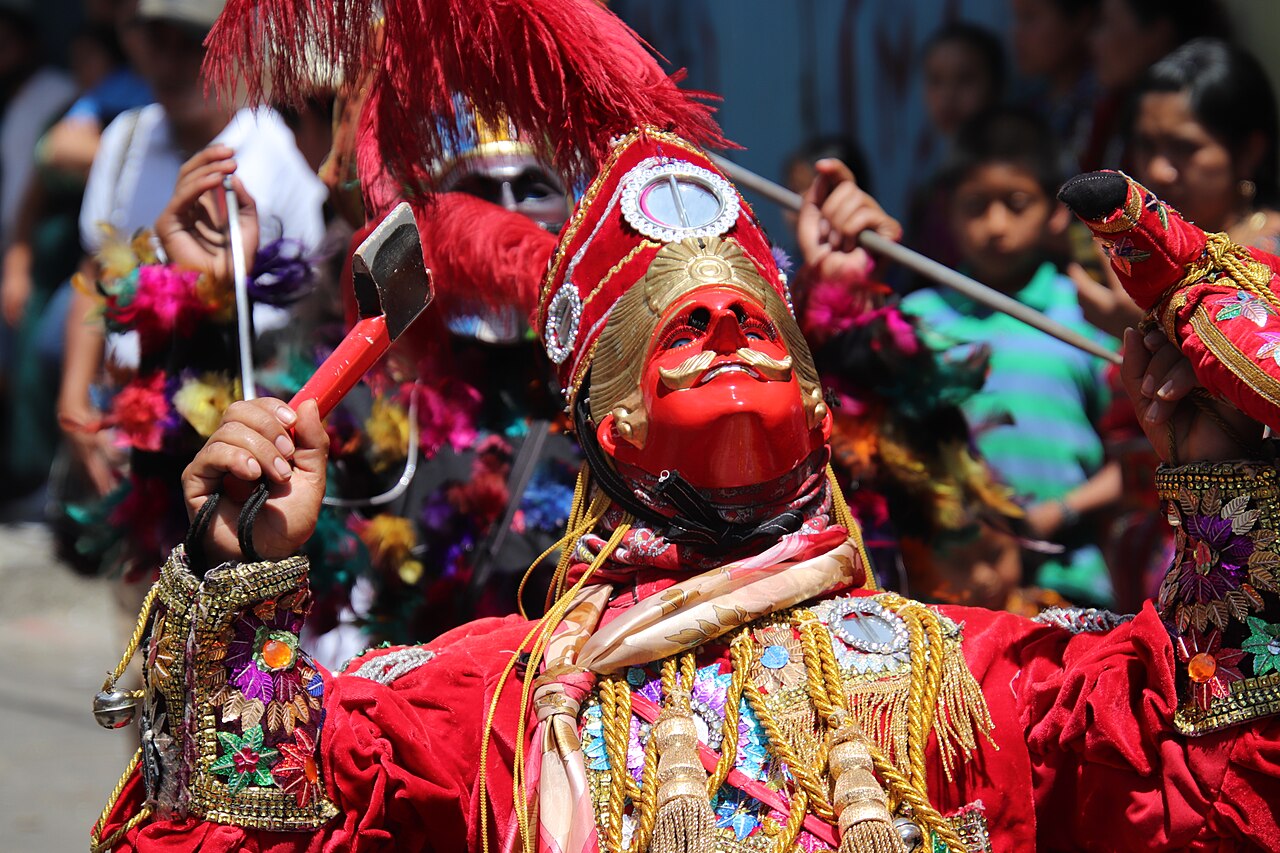
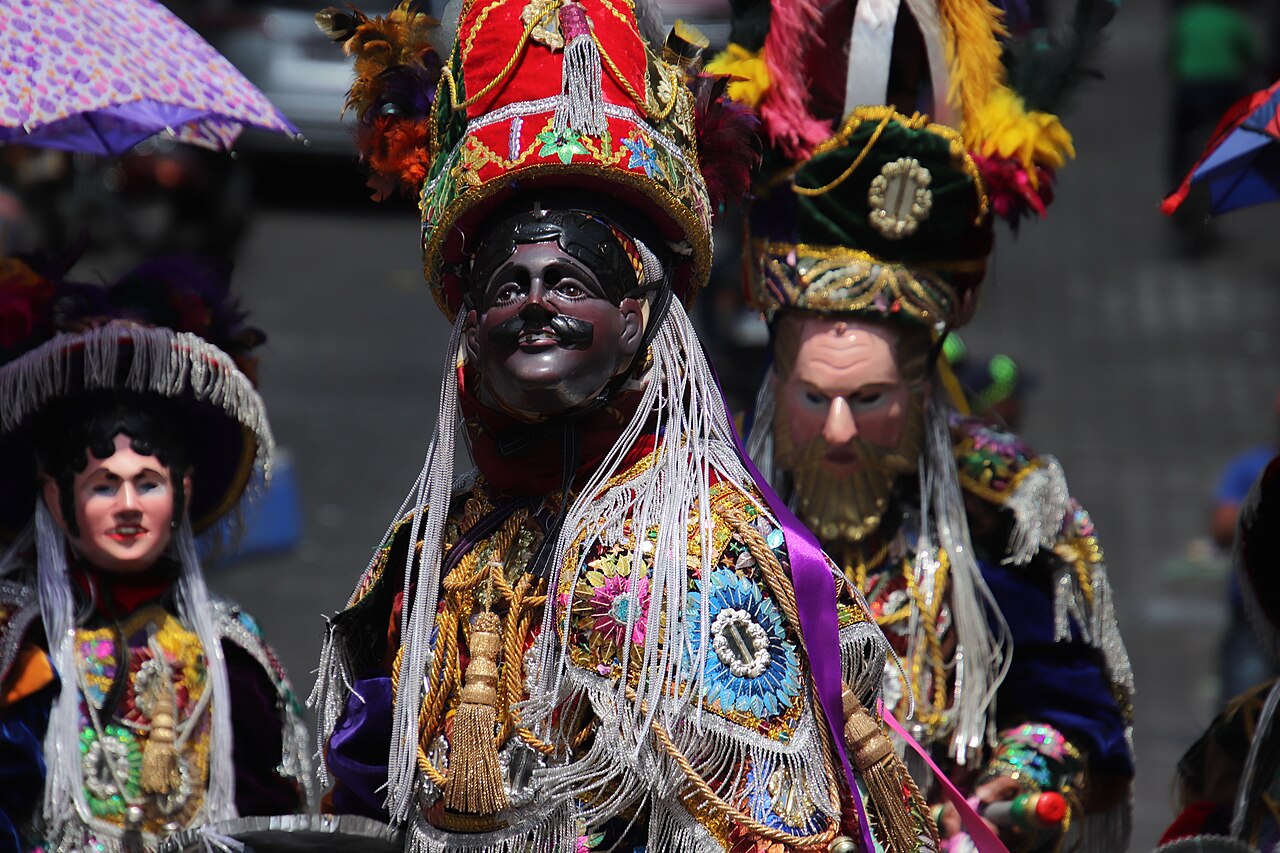
The Baile de la Conquista, also called the Dance of the Conquest, is a Guatemalan folk dance that stages the invasion by Spanish conquistador Pedro de Alvarado and his clash with Tecun Uman, the leader of the K'iche' kingdom of Q'umarkaj. The dance takes its structure from the Spanish Baile de los Moros ("Dance of the Moors"), which commemorates the expulsion of Moorish rule from Spain. In the Guatemalan version, the action starts in Q'umarkaj (also called Utatlán), the K'iche' capital. There, the Rey K'iche' learns from messengers that the Spaniards are approaching. He sends his sons to Xelajuj Noj (modern Quetzaltenango) to recruit Tecun Uman to lead the army. Scenes follow where K'iche' chieftains and Spanish officers pledge loyalty to their leaders. A battle erupts, culminating in the fight between Alvarado and Tecún Umán. The K'iche' are defeated, and the dance ends with the defeat and death of Tecun Uman, with the submission to Spanish rule and Christianity not always portrayed as entirely peaceable. The central moment of the Guatemalan version is the confrontation between Tecun Uman and Pedro de Alvarado.
Whether Tecun Uman actually existed is debated. One clue comes from a letter Alvarado wrote to Hernán Cortés, but it is vague: Alvarado only notes that "one of the four chiefs of the city of Utatlán was killed, who was the captain general of all this country." He gives no name for the K'iche' general, nor does he say how or by whom the man died. Other indigenous sources, like the Título C'oyoi, describe the battle in terms similar to the modern legend and contain the earliest known reference to the leader as Tecum Umam. The Popol Vuh, along with writings by Bartolomé de las Casas and the Título de Totonicapán, confirms that four lords ruled the K'iche' at the time of the conquest. The first-born son of the most powerful lord, the Keeper of the Mat, was expected to prove himself by leading the army and was given the title "nima rajpop achij"—the same title given to Tecun Uman in the Título K'oyoi.
- Type
- Traditional folkloric dance
- Origin
- Guatemala
- Based on
- Spanish Baile de los Moros
- Central figures
- Pedro de Alvarado and Tecun Uman
- Purpose
- Cultural commemoration
- Key constant
- Defeat and death of Tecun Uman
Lore & Background
The Baile de la Conquista borrows its structure directly from the Spanish Baile de los Moros, which recounts the expulsion of Moorish rule from Spain. The dance begins in Q'umarkaj, the K'iche' capital, where the Rey K'iche' receives word of the Spaniards' approach from messengers. The king sends his sons to Xelajuj Noj to recruit Tecun Uman to lead the army. Scenes depict K'iche' chieftains and Spanish officers swearing allegiance, followed by a battle culminating in the confrontation between Alvarado and Tecún Umán. The K'iche' army is defeated, and the dance concludes with the defeat and death of Tecun Uman, with the submission to Spanish rule and Christianity not always portrayed as entirely peaceable.
The true existence of a historical Tecun Uman is debated.
Reader's Guide
The Baile de la Conquista holds significance as a living historical performance that blends indigenous and Spanish colonial narratives, serving both as a cultural tradition and a tool of religious conversion. Its structure, borrowed from the Baile de los Moros, adapts the theme of conquest and conversion to the Guatemalan context, centering on the legendary confrontation between Pedro de Alvarado and Tecun Uman. The dance's persistence across Latin America, with variations based on local folklore, underscores its role in commemorating colonial history while reinforcing Catholic identity. The ongoing debate over Tecun Uman's historicity—rooted in sparse Spanish records and richer indigenous documents—adds layers of complexity, reflecting how folklore can shape and preserve contested memories. The dance's constant resolution, the peaceful submission and conversion of the native population, highlights its original purpose as a missionary tool, while its continued performance honors patron saints and maintains cultural heritage.
Did You Know?
- The Baile de la Conquista is based on the Spanish Baile de los Moros, which commemorates the expulsion of Moorish rule from Spain.
- The dance concludes with the K'iche' warriors submitting peaceably to Spanish rule and embracing Christianity.
- The existence of a historical Tecun Uman is debated; Alvarado's letter to Cortés mentions a killed K'iche' chief but does not name him.
- The Título C'oyoi contains the earliest known reference to the K'iche' leader as Tecum Umam.
Roots in the Moorish Tradition
The Baile de la Conquista did not spring from a vacuum of Guatemalan creativity; its architecture is borrowed wholesale from the Spanish Baile de los Moros, a performance that celebrated the expulsion of Moorish governance from the Iberian Peninsula. The structural skeleton of the conquest dance—its narrative arc, its choreographic logic, and its climactic resolution—maps directly onto that older Iberian form. Where the Moorish dance featured a 'Moorish prince' as its central antagonist, the Guatemalan adaptation substituted a K'iche' warrior figure into that same dramatic slot. Scholars have even proposed that the name 'Tecun Uman' was coined specifically to fill the vacant role left by the Moorish prince, though this hypothesis has attracted little scholarly traction given that indigenous documents referencing a historical figure by that name predate the earliest known performances of the conquest dance. What remains invariant across every regional variation is the theological endpoint: the peaceful submission of the indigenous or 'pagan' population and their embrace of the Christian faith.
The Guatemalan Staging
In the Guatemalan iteration, the performance opens in Q'umarkaj—the capital of the K'iche' kingdom, also known by its Nahuatl rendering Utatlán. The Rey K'iche' learns of the approaching Spanish force through a message relayed from Moctezuma II in Tenochtitlan. He dispatches his sons and daughters to Xelajuj Noj, the site of present-day Quetzaltenango, to enlist Tecun Uman as military commander. The choreography then moves through formal scenes of K'iche' chieftains pledging loyalty to their king and Spanish officers swearing fealty to their own leaders. A full battle sequence follows, pitting native and colonial troops against one another, before the narrative narrows to the singular duel between Pedro de Alvarado and Tecun Uman—the unmistakable dramatic core of the Guatemalan version. The K'iche' army is ultimately routed, and, mirroring the closing of the Baile de los Moros, the surviving warriors lay down their arms, accept Spanish sovereignty, and profess the Christian faith.
The Question of Tecun Uman's Historicity
Whether a K'iche' lord actually bore the name Tecun Uman remains one of the most contested questions in early colonial Guatemalan history. The most frequently cited evidence is a letter from Alvarado to Cortés, in which the conquistador notes that 'one of the four chiefs of the city of Utatlán was killed, who was the captain general of all this country.' Yet Alvarado offers no name, no account of the manner of death, and no identification of the killer. The Título C'oyoi, an indigenous document, narrates the battle in language closely parallel to the modern legend and contains what appears to be the earliest written reference to the leader as 'Tecum Umam.' The Popol Vuh corroborates Bartolomé de las Casas and the Título de Totonicapán in confirming that four lords governed the K'iche' at the time of the conquest, and that the first-born son of the Keeper of the Mat—the most senior lord—was expected to lead the army under the title 'nima rajpop achij,' the very title attached to Tecun Uman in the Título C'oyoi. Genealogical passages in both the Popol Vuh and the Título de Totonicapán identify that son as 'Tecum' at the moment of Alvarado's arrival. An alternative theory holds that Tecun Uman actually fought a subordinate named Argueta, whose descendants claim to preserve a lance stained with the hero's blood.
A Missionary Instrument Across the Americas
Although the Baile de la Conquista is most tightly woven into Guatemalan cultural identity, its reach extended far beyond that single nation. Throughout the early colonial period, Catholic friars and priests actively encouraged the performance of the dance in various Latin American regions as a didactic tool for converting indigenous communities and enslaved Africans to the Catholic faith. The dance functioned less as entertainment and more as a scripted sermon in motion, dramatizing the narrative that European Christian rule was divinely ordained and that the 'pagan' peoples were meant to submit and be saved. Surviving performances outside Guatemala typically take place in connection with a town's patron saint celebration, embedding the conquest narrative within a broader cycle of local religious observance. Each regional variation incorporates elements of local folklore, altering characters, settings, and specific dramatic beats, yet the one element that never changes is the resolution: the native population's peaceful capitulation and conversion. In this sense, the dance operated as a portable, repeatable instrument of colonial religious policy, adaptable to local contexts while preserving its core theological message.
Gallery
Frequently Asked Questions
What is the Baile de la Conquista?
It is a traditional Guatemalan folk dance that dramatizes the arrival of Spanish forces under Pedro de Alvarado and their violent encounter with the K'iche' ruler Tecun Uman in the capital of Q'umarkaj. The performance functions as a staged historical reenactment rooted in local oral tradition.
Who are the main characters in the Baile de la Conquista?
The two central figures are Pedro de Alvarado, representing the Spanish conquistador, and Tecun Uman, the sovereign of the K'iche' kingdom who leads his people in defense. Supporting roles include the Rey K'iche' and his sons, who act as messengers and warriors within the narrative.
What is the Baile de la Conquista based on?
The dance borrows its structural framework from the Spanish Baile de los Moros, a tradition celebrating the removal of Moorish rule from the Iberian Peninsula. Guatemalan performers adapted that template to tell their own conquest story, swapping Moors for K'iche' warriors and reframing the conflict around Alvarado's invasion.
How does the story in the Baile de la Conquista end?
Tecun Uman is ultimately defeated in battle and dies, marking the collapse of K'iche' resistance to the Spanish advance. This outcome is a fixed element of every performance and underscores the tragic loss of indigenous sovereignty.
Why is the Baile de la Conquista culturally significant in Guatemala?
It serves as a living act of cultural commemoration, keeping the memory of the conquest alive through embodied performance rather than written history. By staging the event year after year, communities preserve a shared narrative of loss, resistance, and identity that ties present-day Guatemalans to their pre-colonial past.
More in Latin American folklore 1-24
Spotted an error? Know more?
Reader corrections go straight into our review queue. Suggest an edit · How this site is sourced