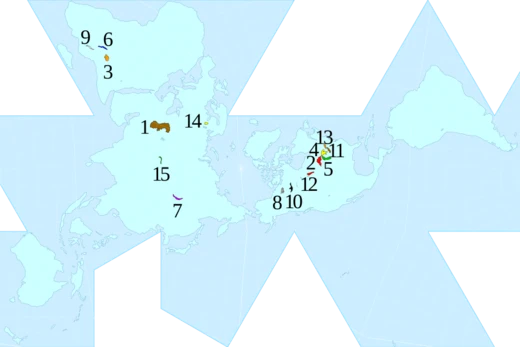
Lake Vostok
Largest subglacial lake in Antarctica, sealed for millions of years.

Lake Vostok is the biggest of Antarctica’s 675 known subglacial lakes and ranks as the 16th largest lake on Earth by surface area. It sits under Russia’s Vostok Station, beneath the central East Antarctic Ice Sheet, where the ice surface is 3,488 meters above sea level. The lake’s freshwater surface lies roughly 4,000 meters below that ice, putting it about 500 meters below sea level. The lake takes its name from the station, which was named after the sloop-of-war *Vostok*—Russian for “East”—and the lake is found in East Antarctica.
The idea of freshwater under Antarctic ice dates back to the late 1800s, when Russian scientist Peter Kropotkin suggested that the immense pressure from thousands of meters of ice could lower the melting point enough to turn the bottom layers into liquid water. Russian glaciologist Igor Zotikov later developed this theory in his 1967 PhD thesis. In 1959 and 1964, Russian geographer Andrey Kapitsa used seismic soundings near Vostok Station to measure ice thickness. In the mid-1990s, while at a symposium in Cambridge, Kapitsa realized his earlier data indicated water beneath the ice. British airborne ice-penetrating radar surveys in the early 1970s had already picked up unusual readings at the site, hinting at a liquid freshwater lake. In 1991, remote sensing specialist J. P. Ridley directed the ERS-1 satellite’s high-frequency array toward the center of the Antarctic ice cap, and the data confirmed the 1973 findings. These results were published in the *Journal of Glaciology* in 1993, confirming the lake’s existence. Russian and British scientists then integrated airborne radar and satellite altimetry data to map the lake, and the discovery appeared in *Nature* on 20 June 1996. The lake holds large amounts of liquid water under more than three kilometers of ice and contains at least 22 cavities of liquid water, each averaging about 10 kilometers across. In 2005, an island was found in the lake’s central part. In January 2006, two smaller nearby subglacial lakes—named 90 Degrees East and Sovetskaya—were reported. Glaciologists from the Centre for Polar Observation & Modelling propose that many Antarctic subglacial lakes may be temporarily interconnected by subsurface rivers, which can suddenly form and push large volumes of water through solid ice.
The overlying ice preserves a continuous paleoclimatic record spanning 400,000 years, while the lake water itself may have been isolated for 15 to 25 million years. Because the lake could have been sealed off for so long, its conditions might resemble those of ice-covered oceans thought to exist on Jupiter’s moon Europa and Saturn’s moon Enceladus. On 5 February 2012, Russian scientists completed the longest ice core ever drilled—3,768 meters—and pierced the ice shield to reach the lake’s surface. The first core of freshly frozen lake ice was obtained on 10 January 2013 at a depth of 3,406 meters. However, when the ice was breached, water from the lake gushed up the borehole, mixing with the Freon and kerosene used to keep the hole from freezing. Some scientists and environmental groups opposed the drilling, arguing that hot-water drilling would have caused less environmental impact. It is hypothesized that unusual life forms might exist in the lake’s liquid layer, a reserve of fossil water.
- type
- Subglacial lake
- location
- Beneath Vostok Station, East Antarctic Ice Sheet
- area
- Largest of Antarctica's 675 subglacial lakes; 16th largest lake in the world by
- depth_below_ice
- Approximately 4,000 m (13,100 ft)
- elevation
- Approximately 500 m (1,600 ft) below sea level
- discovery_confirmed
- 1993 by J. P. Ridley using ERS-1 laser altimetry
- mean_water_temperature
- Around −3 °C (27 °F)
Verified Timeline
Lore & Background
On 5 February 2012, a team of Russian scientists completed the longest ever ice core of 3,768 m (12,400 ft) and pierced the ice shield to the surface of the lake. The first core of freshly frozen lake ice was obtained on 10 January 2013 at a depth of 3,406 m (11,175 ft). However, as soon as the ice was pierced, water from the underlying lake gushed up the borehole, mixing it with the Freon and kerosene used to keep the borehole from freezing. The lake is estimated to have been sealed off under the ice for 15 to 25 million years, and its overlying ice provides a continuous paleoclimatic record of 400,000 years. The lake is an oligotrophic extreme environment, supersaturated with nitrogen and oxygen at levels 50 times higher than typical freshwater lakes, due to the immense pressure of the ice cap. Geothermal heat from Earth's interior may warm the bottom of the lake. The existence of the lake was first suggested by Russian geographer Andrey Kapitsa based on seismic soundings made during the Soviet Antarctic Expeditions in 1959 and 1964. Continued research by Russian and British scientists led to final confirmation in 1993 by J. P. Ridley using ERS-1 laser altimetry. The lake has at least 22 cavities of liquid water, averaging 10 km (6 mi) each. In 2005 an island was found in the central part of the lake. The coldest naturally occurring temperature ever observed on Earth, −89 °C (−128 °F), was recorded at Vostok Station on 21 July 1983. The average water temperature is calculated to be around −3 °C (27 °F); it remains liquid below the normal freezing point because of high pressure from the weight of the ice above it.
Reader's Guide
Lake Vostok is significant as a unique, isolated environment that may resemble conditions on ice-covered moons such as Jupiter's Europa and Saturn's Enceladus. Its discovery confirmed the existence of large subglacial water bodies in Antarctica, reshaping understanding of the continent's hydrology and geology. The lake's water may have been isolated for 15 to 25 million years, offering a potential fossil water reserve that could harbor unusual forms of life. The drilling project has been opposed by some environmental groups and scientists who argue that hot-water drilling would have a more limited environmental impact. The lake also contains at least 22 cavities of liquid water, and in 2005 an island was found in its central part. The presence of tides (rising about 12 mm depending on the Sun and Moon), a 1 microtesla magnetic anomaly on the east coast spanning 105 by 75 km, and the possibility of interconnected subglacial rivers further highlight its complexity. Its study continues to inform astrobiology and climate science. Living Hydrogenophilus thermoluteolus micro-organisms have been found in Lake Vostok's deep ice core drillings, suggesting the presence of a deep biosphere utilizing a geothermal system of the bedrock encircling the subglacial lake.
Did You Know?
- The coldest naturally occurring temperature ever observed on Earth, −89 °C (−128 °F), was recorded at Vostok Station on 21 July 1983.
- Lake Vostok's water is supersaturated with nitrogen and oxygen at levels 50 times higher than typical freshwater lakes on Earth's surface.
- The lake has tides that rise about 12 mm (0.47 in) depending on the position of the Sun and the Moon.
- Living Hydrogenophilus thermoluteolus micro-organisms have been found in Lake Vostok's deep ice core drillings.
- The overlying ice provides a continuous paleoclimatic record of 400,000 years, though the lake water itself may have been isolated for 15 to 25 million years.
Frequently Asked Questions
What is Lake Vostok?
It is the largest subglacial lake in Antarctica and the 16th largest lake on Earth by surface area. The entire body of water sits sealed beneath the East Antarctic Ice Sheet, cut off from sunlight and air for millions of years.
Where exactly is Lake Vostok located?
The lake lies directly beneath Russia's Vostok Station in East Antarctica, with its surface roughly 4,000 meters below the ice and about 500 meters below sea level. It borrows its name from that station, which was itself named after the Russian sloop-of-war Vostok, meaning 'East'.
How was Lake Vostok discovered?
In 1993, J. P. Ridley confirmed the lake's existence by analyzing laser altimetry readings from the ERS-1 satellite. Prior to that, geophysicists had long suspected a hidden water body under the ice but lacked definitive proof.
How far below the ice is Lake Vostok?
The lake's surface sits approximately 4,000 meters (around 13,100 feet) beneath the overlying ice sheet. Despite that staggering depth of ice above it, the lake floor itself is only about 500 meters below sea level.
Why is Lake Vostok considered so significant?
As the largest of Antarctica's 675 known subglacial lakes, it represents a vast volume of water that has been isolated from the surface environment for millions of years. That extreme, undisturbed isolation makes it a uniquely valuable natural laboratory for studying ancient ecosystems and deep Earth history.
More in Lakes Of The World 1-18
Spotted an error? Know more?
This is a living reference — every entry is fact-audited, and reader corrections feed straight into our audit queue. Suggest an edit · See this site's audit record