
TuS Makkabi Berlin
German sports club formed from three Jewish predecessor clubs.

OTFW , Berlin · CC BY-SA 3.0
TuS Makkabi Berlin is a German sports club based in Berlin, established in 1970. The club lays claim to the traditions of predecessor Bar-Kochba Berlin, a major Jewish sports organization founded in 1898. It is one of the largest Maccabi associations in Germany, with about 600 members, and promotes dialogue between Jews and non-Jews in sports.
- founded
- 26 November 1970
- field
- Multi-sport (football, gymnastics, athletics, boxing)
- nationality
- German
- known_for
- Continuing the legacy of pre-war Jewish sports clubs Bar Kochba Berlin and Hakoah Berlin; winning the Berlin Cup in 2023
Quick Facts
- Clubname
- TuS Makkabi Berlin
- Fullname
- TuS Makkabi Berlin e.V.
- Founded
- 1970-11-26
- Ground
- Julius-Hirsch-Sportanlage
- Capacity
- 1,000
- Chairman
- Linir Mizrahi
- Manager
- Wolfgang Sandhowe
- League
- Oberliga NOFV-Nord (V)
- Season
- 2025–26
- Position
- Oberliga NOFV-Nord, 8th of 16
- Website
- https: · tus-makkabi.de
Facts from the source article.
Lore & Background
TuS Makkabi Berlin was formed on 26 November 1970 through the merger of Bar-Kochba Berlin (gymnastics and athletics), Hakoah Berlin (football, re-established 1945), and Makkabi Berlin (boxing). Its predecessor Bar Kochba Berlin, created in 1898, was a prominent Jewish sports club, though the claim of over 40,000 members from 24 countries by 1930 actually refers to the global Maccabi movement, not the local Berlin club. The club fielded teams in several sports, including a football side that competed in city leagues between 1911 and 1929.
In 1929 Bar Kochba merged with Hakoah Berlin to form Bar Kochba-Hakoah, which continued as Hakoah after 1929. The rise of the Nazis led to exclusion of Jewish teams from general competition by 1933, and outright ban in 1938. After World War II, Jewish sports associations re-emerged, leading to the 1970 merger. The football side played in third and fourth tier competition in the 1970s and 1980s, left to join FV Wannsee in 1987, and returned in 1997. Since 2003 the club has played in the Bezirksliga Berlin, later fluctuating between the Verbandsliga Berlin and Landesliga, returning to the Berlin-Liga in 2016. In 2022, Makkabi won promotion to the NOFV-Oberliga Nord after winning the Berlin-Liga.
Reader's Guide
TuS Makkabi Berlin represents a direct link to the vibrant Jewish sports culture that flourished in Germany before the Nazi era. Its predecessor Bar Kochba Berlin, founded in 1898, grew into a global Jewish organization with over 40,000 members by 1930, promoting physical education and Jewish heritage. The club's history reflects the broader trajectory of Jewish life in Germany: early success, persecution under the Nazis (including exclusion from general competition in 1933 and outright ban in 1938), and post-war re-emergence. The 1970 merger of three clubs—Bar-Kochba Berlin, Hakoah Berlin, and Makkabi Berlin—consolidated these traditions. Today, with about 600 members, it is one of the largest Maccabi associations in Germany and actively promotes Jewish-non-Jewish dialogue. Its football team's promotion to the NOFV-Oberliga Nord in 2022 and winning the Berlin Cup in 2023 mark recent competitive achievements. The club also gained attention in 2006 when antisemitic chants were reported during a match, highlighting ongoing challenges. Makkabi Berlin's existence and success serve as a testament to the resilience of Jewish sports in Germany.
Did You Know?
- TuS Makkabi Berlin was formed on 26 November 1970 from the merger of Bar-Kochba Berlin, Hakoah Berlin, and Makkabi Berlin.
- The global Maccabi movement, not the local Bar Kochba Berlin club, had over 40,000 members from 24 countries by 1930.
- World record holder Lilli Henoch was a member of Hakoah Berlin, not Bar Kochba Berlin; she did not train Bar Kochba's women's section in 1924.
- In 2006, during a match, fans and players reportedly chanted antisemitic slogans including 'Gas the Jews'.
A Century of Jewish Sporting Heritage
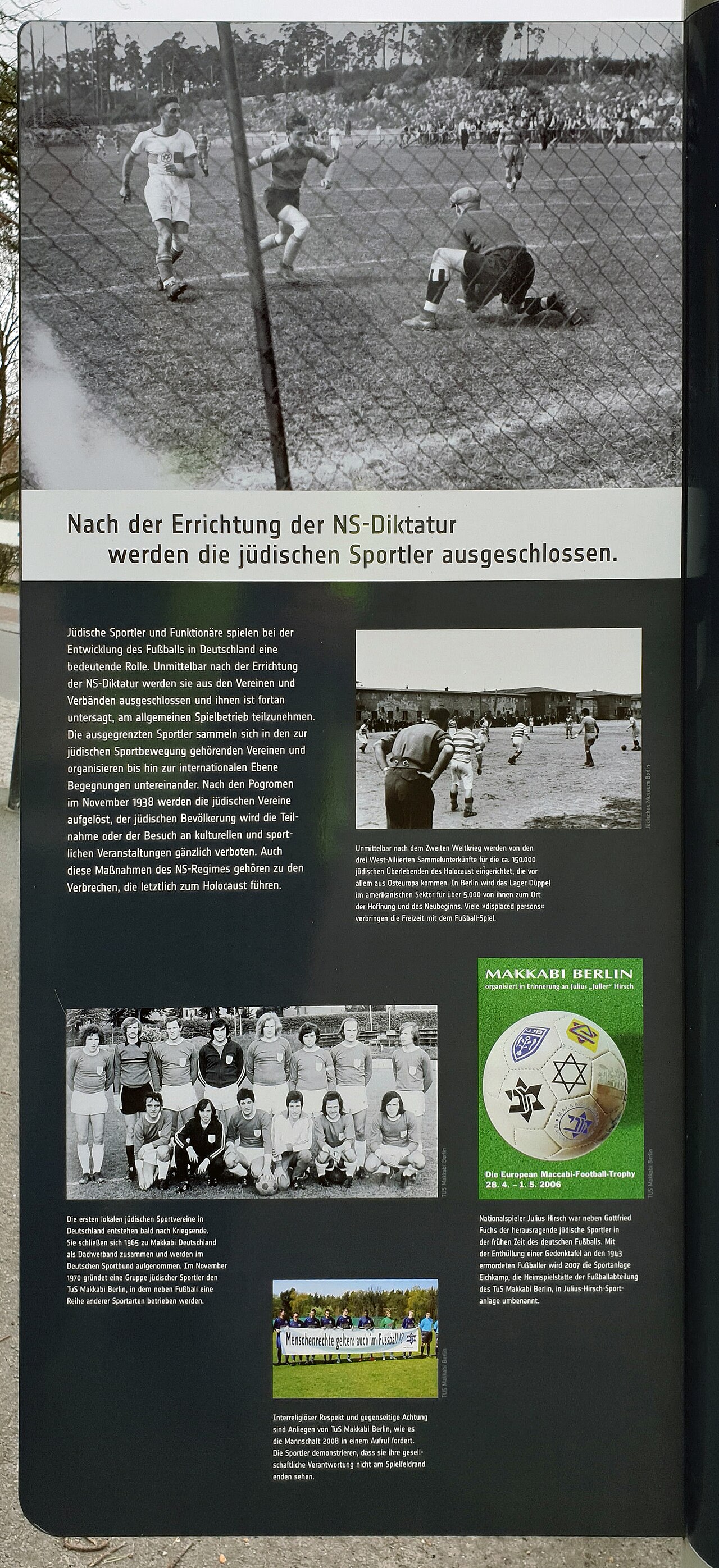
The roots of TuS Makkabi Berlin stretch back to 1898, when Bar Kochba Berlin was founded as part of a broader international movement dedicated to physical education and the preservation of Jewish cultural identity. By the early 1930s, the organization had grown into one of the largest Jewish bodies in the world, boasting more than 40,000 members spread across 24 nations. The club fielded competitive teams in multiple disciplines, and its football side competed in Berlin's city leagues from 1911 through 1929. A particularly notable chapter came in 1924, when Lilli Henoch — a world record holder in the discus, shot put, and 4 × 100 metres relay — took charge of the club's women's training programme. In 1929, Bar Kochba merged with the rapidly ascending Hakoah Berlin, whose footballers had clinched three straight lower-division titles between 1925 and 1927 and reached first-tier competition by 1928. The combined entity continued under the Hakoah name. Yet the Nazi seizure of power in the early 1930s brought systematic exclusion: by 1933 Jewish sides were barred from open competition, and by 1938 they were banned outright as state discrimination curdled into open persecution.
Rebuilding from the Ashes: The Football Journey
In the years following World War II, Jewish sporting and cultural life in Germany slowly reasserted itself. On 26 November 1970, three distinct traditions were stitched together to create TuS Makkabi Berlin: Bar-Kochba Berlin contributed gymnastics and athletics, Hakoah Berlin — whose football section had been re-established in 1945 — brought the football programme, and Makkabi Berlin added boxing. The new club's footballers competed in the third and fourth tiers throughout the 1970s and 1980s before departing in 1987 to join FV Wannsee. That partnership proved short-lived; Wannsee, after its own spell in the lower professional divisions, collapsed in the mid-1990s and slid first into the Landesliga Berlin-2 and then into the Bezirksliga Berlin by the decade's close. Makkabi's players reclaimed their place in 1997, and from 2003 onward they settled into the Bezirksliga. A 2006 promotion lifted them to the Verbandsliga Berlin, though they oscillated between that level and the Landesliga for years. The breakthrough came in 2022, when a Berlin-Liga title earned the club a place in the NOFV-Oberliga Nord.
A Bridge in the Community
With a membership of roughly 600 people, TuS Makkabi Berlin stands as one of the largest Maccabi associations operating in Germany today. The club's 1970 founding wove together gymnastics, athletics, football, and boxing under a single roof, preserving the multi-sport ethos of its predecessor organizations. Beyond competition, however, the club places a deliberate emphasis on fostering dialogue between Jewish and non-Jewish members within a sporting framework. This mission is not incidental; it is woven into the club's stated identity and day-to-day operations. In a country where the history of state-sponsored antisemitism remains a painful and present reality, Makkabi's insistence on shared athletic space carries a weight that extends well beyond the pitch or the gymnasium floor. The club's continued growth and its 2023 Berlin Cup triumph underscore that this community-oriented vision remains as vital as the competitive drive that pushes its teams up the Berlin football pyramid.
Abuse, Resilience, and the 2023 Cup
In October 2006, during a routine Kreisliga-B fixture against the reserve squad of VSG Altglienicke, the atmosphere turned toxic. Fans and players on the opposing side were reported to have chanted "Gas the Jews," "Auschwitz is back," and "Führer, Führer," alongside other inflammatory slogans. The incident triggered widespread media attention across Germany and in Israel, spotlighting the persistent hostility that Jewish sporting communities in the country still face. Yet Makkabi did not retreat. The club continued to field its teams, navigate the lower Berlin leagues, and ultimately claw its way back up through the divisions. The 2022 promotion to the NOFV-Oberliga Nord and the 2023 Berlin Cup victory stand as tangible proof that the club has endured and thrived despite the very real threats to its members' safety and dignity. For a community that was systematically erased from German sport in the 1930s, that persistence is itself a form of victory.
Gallery
Frequently Asked Questions
What is TuS Makkabi Berlin?
TuS Makkabi Berlin is a German multi-sport club based in Berlin, established on 26 November 1970. It carries forward the sporting heritage of pre-war Jewish clubs such as Bar-Kochba Berlin and Hakoah Berlin, and today counts around 600 members across disciplines like football, gymnastics, athletics, and boxing.
How did TuS Makkabi Berlin come to exist?
The club was formed in 1970 as a successor to three earlier Jewish sports organizations, most notably Bar-Kochba Berlin, which had been active since 1898. By consolidating these traditions into one body, the founders ensured that the community's sporting identity would survive beyond the wartime disruptions that had destroyed the original clubs.
What is TuS Makkabi Berlin's most notable recent achievement?
The team captured the Berlin Cup in 2023, a result that drew significant attention within the city's football community. It stands as one of the club's headline moments in its post-1970 history.
How big is TuS Makkabi Berlin compared to other Maccabi clubs in Germany?
With roughly 600 active members spread across several sports, it ranks among the largest Maccabi associations operating in the country. Its multi-sport structure—covering football, gymnastics, athletics, and boxing—helps it maintain that scale.
Why is TuS Makkabi Berlin considered important in the broader German sports landscape?
Beyond competition, the club actively uses sport as a platform for dialogue between Jewish and non-Jewish communities in Berlin. It also serves as a living link to the pre-war era of Jewish organized sport in Germany, keeping the memory of clubs like Bar-Kochba and Hakoah present in modern athletic culture.
More in Jewish football clubs 1-24
Spotted an error? Know more?
This is a living reference — every entry is fact-audited, and reader corrections feed straight into our audit queue. Suggest an edit · See this site's audit record