
Club Náutico Hacoaj
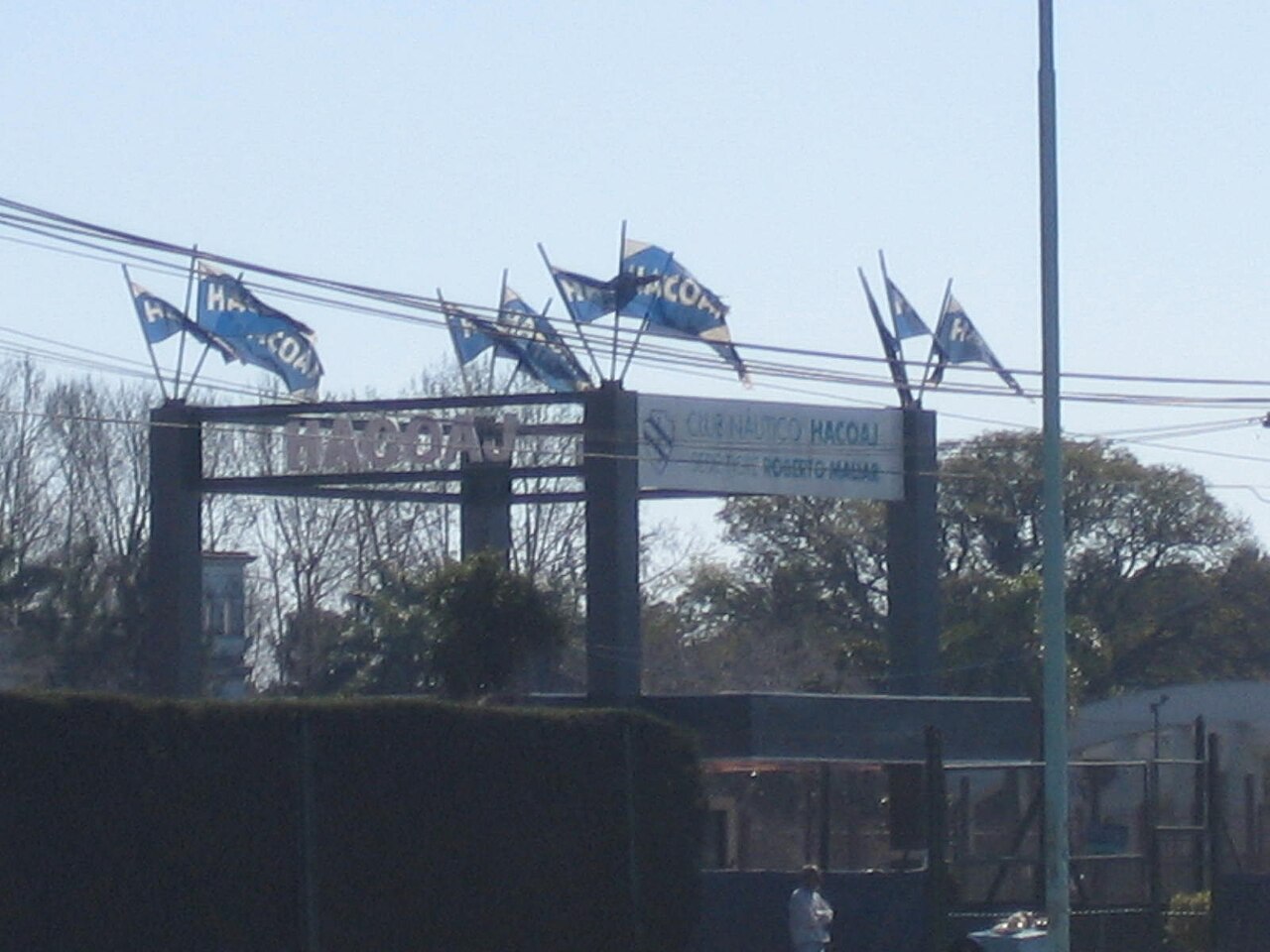
Founded in 1935 as a Jewish rowing club in Tigre.

Manuel-g.Bauer · CC BY 4.0
Club Náutico Hacoaj is an Argentine sports club headquartered in the Tigre district of Greater Buenos Aires. Founded in 1935 as a rowing club, it is considered one of the most important institutions of the Jewish community in Argentina, with more than 10,000 members. The club hosts a wide range of activities including basketball, field hockey, football, golf, tennis, and volleyball.
- founded
- 1935
- location
- Tigre district, Greater Buenos Aires, Argentina
- field
- Multi-sport club (rowing, football, tennis, hockey, basketball, etc.)
- membership
- More than 10,000 members
- notable_for
- One of the most important institutions of the Jewish community in Argentina
Quick Facts
- Fullname
- Club Náutico Hacoaj
- Founded
- 1935-12-24
- Location
- Tigre, Argentina
- Leader Title
- President
- Leader Name
- Osvaldo Ofman
- Activities
- Football / Artistic gymnastics / Cestoball / Field hockey / Golf / Judo / Paddle tennis / Swimming / Rowing / Tennis / Volleyball / Aquagym / Basketball / Boxing / Gymnastics / Squash / Yoga
- Website
- https: · hacoaj.org.ar · hacoaj.org.ar
Facts from the source article.
Lore & Background
Large numbers of Jews first came to Argentina in the middle of the 19th century, encouraged by Argentine immigration policies. The first Jews arrived from Russia, Poland, the Austro-Hungarian Empire, Germany, and the Ottoman Empire, settling mainly in rural areas of Buenos Aires, Entre Ríos, and Santa Fe. During the 1920s and 1930s, a second immigrant group arrived, developing professional careers in cities and founding institutions such as temples, cemeteries, hospitals, committees, and clubs.
Mauricio Schverlij, a young Jewish engineer, had his request to join a rowing club in Tigre Partido rejected. Suspecting the rejection was due to his Jewish origin, he called relatives and friends to create a rowing club representing the Jewish community. On the night of 24 December 1935, a meeting established the 'Club Náutico Israelita' ('Israelite Rowing Club'). One year later the club changed its name to 'Club Náutico Hacoaj' in honor of Hakoah in Vienna, Austria, a club forcibly dissolved by the Nazis in 1938 (though later re-established). Hacoaj started in a small rented place in Tigre with a mooring, boats, tennis courts, basketball, bocce, football, a colonial-style main building, dormitories, and a wooden dance floor.
Since 2024, Hacoaj's football team plays in Torneo Promocional Amateur, the fifth level of the Argentine football system. The club's facilities include three football pitches, two field hockey pitches, three indoor stadiums, an artistic gymnastics venue, six paddle tennis courts, and swimming pools.
Reader's Guide
Club Náutico Hacoaj holds significance as a cornerstone of Jewish communal life in Argentina, founded in response to discrimination. Its creation by Mauricio Schverlij after being denied membership at another rowing club highlights the role of Jewish institutions in providing social and sporting spaces. The club's name, derived from the Viennese Hakoah club destroyed by the Nazis, connects it to broader Jewish history. With over 10,000 members and a wide array of sports, Hacoaj has produced notable athletes including tennis player Diego Schwartzman, who reached top-10 world rankings and won four ATP titles, and football player Daniel Brailovsky, who represented Argentina and Israel. The club also hosts international tennis tournaments, such as the ATP Challenger 50 in 2022. Its football team competes in the fifth tier of Argentine football as of 2024. Hacoaj remains a vibrant institution, reflecting the integration and achievements of the Jewish community in Argentina.
Did You Know?
- The club was founded on 24 December 1935 as 'Club Náutico Israelita' after Mauricio Schverlij was rejected from another rowing club, allegedly due to his Jewish origin.
- The name 'Hacoaj' honors Hakoah of Vienna, Austria, a club forcibly dissolved by the Nazis in 1938 (though later re-established); 'coaj' means 'power' in Hebrew.
- The club has a large tennis program, with hundreds of active players, including a thriving children's tennis school and competitive tournament players.
- The club's main tennis court is named after Diego Schwartzman, the most renowned player of the club, who won four ATP tour titles and was ranked among the top 10 in the world.
A Rejection That Built a Club
The origins of Club Náutico Hacoaj are rooted in an act of quiet defiance. In the mid-1930s, a young Jewish engineer named Mauricio Schverlij sought membership in an existing rowing club in the Tigre Partido. His application was turned down, and he suspected his faith was the reason. Rather than accept the exclusion, Schverlij gathered relatives and friends and, on the evening of 24 December 1935, they convened a meeting that gave birth to the 'Club Náutico Israelita'—the first rowing club in the area where Jewish athletes could compete. The name 'Náutico' was chosen deliberately to signal the club's nautical roots. Within a year, the organization adopted the name Hacoaj, paying tribute to the Hakoah sports club in Vienna, Austria, which the Nazis destroyed in 1938. The Hebrew root 'coah' carries the meaning of power, a fitting emblem for a community determined to build its own ground. The club's earliest days were modest: a rented lot in Tigre with a mooring, a handful of boats, tennis courts, a colonial-style clubhouse, dormitories, and a wooden dance floor.
Tennis and the Schwartzman Legacy
Hacoaj's tennis program has grown into one of the club's most prominent pillars. As of 2026, the institution fields 850 active tennis players, including 250 children enrolled in its tennis school and 50 competing in tournaments, supported by three dedicated academies. The club's main court bears the name of Diego Schwartzman, its most celebrated player, who captured four ATP tour titles and climbed into the world's top ten. Schwartzman's deep connections to the club are further honored by his Grand Slam runs: quarterfinal appearances at the 2017 and 2019 U.S. Open, a quarterfinal at Roland Garros in 2018, and a semifinal at the French Open in 2020. Hacoaj's tennis ambitions extended beyond player development when, in 2022, the club hosted its first international tournament, the ATP Challenger 50. The momentum continued, with the venue set to stage the 'AAT Challenger IEB+ edición Tigre I y II' in 2026, cementing its place on the professional circuit.
A Community Institution in the Making
Club Náutico Hacoaj occupies a place of deep cultural significance within Argentina's Jewish community. The club's story is inseparable from the broader narrative of Jewish immigration to Argentina, which began in the mid-nineteenth century with arrivals from Russia, Poland, the Austro-Hungarian Empire, Germany, and the Ottoman Empire, many settling as tenant farmers in Buenos Aires, Entre Ríos, and Santa Fe. A second wave in the 1920s and 1930s brought professionals—teachers, journalists, actors, and politicians—who concentrated in urban neighborhoods such as Villa Crespo, Balvanera, Flores, Barracas, and La Boca. Following a long tradition of building their own institutions, including temples, hospitals, and cemeteries, these communities also founded sports clubs. Hacoaj, established in 1935, has grown to exceed 10,000 members and is widely regarded as one of the most important Jewish institutions in the country. Its headquarters in the Tigre district of Greater Buenos Aires serve as a hub for competitive and recreational sports alike, from basketball and field hockey to football, golf, volleyball, and a full range of fitness activities.
Athletes, Facilities, and the Broader Sporting Canvas
Beyond its founding story and community role, Hacoaj has produced athletes who have represented Argentina on the world stage. In football, Daniel Brailovsky earned caps for both the Argentine and Israeli national teams, a dual heritage that mirrors the club's own identity. In field hockey, the club's connection to the Argentina national squad is particularly strong: Giselle Kañevsky, Pilar Campoy, and Mariné Russo all played for the country's senior team, underscoring Hacoaj's role as a development ground for elite hockey talent. The club's sporting footprint extends across a wide array of disciplines, with facilities that include three football pitches, two field hockey fields, three indoor stadiums, an artistic gymnastics venue, six paddle tennis courts, and swimming pools. On the competitive football front, Hacoaj's team has competed in the Torneo Promocional Amateur, the fifth tier of the Argentine football pyramid, since 2024. Recreational offerings such as aquagym, boxing, squash, yoga, and gymnastics round out a membership experience that blends high-performance sport with everyday community life.
Gallery



Frequently Asked Questions
What is Club Náutico Hacoaj?
It is an Argentine multi-sport club based in the Tigre district of Greater Buenos Aires. Originally established as a rowing club, it now offers a broad lineup of sports including football, basketball, field hockey, tennis, golf, and volleyball. It is widely regarded as one of the most important institutions within Argentina's Jewish community.
When and where was Club Náutico Hacoaj founded?
The club was established in 1935 in the Tigre district, part of Greater Buenos Aires, Argentina. It began its life specifically as a Jewish rowing club before gradually expanding into a broad multi-sport organization.
How large is Club Náutico Hacoaj's membership?
The club counts more than 10,000 members, making it one of the larger community sports organizations in the country. That scale reflects its long-standing role as a central gathering place for the local Jewish population.
What sports can you play at Club Náutico Hacoaj?
Members can take part in a wide variety of disciplines, including rowing, football, basketball, field hockey, tennis, golf, and volleyball. This multi-sport setup means the club functions as a full community recreation hub rather than a single-sport team.
Why is Club Náutico Hacoaj considered important to Argentine Jewish life?
Since its 1935 founding, it has served as a cornerstone institution for the Jewish community in Argentina, providing both athletic and social infrastructure. With over 10,000 members and a broad range of activities, it stands as one of the most prominent community anchors in Greater Buenos Aires.
More in Jewish football clubs 1-24
Spotted an error? Know more?
This is a living reference — every entry is fact-audited, and reader corrections feed straight into our audit queue. Suggest an edit · See this site's audit record