
Midrash HaGadol
14th-century Yemenite compilation of aggadic midrash on the Torah.

Wikimedia Commons · Public domain
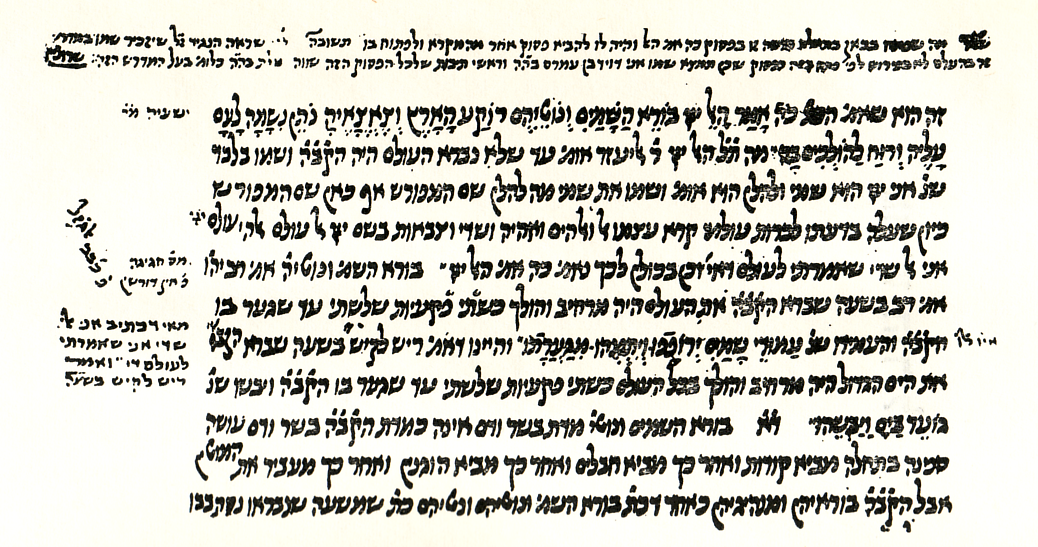
Midrash HaGadol (Hebrew: מדרש הגדול), or The Great Midrash, is a work of aggadic midrash expanding on the narratives of the Torah. It was written by David ben Amram Adani of Yemen in the 14th century. Its contents were compiled from the Jerusalem and Babylonian Talmud, earlier midrashic literature of tannaitic provenance, and borrows from the Targums, Maimonides, Kabbalistic writings, and other works, and is notable for frequently citing its sources. It is the largest of the midrashic collections and came to popular attention in the late 19th century through the efforts of Jacob Saphir, Solomon Schechter, and David Zvi Hoffmann.
- Author
- David ben Amram Adani of Yemen
- Century
- 14th century
- Field
- Aggadic midrash
- Known for
- Largest midrashic collection; contains material not found elsewhere, including part of the Mekhilta of Rabbi Shimon ben Yochai
- First manuscript brought to attention
- Jacob Saphir (1866)
- First published
- Genesis (1902) by Solomon Schechter
Lore & Background
The existence of Midrash HaGadol was first brought to Jewish scholarship by Jacob Saphir, who in his Even Sapir (1866) reported seeing a manuscript in the possession of the Chief Rabbi of Yemen. He described a work on the entire Torah containing 'twice as much as our Midrash Rabbah.' The first manuscript was brought from Yemen to Jerusalem and later to Berlin in 1878 by others after Saphir's initial report, after which it became the subject of much scholarly attention. Currently, approximately two hundred manuscripts reside in various public and private Hebraica collections.
Reader's Guide
Midrash HaGadol is significant as the largest midrashic collection and a crucial source for reconstructing lost or fragmented ancient works. Most of the Mekhilta of Rabbi Shimon ben Yochai, previously available only in scattered manuscripts, is found within it, allowing scholars to reconstruct that ancient midrash. It also contains what are considered more correct versions of previously known Talmudic and midrashic passages. The work is unique in that it never cites its sources, fusing material from the Jerusalem and Babylonian Talmuds, earlier midrashim, Targums, Maimonides, Kabbalistic writings, and geonic writings into a new literary creation. Its authorship was disputed, with some attributing it to Abraham Maimonides, but modern scholars almost uniformly attribute it to David bar Amram al-Adani. The work was published in parts from 1902 onward, with later editions by M. Margulies, E.N. Rabinowitz, Adin Steinsaltz, and S. Fisch, and a five-volume edition by Mossad Harav Kook.
Did You Know?
- Midrash HaGadol contains material from the Mekhilta of Rabbi Shimon ben Yochai, which was used to reconstruct that ancient work.
- The work frequently cites its sources, a notable characteristic among midrashic collections.
- Its existence was first reported by Jacob Saphir in 1866 after seeing a manuscript in Yemen.
- Approximately two hundred manuscripts of Midrash HaGadol are known to exist.
Authorship and the Question of Origin
The question of who actually composed Midrash HaGadol has generated genuine scholarly debate. The work is traditionally attributed to David ben Amram Adani, a Yemenite figure of the fourteenth century, and this attribution enjoys near-unanimous support among modern scholars. However, an older theory, traceable to the medieval authority Yiḥyah Salaḥ, proposed that the text was the work of Rabbi Abraham Maimonides, son of the great Maimonides himself. In his 1940 study, S. Fisch attempted a middle path, suggesting that Abraham Maimonides may have originally composed the work in Judeo-Arabic in Egypt, and that David al-Adani later rendered it into Hebrew. Fisch even speculated about how a text authored in Egypt could end up lost before resurfacing in Yemen. Yet Strack and Stemberger, writing in 1991, judged the Abraham Maimonides attribution to be only extremely weakly supported, and Fisch himself ultimately conceded the point in his Encyclopaedia Judaica entry. Today, the consensus firmly places the work in the hands of David bar Amram al-Adani.
A Unique Tapestry of Sources
What sets Midrash HaGadol apart from other aggadic collections is the extraordinary breadth and manner of its source material. The compiler drew upon both the Jerusalem and Babylonian Talmuds, earlier tannaitic midrashim, the Aramaic Targums, the writings of Maimonides and Isaac Alfasi, Kabbalistic texts, and a long list of lesser-known works including Avot of Rabbi Natan, Pesikta Rabbati, Pesikta de-Rav Kahana, Pirke Rabbi Eliezer, and Mishnat Rabbi Eliezer. It also incorporates material from the Mekhilta of Rabbi Shimon ben Yochai, Sifri Zutta, and various Mekhilta traditions. Remarkably, none of these sources are ever explicitly cited, a feature that distinguishes this midrash from its peers. Rather than simply quoting, the author fuses all these ingredients into a seamless new literary creation, so that in many passages the original source cannot be cleanly identified. The text even appears to have used the same sourcebook that Moses Gaster later employed for his Sefer Ma'asiyot. This synthesis makes the work genuinely unique among midrashic compilations.
From Yemenite Shelves to European Print
For centuries, Midrash HaGadol was largely unknown to European Jewish scholarship, though it was presumably familiar to Yemenite communities. The turning point came in 1866, when Jacob Saphir, in his work Even Sapir, reported encountering a manuscript in the hands of the Chief Rabbi of Yemen. He described a Torah commentary containing roughly twice the material of Midrash Rabbah. In 1878, Saphir personally transported the first manuscript from Yemen through Jerusalem to Berlin, igniting intense academic interest. The publication process then unfolded over decades: Solomon Schechter issued the Genesis portion in 1902, David Zvi Hoffmann published the Exodus section in 1913, and S. Fisch released the Numbers volume in 1940 in a more reader-friendly format than his predecessors. Subsequent editions followed for Leviticus, Numbers, and Deuteronomy through scholars like Rabinowitz, Steinsaltz, and Margulies. The Mossad Harav Kook in Jerusalem produced a five-volume set. Today, roughly two hundred manuscripts of the work are scattered across public and private Hebraica collections worldwide.
Recovering Lost Texts and Correcting the Record
Beyond its own literary value, Midrash HaGadol has proven indispensable for reconstructing other ancient texts. Most significantly, it preserves the bulk of the Mekhilta of Rabbi Shimon ben Yochai, a work that before the midrash's wider recognition existed only in scattered, fragmented manuscripts. Scholars have used the Midrash HaGadol alongside those fragments to piece together the ancient Mekhilta in a far more complete form. The collection also contains midrashic material that appears nowhere else in the surviving corpus, making it a treasure trove of otherwise lost tradition. Furthermore, researchers have identified passages within the work that offer more accurate versions of Talmudic and midrashic texts already known from other sources, effectively serving as a corrective witness. An early citation by Joseph Shalit Riqueti in his 1676 Sefer Chochmat HaMishkan references a Midrash HaGadol brought from Aden, hinting that the text circulated in Yemenite scholarly circles well before European scholars took notice, though it remains uncertain whether this is the very same work.
Gallery
Frequently Asked Questions
What is Midrash HaGadol and who wrote it?
Midrash HaGadol, or 'The Great Midrash,' is a 14th-century Yemenite aggadic midrash that expands on the narratives of the Torah. It was composed by David ben Amram Adani of Yemen.
What makes Midrash HaGadol stand out among midrashic works?
It is the largest of all midrashic collections and is unusual for frequently naming its own sources within the text. It also preserves material found nowhere else, including a fragment of the Mekhilta of Rabbi Shimon ben Yochai.
Where does Midrash HaGadol draw its material from?
The work weaves together passages from the Jerusalem and Babylonian Talmud, earlier tannaitic midrashim, the Targums, Maimonides, and Kabbalistic writings. This eclectic sourcing makes it a rich patchwork of multiple Jewish interpretive traditions.
How did Midrash HaGadol come to the attention of modern scholars?
The manuscript stayed largely unknown until Jacob Saphir drew public attention to it in 1866. The first printed edition, covering the book of Genesis, appeared in 1902 under Solomon Schechter's editorship.
Why is Midrash HaGadol important to Jewish folklore?
As the most expansive aggadic midrash, it preserves a vast body of Torah narrative commentary that would otherwise be lost to history. Its unique content and source-citing style make it an irreplaceable window into medieval Yemenite Jewish interpretive culture.
More in Jewish folklore 1-24
Spotted an error? Know more?
Reader corrections go straight into our review queue. Suggest an edit · How this site is sourced