
Allegory of the long spoons
A parable showing cooperation as the key to paradise.

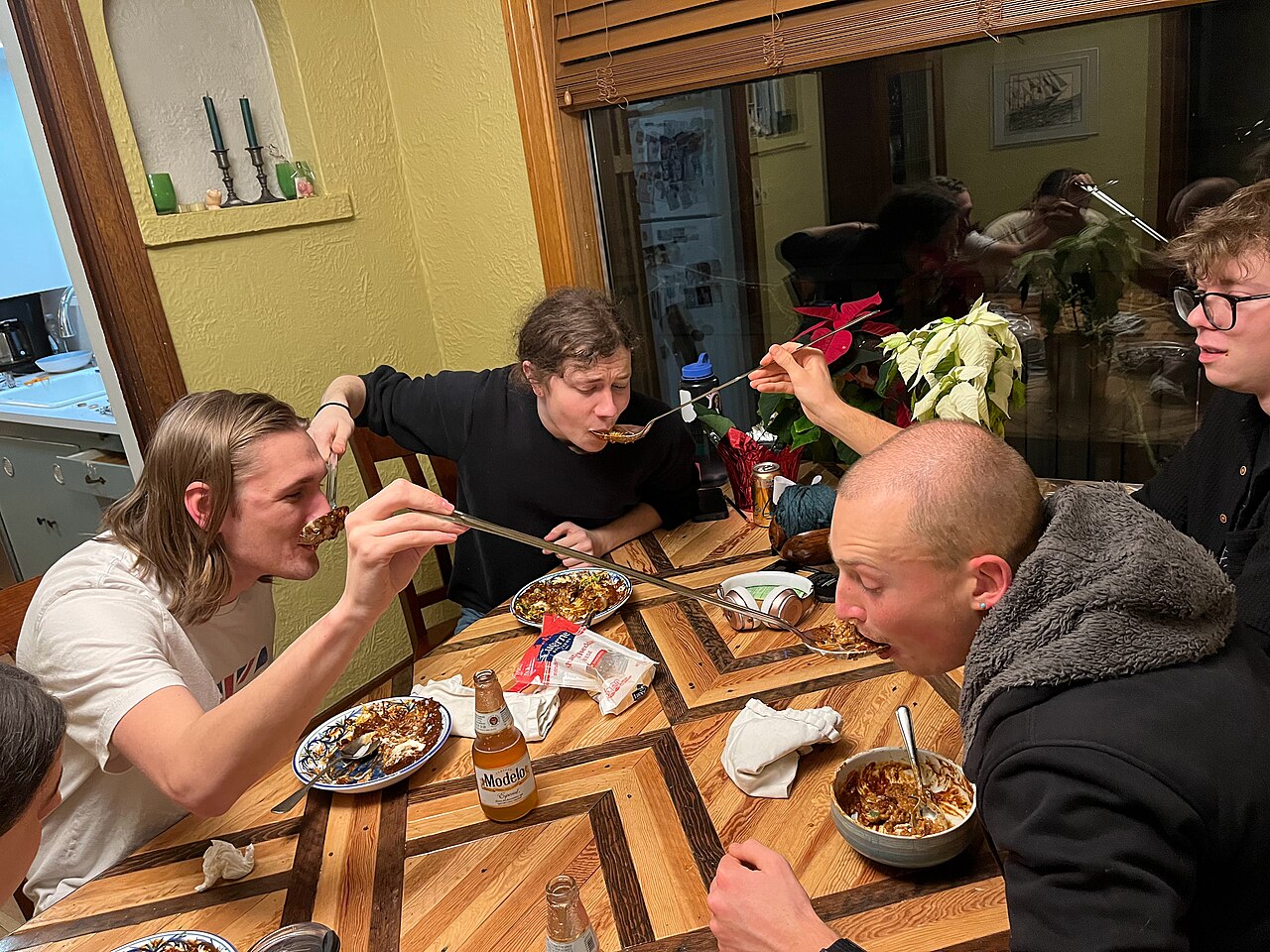
Thmorriss · CC BY-SA 4.0
The allegory of the long spoons is a parable that contrasts heaven and hell by describing people who must eat using overly long utensils. The story is credited to Rabbi Haim of Romshishok, among other sources, and appears in the folklore of various cultures, including Jewish, Hindu, Buddhist, Middle-Eastern, and Christian traditions.
In the parable, both realms provide food, but the spoons are too long to feed oneself. In hell, the inhabitants refuse to cooperate and starve. In heaven, the diners feed each other across the table and are satisfied. The tale encourages kindness and is often used in sermons or as advice for those who are uncaring.
The story suggests that people can use their given tools—here, the long spoons—to nourish one another, but the outcome depends on how they treat each other. With the same resources, one group can create a pleasant environment through mutual care, while another can produce misery through selfishness. Writer Dawn Eden Goldstein notes this simple truth is easily forgotten by lonely people, who can improve their situation by reaching out to others.
Variations exist: in medieval Europe, the food is a bowl of stew; in China, it is rice eaten with long chopsticks. Some versions use regular cutlery but have diners unable to bend their arms, as in a story attributed to Rabbi Haim where both arms are splinted with wooden slats.
The parable is rarely depicted in art but remains well known in sermons, especially regarding hell, as gruesome depictions of the afterlife have become less common. A scene in the 2013 thriller *The East* draws strong comparisons when the protagonist Sarah is shown as selfish for not feeding a diner beside her while in a straitjacket. The 2019 film *The Platform* has also been compared to the allegory. Caritas produced a short animated video based on the story for their campaign "One human family, food for all."
- Attributed to
- Rabbi Haim of Romshishok (and other sources)
- Type
- Parable / Allegory
- Cultural affiliations
- Jewish, Hindu, Buddhist, Oriental (Middle-Eastern), Christian
- Common food in medieval europe
- Bowl of stew
- Common food in china
- Bowl of rice eaten with long chopsticks
- Alternative version
- Diners unable to bend their arms
Lore & Background
The allegory of the long spoons is a parable that shows the difference between heaven and hell by means of people forced to eat with long spoons. It is attributed to Rabbi Haim of Romshishok, as well as other sources. In each location, the inhabitants are given access to food, but the utensils are too unwieldy to serve oneself with. In hell, the people cannot cooperate, and consequently starve. In heaven, the diners feed one another across the table and are sated.
The story can encourage people to be kind to each other. There are various interpretations of the fable including its use in sermons and in advice to uncaring people. The story suggests that people can use what they are given (the long spoons in this allegory) to help nourish each other, but the problem, as Haim points out, lies in how people treat each other. Given the same level playing field one group of people who treat each other well will create a pleasant environment, whereas another group of people, given exactly the same tools to work with, can create unpleasant conditions simply by how they treat each other.
Writer Dawn Eden Goldstein suggests that this is a simple truth that can be easily forgotten by lonely people who cannot see their situation clearly. She argues that such conditions can be improved by reaching out to others. The long spoons allegory has become part of the folklore of several cultures, for example: Jewish, Hindu, Buddhist, 'Oriental' (Middle-Eastern) and Christian. In medieval Europe, the food in the story is a bowl of stew; in China, it is a bowl of rice being eaten with long chopsticks. In some versions of the story, the diners are using regular cutlery but are unable to bend their arms, with a story attributed to Rabbi Haim of Romshishok describing how 'both arms were splinted with wooden slats so he could not bend either elbow to bring the food to his mouth'.
Reader's Guide
The allegory of the long spoons serves as a concise moral lesson about the importance of cooperation and mutual aid. Its significance lies in its ability to illustrate that the same circumstances can lead to either suffering or fulfillment depending on how people treat one another. The parable has been used in sermons and advice to uncaring people, and it has been referenced in modern popular culture, such as in the 2013 thriller The East and the 2019 film The Platform. Caritas also made a short animated video based on this allegory for their campaign 'One human family, food for all'. The story's enduring legacy is its simple yet powerful message that selfishness leads to starvation, while generosity creates abundance. It has been adopted across multiple religious and cultural traditions, demonstrating its universal appeal. The allegory also offers a corrective to depictions of hell that focus on physical torment, instead emphasizing the social and relational aspects of suffering.
The Core Parable
The allegory of the long spoons presents a deceptively simple contrast between two realms. In both settings, the inhabitants have access to food, yet the utensils provided are far too long and unwieldy for any individual to bring a spoonful to their own mouth. The critical divergence emerges not in the physical circumstances but in the social behavior of the diners. In the realm of suffering, each person attempts to feed themselves in isolation, and the result is universal starvation despite an abundance of nourishment on the table. In the realm of bliss, the same diners recognize their shared predicament and reach across the table to feed one another, and everyone is sated. The parable is attributed to Rabbi Haim of Romshishok, though other sources also claim it. Its power lies in holding the material conditions constant while varying only the quality of human interaction, making the moral unmistakable: the difference between flourishing and despair is not what we are given, but how we choose to treat the people beside us.
Interpretation and Moral Philosophy
At its philosophical core, the long spoons fable argues that the tools of survival are already in our hands; what determines our fate is the manner in which we extend them toward others. Rabbi Haim's point, as the tradition presents it, is that the problem is never the spoon itself but the refusal to use it cooperatively. Two groups placed on an identical level playing field—one who treats its members with generosity and one who does not—will produce radically different environments, even though the material resources are indistinguishable. Writer Dawn Eden Goldstein has emphasized that this is a truth easily lost by people experiencing loneliness, who may perceive their circumstances as insurmountable when the real barrier is a failure to reach out. The allegory has therefore found a natural home in sermons and in direct counsel to those who have grown indifferent to the needs of others, serving as a compact reminder that compassion is not an optional extra but the very mechanism that turns scarcity into plenty.
Cultural Diffusion and Variations
One of the most remarkable aspects of the long spoons parable is its extraordinary cross-cultural reach. The story has been absorbed into the folk traditions of Jewish, Hindu, Buddhist, Christian, and broader Middle-Eastern communities, suggesting that the underlying insight about cooperation transcends any single religious or geographic origin. The details shift to suit local culinary contexts: in medieval European tellings the food is a bowl of stew, while in Chinese retellings the diners struggle with a bowl of rice and long chopsticks. A particularly vivid variant, linked to Rabbi Haim of Romshishok, replaces the oversized spoons with a physical constraint—both arms splinted with wooden slats so that neither elbow can bend, making it impossible to bring food to one's own mouth. These variations demonstrate that the allegory is not a fixed text but a living narrative, adapting its imagery while preserving the central lesson: the obstacle is never the tool but the unwillingness to feed the person across from you.
Legacy in Film, Art, and Public Messaging
Although the parable is rarely rendered as a standalone work of visual art, its influence on contemporary storytelling and public messaging is substantial. In the 2013 thriller The East, a scene in which the protagonist Sarah, bound in a straitjacket, selfishly neglects to feed the diner seated beside her draws a direct parallel to the hellish half of the allegory. The 2019 film The Platform has likewise been compared to the long spoons story, its vertical tower of shared food echoing the same tension between hoarding and mutual aid. In the realm of religious discourse, the parable remains a go-to illustration in sermons when the topic of hell arises, especially as the older tradition of depicting hell in grotesque, torturous imagery has been fading in recent decades. The Catholic relief organization Caritas produced a short animated video built around the allegory for its "One human family, food for all" campaign, translating the ancient fable into a modern call for collective responsibility toward the world's hungry.
Gallery
Frequently Asked Questions
What is the Allegory of the Long Spoons?
It is a parable that pits two groups of diners against each other, both forced to eat with utensils far too long to reach their own mouths. The contrast between their outcomes illustrates how selfishness versus cooperation shapes one's fate.
Who is the Allegory of the Long Spoons attributed to?
The tale is most commonly credited to Rabbi Haim of Romshishok, though it also surfaces in a broad range of other religious and cultural traditions beyond Judaism.
What actually happens in the story?
In the negative realm, diners refuse to help one another and slowly starve despite food being present. In the positive realm, the same diners simply turn to feed each other across the table and are well nourished.
What is the moral lesson of the Allegory of the Long Spoons?
The parable teaches that kindness and mutual aid turn an otherwise impossible situation into one of plenty, framing cooperation as the true key to paradise.
Is the Allegory of the Long Spoons exclusively a Jewish story?
No; it appears across Jewish, Hindu, Buddhist, Middle-Eastern, and Christian folk traditions, sometimes with regional twists such as long chopsticks or diners whose arms cannot bend.
More in Jewish folklore 1-24
Spotted an error? Know more?
Reader corrections go straight into our review queue. Suggest an edit · How this site is sourced