
Jewish pope Andreas
Legend of a Jewish convert who became pope and aided Jews.

Jewish pope Andreas is a legendary figure from medieval Jewish folklore, described in the 1906 Jewish Encyclopedia as a Jew who converted to Christianity, rose to become cardinal and then pope. The legend is significant for its portrayal of a pope who secretly retained his Jewish identity and ultimately used his position to protect Jews from persecution, composing a penitential prayer that was incorporated into Jewish liturgy.
- Field
- Legendary religious figure
- Known for
- Legend of a Jewish pope who protected Jews and composed a Selichot prayer
- Nationality
- Unspecified (associated with Mainz in some versions)
Lore & Background
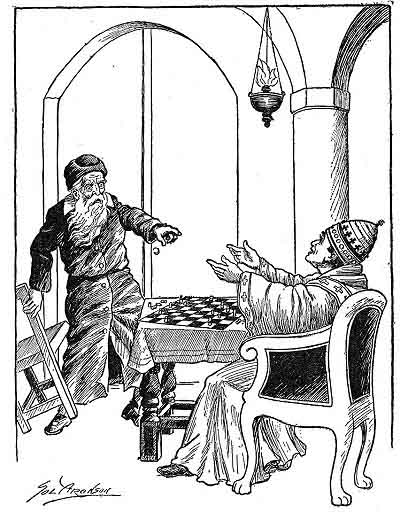
The legend is sometimes associated with Antipope Anacletus II or Pope Alexander III, who was well-disposed toward Jews. A traditional account tells of El-hanan (or Elhanan), a Jewish boy stolen from his home in Mainz by a Christian maidservant. Raised in a monastery, he rose to become pope while aware of his Jewish origin. He issued an edict of persecution against the Jews of Mainz, knowing his father Simeon would come to plead. During a chess game, the pope used a move only his son knew, leading to recognition and reunion. The pope then composed a penitential prayer (Selichot) and, in some versions, fled to Mainz to live as a pious Jew.
Reader's Guide
The legend of Jewish pope Andreas holds significance as a medieval Jewish folk narrative that addresses themes of identity, persecution, and hidden power. It reflects Jewish hopes for a protector within the highest Christian authority, even as it acknowledges the reality of anti-Jewish calumnies and violence. The story's inclusion of a Hebrew prayer composed by the pope and adopted by Jewish communities underscores a desire for reconciliation and mutual recognition. The legend's association with historical figures like Antipope Anacletus II or Pope Alexander III suggests attempts to anchor the tale in real events, though the Jewish Encyclopedia notes the legend's variations and uncertain origins. Its persistence in multiple Hebrew manuscripts and the Yiddish Mayse Bukh indicates its resonance across centuries. Unlike the legend of Pope Joan, which challenges gender norms, this story explores religious conversion and hidden identity, offering a fantasy of Jewish agency within a hostile hierarchy. The legend's legacy endures as a testament to the imaginative responses of medieval Jews to their precarious position.
Did You Know?
- The legend of Jewish pope Andreas appears in Hebrew manuscripts dating from the early 14th to early 16th centuries, predating any print version.
- Four earlier Hebrew versions of the legend, written between the early 14th and early 16th centuries, survive in manuscripts.
- The pope in the legend composed a Selichot (penitential prayer) in Hebrew, signed 'Andreas,' which was incorporated into Jewish prayer books.
A Medieval Jewish Legend
The story of the Jewish pope Andreas occupies a distinctive position within the corpus of medieval Jewish narrative tradition. Among the small number of legends that can be confidently identified as belonging to Jewish origin from the Middle Ages, his tale stands out for sharing the structural qualities of folktales. He is traditionally grouped alongside the legend of the golem and the story of the Rashi chapel wall, a tale in which a wall supposedly shifted backward to prevent a passing carriage from crushing a poor woman on a narrow path. These three narratives are cited together as examples of medieval Jewish legends that partake of folktale character, distinguishing them from more straightforward historical or religious accounts. The Andreas legend, like its companions, belongs to a tradition of storytelling that predates modern literary classification and exists primarily in oral and semi-literate transmission across European Jewish communities. Its medieval dating places it in an era when Jewish communities across Europe maintained rich oral traditions that blended religious teaching with imaginative narrative, creating stories that resonated across generations within the ghettos and settlements where Jewish life was concentrated.
Folktale Elements in the Legend
The Andreas legend is specifically noted for partaking of the character of folktales, a designation that carries particular meaning within the study of Jewish narrative. Folktales in this tradition are defined by the presence of unusual personages, by sudden transformations of men into beasts or beasts into men, or by other incidents that defy natural law. The Andreas story, like the golem legend and the Rashi chapel wall tale, falls into this category of narratives where the supernatural or the impossible intrudes upon the everyday. This sets it apart from the many stories collected in Yiddish Maasebücher, where scholars have observed that nothing fairy-like or supernormal actually occurs, making it difficult to classify those as true folktales. The Andreas legend, by contrast, is explicitly identified as sharing the exaggerated, transformative qualities that mark genuine folktale structure. In the broader context of Jewish folklore, which encompasses legends, oral history, proverbs, jokes, popular beliefs, fairy tales, stories, tall tales, and customs, his tale represents the more fantastical end of the spectrum, where narrative serves not merely to instruct or entertain but to explore the boundaries between the natural and the miraculous.
Preservation by Scholars
The survival of the Andreas legend owes much to the work of nineteenth-century scholars who undertook the systematic gathering of Jewish oral traditions. Abraham Moses Tendlau collected several of these medieval legends, including the Andreas story, in his work Sagen und Legenden der Jüdischen Vorzeit, providing one of the earliest scholarly frameworks for preserving narratives that might otherwise have been lost to the passage of time. Tendlau's collection sits alongside a broader wave of folklore scholarship in the late nineteenth century, during which researchers such as Israël Lévi, Moses Gaster, Max Grunwald, L. Wiener, and F. S. Krauss published folktales gathered directly from Jewish communities or drawn from Hebrew manuscripts. Lévi contributed to the Revue des Etudes Juives, the Revue des Traditions Populaires, and Melusine; Gaster published in Folk-Lore and in the reports of Montefiore College; while Grunwald, Wiener, and Krauss contributed to Mitteilungen der Gesellschaft für Jüdische Volkskunde and the two series of Urquell. The Andreas legend, preserved within this scholarly apparatus, gained a fixed textual form that allowed it to be studied, compared, and transmitted beyond the immediate communities where it had been told for generations.
Context Within Aggadic and Folkloric Tradition
The Andreas legend does not exist in isolation but forms part of a vast web of Jewish narrative material that spans from the Mishnah and both Talmuds through the Midrashic literature and into the oral traditions of European Jewish communities. A number of aggadic stories bear folktale characteristics, and the Andreas tale occupies a space where religious narrative and popular storytelling intersect. This intersection is visible in the way scholars have approached the material: Rabbi Louis Ginzberg's five-volume Legends of the Jews paraphrases and rewrites aggadot into continuous narrative; Bialik and Ravnitzky's Sefer Ha-Aggadah presents aggadot with their original sources, often selecting the later Babylonian Talmudic form while also showing earlier Jerusalem Talmudic versions; and Berdyczewski's Mimekor Yisrael limits itself to aggadot within the domain of folklore. The Andreas legend, as a medieval Jewish narrative with folktale qualities, belongs to this same continuum of storytelling that has been collected, compiled, and reinterpreted across centuries, from the oral traditions of the European ghettos to the scholarly publications of the modern era.
Gallery
Frequently Asked Questions
Who is the 'Jewish pope Andreas' in Jewish folklore?
He is a legendary figure from medieval Jewish tradition, described as a man of Jewish origin who converted to Christianity and eventually rose to the papal throne. The tale is preserved in sources such as the 1906 Jewish Encyclopedia and is sometimes linked to the city of Mainz.
What does the legend say Andreas did while pope?
According to the story, he kept his Jewish heritage hidden beneath his Christian office and leveraged his authority to shield Jewish communities from persecution. His actions are framed as an act of quiet solidarity with his ancestral people.
What is the connection between Andreas and Jewish liturgy?
The legend credits him with composing a penitential prayer, a Selichot, that was later woven into the Jewish prayer book. This detail is central to why the story resonates in Jewish folk memory rather than purely Christian hagiography.
Where does the 'Jewish pope Andreas' legend come from?
It is a medieval Jewish folk narrative rather than a documented historical account, surviving primarily in encyclopedic and scholarly references such as the 1906 Jewish Encyclopedia entry. Some versions tie the figure to Mainz, though his exact origins remain unspecified.
Why do fans of Jewish folklore care about the Andreas legend?
It inverts the usual power dynamic by imagining a Christian leader who secretly remains loyal to his Jewish roots and actively defends his people. The story endures because it blends themes of hidden identity, covert resistance, and the hope that even the highest institutions can be turned toward justice.
More in Jewish folklore 1-24
Spotted an error? Know more?
Reader corrections go straight into our review queue. Suggest an edit · How this site is sourced