
Aggadah
Non-legalistic rabbinic lore conveying moral and theological truths.

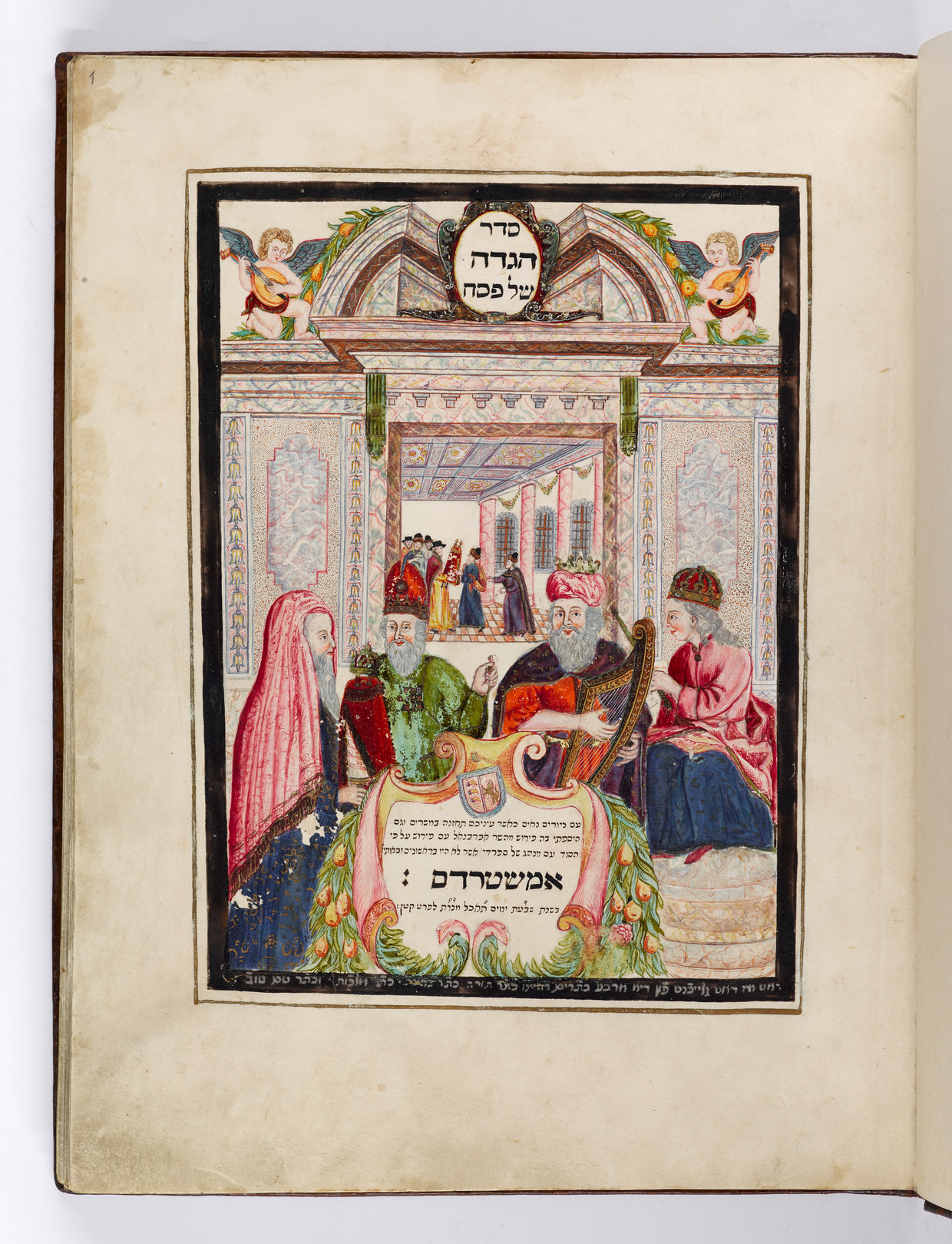
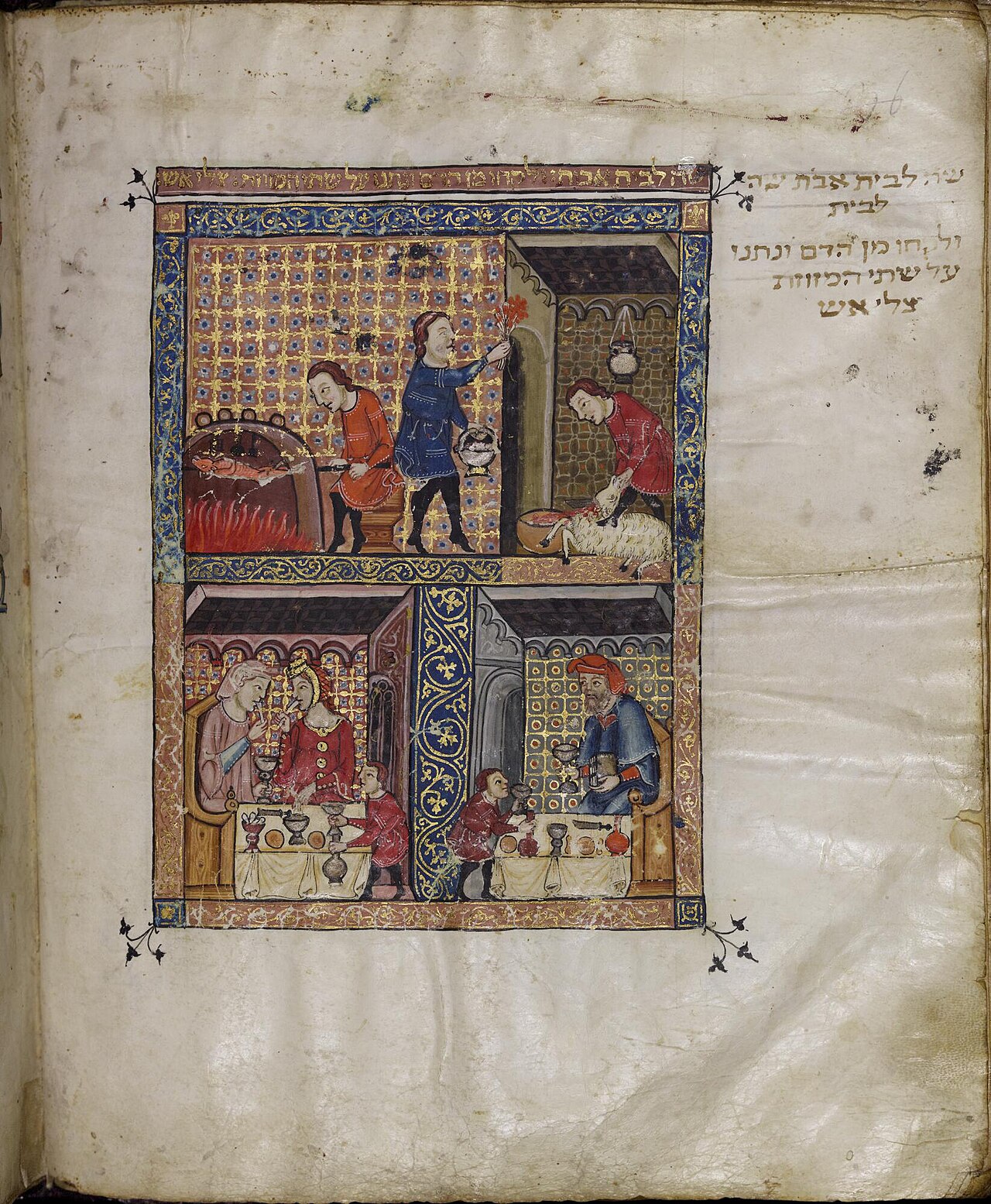
Scribe: Yôsēf ben Dāwīd mil-Leypnîq Yosef ben David, of Leipnik Joseph ben David · Public domain
**Aggadah** (Hebrew: אַגָּדָה, also הַגָּדָה; Aramaic: אֲגַדְתָּא) refers to the non-legal portions of classical rabbinic literature, especially the Talmud and Midrash. It is a collection of rabbinic writings that includes folklore, historical stories, moral lessons, and practical guidance on topics ranging from business to medicine. The mainstream rabbinic view holds that Aggadah is designed to convey moral or theological truths through allegory, and it is not necessarily meant to be understood literally.
**Etymology**
Most scholars believe the Hebrew word *aggadah* and its Aramaic counterpart *aggadta* are variants of *haggadah*, resulting from a common shift from *haphalah* to *aphalah* forms. A minority, however, trace these words to a separate Aramaic root meaning "draw, pull, spread, stretch" (related to Hebrew roots *mashakh* or *natah*). According to this second view, Aggadah can be seen as "the part of the Torah which draws man towards its teachings," or as teachings that strengthen religious experience and spiritual connection, in addition to explaining texts.
**As Part of the Oral Torah**
Aggadah belongs to Judaism's Oral Torah—the traditions that provide the authoritative interpretation of the Written Torah. In rabbinic literature, it is widely understood as a medium for transmitting fundamental teachings (homiletic sayings) or for explaining biblical verses (exegetic sayings). Rabbinic thought often sees Aggadah as having a hidden, allegorical dimension alongside its plain meaning. Where a literal reading contradicts reason, the rabbis typically seek an allegorical explanation: "We are told to use our common sense to decide whether an aggada is to be taken literally or not."
**Literal-Allegorical Teachings**
Moshe Chaim Luzzatto (1707–1746) discussed this two-tiered approach in his *Discourse on the Haggadot*. He explained that the Oral Law has two components: the legal part (discussing commandments and halakha) and the "secret" part (discussing deeper teachings). Aggadah, along with Kabbalah, falls into the latter. The rabbis of the Mishnaic era believed it was dangerous to record these deeper teachings explicitly, like mishnah.
- Field
- Rabbinic literature, exegesis
- Known for
- Non-legalistic rabbinic lore and allegorical teachings
- Part of
- Oral Torah
- Found in
- Talmud and Midrash
- Etymology
- Hebrew אַגָּדָה and Aramaic אֲגַדְתָּא; majority view: variant of haggadah; minority view: from Aramaic root נגד meaning 'draw, pull, spread, stretch'
Lore & Background
The Aggadah is part of Judaism's Oral Torah, providing authoritative interpretation of the Written Torah. Rabbinic thought understands much of the Aggadah as containing a hidden, allegorical dimension in addition to its overt, literal sense. Where a literal interpretation contradicts rationality, the rabbis seek an allegorical explanation. Moshe Chaim Luzzatto (1707–1746) discussed this two-tiered mode of transmission, explaining that the Oral Law comprises a legal component and a 'secret' component, with Aggadah and Kabbalah falling under the latter. The rabbis of the Mishnaic era believed it dangerous to record deeper teachings explicitly, so they conveyed them in a concealed mode via paradoxes, depending on consistent rules and principles for those 'equipped with the keys'.
Reader's Guide
Aggadah holds lasting significance as a key component of classical rabbinic literature, preserving non-legalistic teachings that convey moral, theological, and spiritual insights through allegory and narrative. Its legacy lies in its role as a medium for transmitting deeper, often concealed teachings of the Oral Torah, requiring interpretive skill to unlock meanings that might otherwise appear non-rational or fantastic. The work of commentators such as Samuel Edels, Judah Loew, Yosef Hayyim, the Vilna Gaon, Jacob ibn Habib, Zundel ben Joseph, and Abraham Isaac Kook has ensured ongoing engagement with Aggadic material. The development of Aggadah traces back to the Bible itself, with the Soferim era giving it impetus, and figures like Abtalion and Shemaiah being the first to bear the title darshan. Their pupil Hillel laid down hermeneutic rules for Midrash interpretation. Aggadah appears in Apocrypha, Pseudepigrapha, and works of Josephus and Philo, but reached its highest development in the Mishnaic-Talmudic period. Its continued study reflects Judaism's commitment to layered textual interpretation and the integration of lore, ethics, and mysticism.
Did You Know?
- The majority scholarly opinion holds that the Hebrew word aggadah and Aramaic aggadta are variants of haggadah due to a common linguistic shift from haphalah to aphalah forms.
- A minority of scholars believe aggadah derives from an Aramaic root meaning 'draw, pull, spread, stretch', seeing it as 'the part of the Torah which draws man towards its teachings'.
- Maimonides described three approaches to interpreting Aggadah, rejecting both literal acceptance without allegory and rationalist rejection of non-rational teachings.
- The Aggadic material in the Babylonian Talmud is presented separately in Ein Yaakov, a compilation of the Aggadah together with commentaries.
Nature and Scope of Aggadah
Aggadah represents the non-legalistic dimension of classical rabbinic literature, appearing primarily in the Talmud and Midrash. Unlike halakhic material, which addresses commandments and legal rulings, Aggadah encompasses a remarkably broad spectrum of rabbinic thought: folklore, historical anecdotes, moral exhortations, and practical guidance spanning fields from commerce to medicine. The predominant rabbinic understanding holds that these narratives function as allegorical vehicles for conveying moral and theological truths, designed to be accessible to a wide audience rather than demanding literal acceptance. In the Midrash, aggadic and halakhic material are compiled as two distinct collections: the Aggadic Midrashim draw sermonic implications from the biblical text, while the Halakhic Midrashim extract legal rulings from it. In the Talmud, by contrast, the two streams are interwoven throughout. Many Torah commentaries and the Targumim also incorporate aggadic material, interpreting the biblical text through the lens of these rabbinic statements, particularly those found in the Midrash.
Etymology and Linguistic Roots
The Hebrew word aggadah and its Aramaic counterpart aggadta carry meanings spanning tales, legend, and lore. The majority scholarly position holds that both forms are variants of haggadah, arising from a common linguistic shift from haphalah to aphalah forms. A minority of scholars, however, trace the term to a separate Aramaic root נגד, meaning to draw, pull, spread, or stretch, corresponding to the Hebrew roots משך or נטה. Under this alternative etymology, aggadah acquires a far more evocative character: it becomes the part of the Torah which draws a person toward its teachings, or the body of instruction that strengthens one's religious experience and spiritual connections in addition to explaining texts. This reading resonates with the broader concept of Masorah in the sense of living tradition, suggesting that aggadah is not merely supplementary narrative but an active force pulling the reader deeper into sustained engagement with the sacred text.
The Concealed Mode of Transmission
Moshe Chaim Luzzatto, in his Discourse on the Haggadot, articulates a two-tiered structure within the Oral Law. The first component addresses mitzvot and halakha; the second, which he designates the secret component, encompasses deeper theological teachings. Aggadah, alongside Kabbalah, belongs to this latter category. The rabbis of the Mishnaic era deliberately chose not to record these deeper teachings in an explicit, mishnah-like format. Their concern was twofold: the value of such material demanded that it not become accessible to those of bad character, and its depth required that it not be made available to those not schooled in the ways of analysis. Instead, these teachings were conveyed through a concealed mode employing paradoxes. Crucially, this mode of transmission still operated under consistent rules and principles, so that those equipped with the keys could unlock the meaning, while to others the material would simply appear non-rational or fantastic.
Maimonides and the Three Paths of Interpretation
Maimonides, in his preface to the tenth chapter of Tractate Sanhedrin, outlines three approaches to reading Aggadah. The first, typical of the uneducated, accepts every aggadah as literally true even when it contradicts common sense; Maimonides dismisses this stance outright. The second, associated with doctors and philosophers, insists that the Sages intended everything literally and therefore rejects non-rational or fantastic teachings as impossible, effectively branding the Sages as simpletons and ignoramuses. Maimonides opposes this wholesale rationalist rejection. The third approach, which he endorses and which represents the general rabbinic view, recognizes that many Aggadot operate on two levels: overt and hidden. Impossible assertions are understood as parables, while those that can be read literally may be taken at face value. This two-level reading is also embraced by mystical streams of Judaism; Isaiah Horowitz insisted that none of these mind-boggling stories lack profound meaning, and that any failure to perceive it resides in the reader.
Gallery
Frequently Asked Questions
What is Aggadah in Jewish folklore?
Aggadah is not a single character or tale but the entire non-legalistic layer of classical rabbinic literature. It gathers folk narratives, moral parables, historical anecdotes, and practical wisdom that sit alongside the legal discussions in the Talmud and Midrash.
What kind of stories and teachings does Aggadah contain?
The collection spans folklore, theological allegories, ethical lessons, and even practical guidance on topics like medicine and commerce. The mainstream rabbinic view holds that these narratives are meant to convey deeper spiritual truths through figurative language rather than to be read as straightforward historical fact.
Where can I actually find Aggadah texts?
Aggadah passages are woven throughout the Talmud and the various Midrash collections, often appearing as interludes between legal rulings. It is regarded as part of the broader Oral Torah tradition transmitted alongside the written scripture.
What does the word 'Aggadah' mean etymologically?
The Hebrew form (אַגָּדָה) and its Aramaic counterpart (אֲגַדְתָּא) are most commonly traced by scholars to a variant of 'haggadah.' A minority reading instead links it to the Aramaic root נגד, evoking the idea of drawing out, stretching, or spreading a teaching.
Why is Aggadah considered important in Jewish tradition?
Aggadah provides the narrative and spiritual dimension of rabbinic thought, offering communities stories and theological reflections that complement the legal framework of halakhah. It preserves generations of folk wisdom and moral instruction in a form that speaks to both the heart and the mind.
More in Jewish folklore 1-24
Spotted an error? Know more?
Reader corrections go straight into our review queue. Suggest an edit · How this site is sourced