
Dutch Schultz
New York mobster who defied the Mafia Commission and was killed.

US Goverment · Public domain
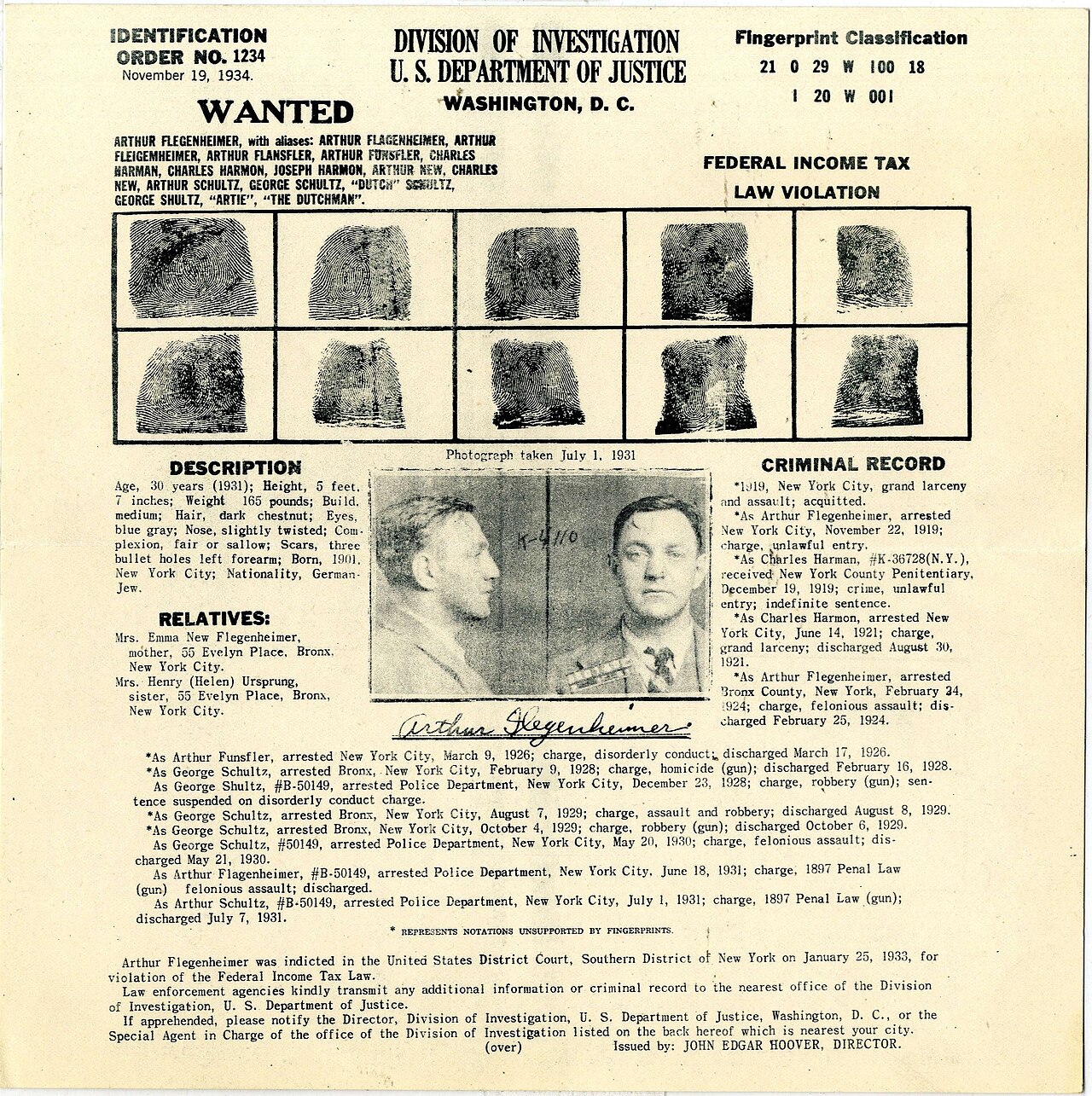
Arthur Simon Flegenheimer, better known as Dutch Schultz, was a New York City mobster active during the 1920s and 1930s. He built his wealth through organized crime, primarily bootlegging and the numbers racket. His operations were damaged by two tax evasion cases brought by U.S. Attorney Thomas Dewey, and he also faced threats from fellow gangster Lucky Luciano. Hoping to avoid a conviction, Schultz asked the Mafia’s ruling body, the Commission, for permission to kill Dewey. The Commission refused. When Schultz went ahead and tried to kill Dewey anyway, the Commission ordered his death. He was shot in a Newark, New Jersey, restaurant in 1935 and died the next day.
Flegenheimer was born in the Bronx on August 6, 1901, to German Jewish immigrants Herman and Emma Flegenheimer, who had married in Manhattan in November 1900. He had a younger sister, Helen, born in 1904. His father apparently abandoned the family; the 1910 U.S. census lists his mother as divorced, though in her 1932 citizenship petition she claimed her husband died in 1910—it is unclear if this happened before or after the census. The abandonment traumatized young Flegenheimer, who spent his life denying it. He left school after eighth grade to support himself and his mother, working as a feeder and pressman for several Bronx companies between 1916 and 1919.
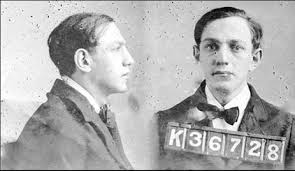
Before turning to burglary, Flegenheimer worked at a nightclub owned by a small-time mobster, where he robbed craps games. He was eventually caught breaking into an apartment and sent to prison on Blackwell’s Island (now Roosevelt Island). His mugshot at age 18 later appeared in the 2010 book *New York City Gangland*. He was so unruly that he was transferred to a work farm in Westhampton, Long Island. After an escape and recapture, two months were added to his sentence. Released on parole on December 8, 1920, he returned to Schultz Trucking. With Prohibition underway, the company began smuggling alcohol from Canada, which led Flegenheimer to associate with known criminals. Around this time he adopted the name “Dutch Schultz.” After a disagreement, he left Schultz Trucking and went to work for their Italian competitors.
In the mid-1920s, Schultz became a bouncer at the Hub Social Club, a Bronx speakeasy owned by gangster Joey Noe. Impressed by Schultz’s brutal reputation, Noe made him a partner.
Quick Facts
- Birth Name
- Arthur Simon Flegenheimer
- Birth Date
- August 6, 1901
- Birth Place
- New York City, New York, U.S.
- Death Date
- 1935-10-24
- Death Place
- Newark, New Jersey, U.S.
- Death Cause
- Peritonitis from a gunshot wound
- Resting Place
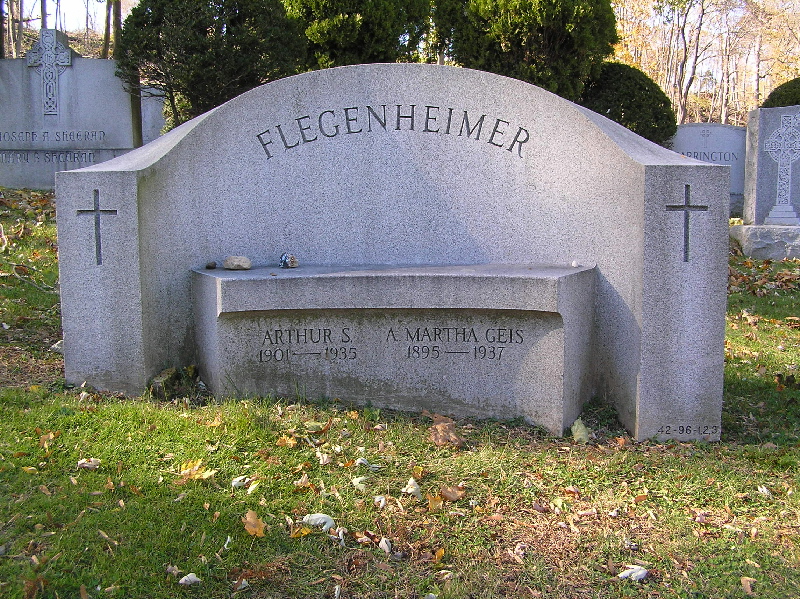
- Gate of Heaven Cemetery, Hawthorne, New York, U.S.
- Years Active
- 1918–1935
- Organization
- Noe-Schultz Gang
- Known For
- Murder, bootlegging, numbers game, extortion
- Opponents
- The Rock Brothers (the Bronx) · Legs Diamond · Lucky Luciano · U.S. Attorney Thomas Dewey · Bumpy Johnson
- Allegiance
- New York City's Five Families
Facts from the source article.
Lore & Background
Arthur Simon Flegenheimer was born in the Bronx borough of New York City on August 6, 1901, the second child of German Jewish immigrants. His father apparently abandoned the family, and his mother is listed as divorced in the 1910 census, though in her 1932 citizenship petition she wrote that her husband had died in 1910. Flegenheimer dropped out of school in the eighth grade and worked various jobs before turning to burglary. He was caught breaking into an apartment and sent to prison on Blackwell's Island; after an escape, he had two months added to his sentence. Released on parole on December 8, 1920, he went back to work at Schultz Trucking, which began smuggling alcohol during Prohibition. He became known as Dutch Schultz and later worked for Italian competitors after a disagreement.
In the mid-1920s, Schultz became a bouncer at the Hub Social Club, a speakeasy owned by Joey Noe. Noe made him a partner, and they opened more illegal drinking establishments in the Bronx. They brought in beer from a brewer in Union City, New Jersey, and Schultz often rode shotgun to guard trucks. They dealt with rival bootleggers John and Joe Rock, kidnapping Joe and allegedly blinding him. The Noe-Schultz gang expanded across the Bronx and into Manhattan, leading to a bootleg war with Jack 'Legs' Diamond. Noe was shot in October 1928 and died in November. Schultz is believed to have ordered the killing of Arnold Rothstein in retribution. Schultz also faced conflict with his own enforcer Vincent Coll, who formed a rival crew; Coll was killed in a drugstore in February 1932.
Schultz also extorted New York restaurant owners through an employer association he founded, using labor unions to force compliance. During his tax trial, he suspected his associate Jules Modgilewsky (Julie Martin) of skimming. In March 1935, Schultz confronted Martin at a meeting in Cohoes, New York, where Martin admitted to skimming after being punched. Schultz's rackets were weakened by tax evasion trials led by Thomas Dewey and threatened by Lucky Luciano. After the Commission refused his request to kill Dewey, Schultz disobeyed and made an attempt, leading the Commission to order his murder. He was shot at a restaurant in Newark, New Jersey, and died the next day.
Reader's Guide
Dutch Schultz's significance lies in his rise as a major New York mobster during Prohibition, amassing wealth through bootlegging and the numbers racket. His conflict with the Mafia Commission over the proposed murder of prosecutor Thomas Dewey illustrates the limits of mob power and the Commission's authority. Schultz's defiance led directly to his murder, marking a rare instance of the Commission ordering the death of a non-Italian gangster. His criminal career also highlights the violent gang wars of the era, including conflicts with Jack Diamond and Vincent Coll. The tax evasion trials led by Dewey weakened his operations and foreshadowed the federal government's increasing use of tax laws against organized crime. Schultz's legacy is that of a ruthless, independent mobster whose refusal to submit to the Commission cost him his life.
Did You Know?
- Schultz's father apparently abandoned the family, though his mother later claimed he died in 1910.
- The Commission ordered his murder after he disobeyed their refusal to kill Thomas Dewey.
Gallery

Frequently Asked Questions
Who is Dutch Schultz?
Arthur Simon Flegenheimer was a Bronx-born gangster who ran one of New York's most aggressive criminal empires during the Prohibition era and the early 1930s. He became notorious for his volatility and his willingness to use violence to protect his turf and income.
What criminal operations defined Dutch Schultz's career?
Schultz built his fortune primarily through bootlegging alcohol during Prohibition and later through running an illegal numbers-betting ring across Manhattan. Those two rackets generated enormous cash flow and made him a major player in the city's underworld.
What was the Dutch Schultz–Thomas Dewey conflict about?
U.S. Attorney Thomas Dewey pursued Schultz in two separate tax-evasion prosecutions that threatened to wipe out the mobster's ill-gotten earnings. Schultz reportedly asked the Mafia Commission for approval to assassinate Dewey, was denied, and went ahead with the plot regardless.
Why is Dutch Schultz considered significant in organized-crime history?
His case became a landmark example of the Mafia Commission enforcing internal discipline against a member who acted without authorization. It also marked a turning point in the power struggle between older, more reckless gangsters and the emerging, more orderly Luciano-era syndicate.
More in Infamous Criminals And Outlaws 1-24
Spotted an error? Know more?
Reader corrections go straight into our review queue. Suggest an edit · How this site is sourced