Dick Turpin
English highwayman romanticised after execution for horse theft.

Acabashi · CC BY-SA 4.0
Richard Turpin (baptised 21 September 1705 – 7 April 1739) was an English highwayman whose life became romanticised after he was hanged in York for stealing horses. He is also remembered for a made-up story, popularised nearly a century after his death by the Victorian writer William Harrison Ainsworth, about a 200-mile overnight ride from London to York on his horse Black Bess.
Turpin may have started out as a butcher, like his father, but by the early 1730s he had joined a gang that stole deer. He later turned to poaching, burglary, horse theft, and murder. His most famous crime—highway robbery—only began after the rest of his gang were arrested in 1735. He vanished from public view late that year, then reappeared in 1737 with two new partners. He accidentally shot and killed his accomplice Thomas Rowden (or Rowland) in 1737, then fled and soon after killed a man who tried to capture him.
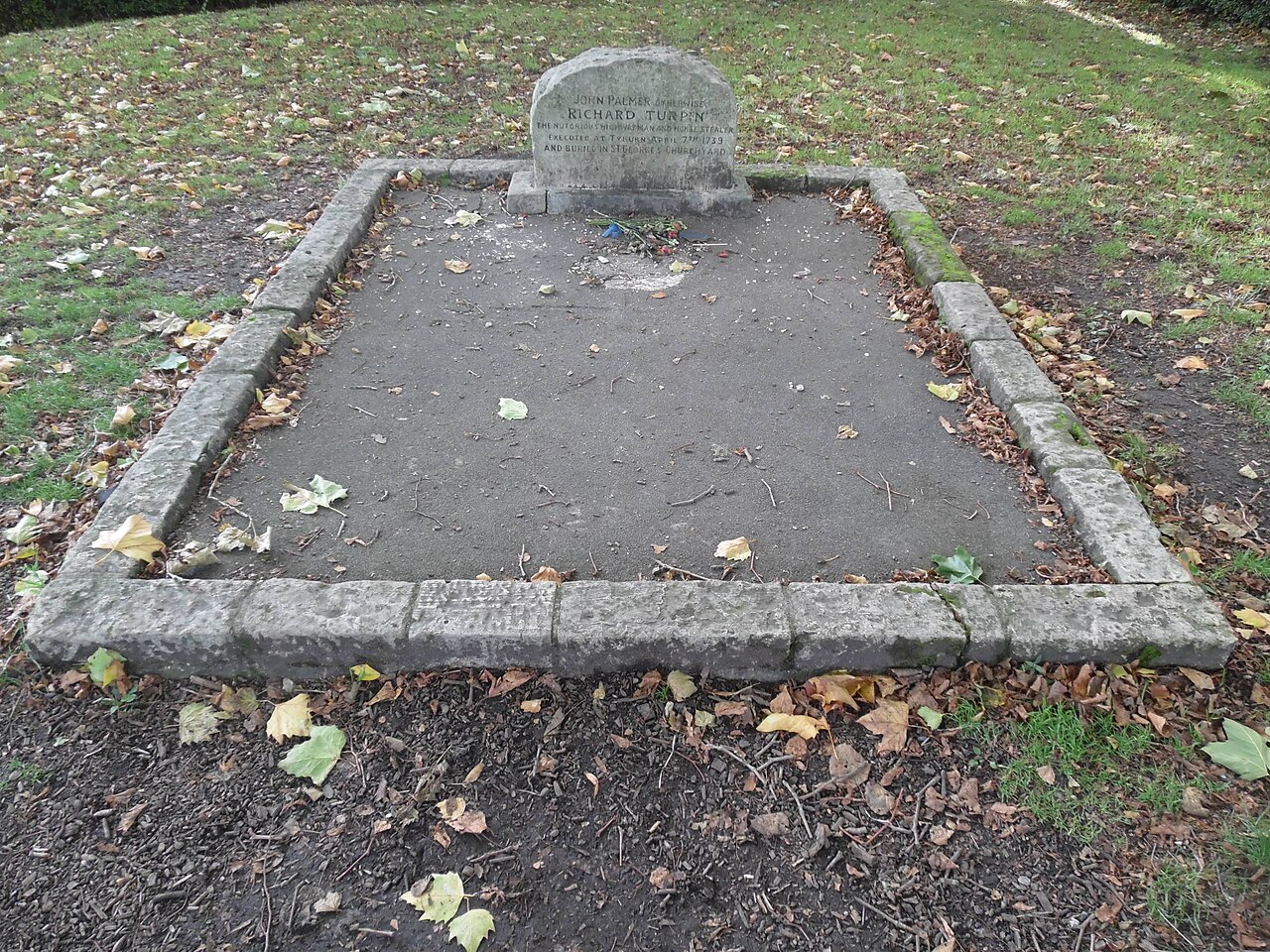
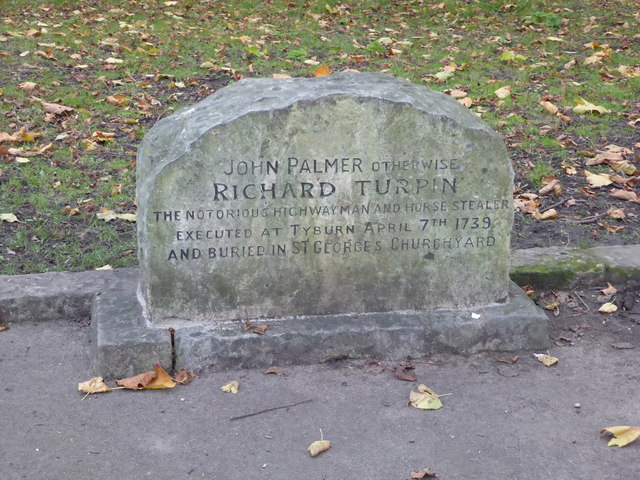
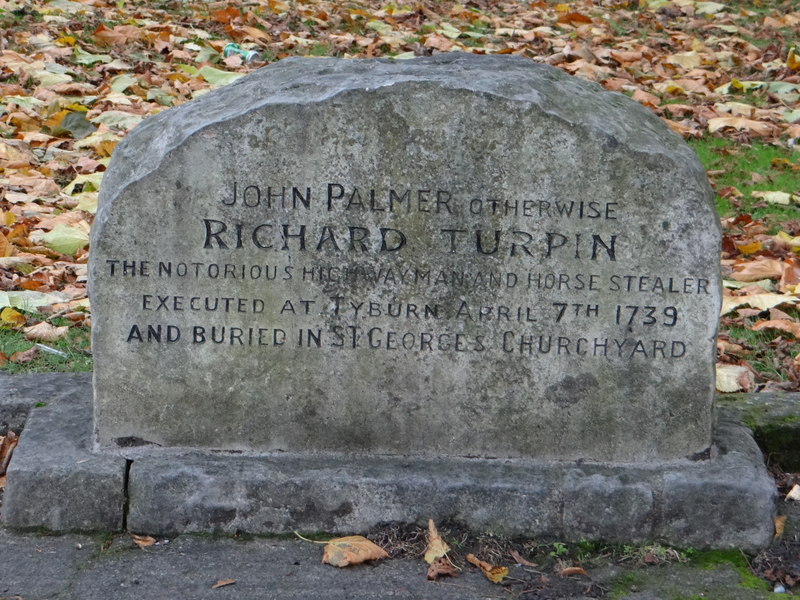
Later in 1737, Turpin moved to Yorkshire and used the alias John Palmer. While staying at an inn, local magistrates grew suspicious of how he paid for his lifestyle. Believing he was a horse thief, they locked him in York Castle to await trial. His true identity came out when a letter he wrote to his brother-in-law from prison fell into the authorities’ hands. On 22 March 1739, he was found guilty of two counts of horse theft and sentenced to death. He was hanged at Knavesmire on 7 April 1739.
After his execution, Turpin became a legend. He was romanticised as dashing and heroic in English ballads and popular theatre during the 18th and 19th centuries, and later in 20th-century film and television.
Turpin was born at the Rose and Crown Inn in Hempstead, Essex, the fifth of six children of John Turpin and Mary Elizabeth Parmenter. He was baptised on 21 September 1705 in the same parish where his parents had married more than ten years earlier. His father was a butcher and innkeeper. Some stories say Turpin may have followed his father into these trades: one suggests he was apprenticed to a butcher in Whitechapel as a teenager, another that he ran his own butcher’s shop in Thaxted. Trial testimony from 1739 indicates he had a basic education and, though no record of the marriage date survives, that he married Elizabeth Millington around 1725.
Quick Facts
- Birth Name
- Richard Turpin
- Birth Date
- 1705-09-21 (baptised)
- Birth Place
- Hempstead, Essex, England
- Death Date
- 1739-04-07
- Death Place
- Knavesmire, York, England
- Cause
- Execution by hanging
- Other Names
- John Palmer
- Charge
- Horse theft
- Conviction
- Guilty
- Conviction Penalty
- Death
- Occupation
- Butcher · poacher · burglar · horse thief · highwayman
- Spouse
- Elizabeth Millington
Facts from the source article.
Lore & Background
Turpin was born at the Rose and Crown Inn in Hempstead, Essex, the fifth of six children to John Turpin and Mary Elizabeth Parmenter. He may have followed his father's trade as a butcher early in his life, and by the early 1730s he had joined a gang of deer thieves, later becoming a poacher, burglar, horse thief, and killer. He married Elizabeth Millington around 1725, though the claim that he opened a butcher's shop in Buckhurst Hill, Essex, is not reliably documented in primary sources and is considered speculative or romanticized.
Turpin's involvement in highway robbery followed the arrest of the other members of his gang in 1735. He disappeared from public view towards the end of that year, resurfacing in 1737 with two new accomplices, one of whom—Thomas Rowden (or Rowland)—Turpin accidentally shot and killed in 1737. He fled and shortly afterwards killed a man who attempted his capture.
Reader's Guide
Turpin became the subject of legend after his execution, romanticised as dashing and heroic in English ballads and popular theatre of the 18th and 19th centuries and in film and television of the 20th century. His fictional 200-mile overnight ride from London to York on his horse Black Bess, invented by William Harrison Ainsworth nearly a century after Turpin's death, cemented his place in popular culture. The historical Turpin, however, was a violent criminal involved in brutal robberies, including the attack on a 70-year-old farmer whom he beat and burned. His trial in 1739 revealed he had a rudimentary education. The romanticised image overshadows the reality of his life as a poacher, burglar, horse thief, and killer.
Did You Know?
- Turpin was baptised on 21 September 1705 in Hempstead, Essex.
- The story of his 200-mile overnight ride on Black Bess was invented by Victorian novelist William Harrison Ainsworth.
- Turpin assumed the alias John Palmer while living in Yorkshire.
Turpin in Hobsbawm's Theoretical Framework
Dick Turpin occupies a deliberate place within the theoretical architecture that Marxist historian Eric Hobsbawm built across Primitive Rebels (1959) and Bandits (1969). In those works, Hobsbawm coined the term "social bandit" to describe outlaws who live on the margins of rural societies, sustaining themselves through robbery and plunder. What sets this figure apart from a mere criminal is the perception of the surrounding community: ordinary people regard such individuals as heroes and beacons of popular resistance rather than threats. Hobsbawm characterized this dynamic as a "pre-historic social movement," deliberately distinguishing it from the organized labour movements of later industrial eras. Turpin appears in Hobsbawm's roster of such figures, named alongside outlaws from vastly different continents and periods. By including him, Hobsbawm implicitly treats Turpin as an English embodiment of a pattern the historian regarded as one of the most universal social phenomena in recorded history. The inclusion positions Turpin not as a local curiosity but as a data point in a cross-cultural analysis of how communities produce and celebrate figures who operate outside the law while remaining embedded in their social fabric.
The Hero-Criminal Duality
The defining tension in Turpin's legacy, as articulated through Hobsbawm's framework, is the split between how the state and how the community perceive him. In Hobsbawm's formulation, the lord and the state classify such outlaws as criminals, yet the very same individuals remain embedded within peasant society and are regarded by their people as champions, avengers, and fighters for justice. Some are even seen as leaders of liberation. In every case, they are men to be admired, helped, and supported. This dual status is what makes the phenomenon analytically significant: it is not simply that a criminal exists, but that a community actively invests moral legitimacy in someone the legal system has condemned. Hobsbawm stressed that this relationship between the ordinary person and the rebel is what renders social banditry interesting and meaningful as a historical force. For Turpin, this means his cultural identity is not fixed by any single act or verdict. He exists in the space between criminal and champion, a figure whose meaning is determined as much by the admiration of the common people as by the condemnation of the authorities who pursued him.
Romanticization and the Mediated Legend
Hobsbawm was careful to note that the social bandit is not merely a person but a "symbol and mediated idea." This distinction is crucial for understanding Turpin's enduring cultural presence. The historian acknowledged that outlaws are frequently romanticized after the fact through rhetoric and texts that circulate independently, granting them a permanence and potency that far exceeds their localized, transitory existence. In the specific context of Hobsbawm's own work, critics such as Paul Sant Cassia observed that this romanticization carried a political rather than a nationalistic character. The bandit figure, in Hobsbawm's hands, served a Marxist narrative of class struggle in pre-industrial societies, which shaped how readers interpreted figures like Turpin. Yet even critics who challenged the theoretical framework conceded that the fluid, ambiguous quality of the bandit figure persists regardless of the interpretive lens applied. For Turpin, this means his legend has been continuously reshaped by the needs of different audiences and political moments, never settling into a single fixed meaning. He is as much a story told about him as he is a historical individual.
Turpin Among a Global Constellation of Outlaws
Hobsbawm's Bandits does not treat Turpin in isolation. He is listed in the same breath as Pancho Villa of Mexico, Lampião of Brazil, Ned Kelly of Australia, Juraj Jánošík of the Carpathian region, Sándor Rózsa of Hungary, Billy the Kid of the American frontier, and Carmine Crocco of Italy. This constellation underscores a central claim of the theory: social banditry is a widespread phenomenon that has occurred in many societies throughout recorded history and continues to exist in modified forms, from piracy to organized crime syndicates. Within this global roster, Turpin shares a particular cultural proximity with Robin Hood, the legendary English folk-hero, and with Ned Kelly, the Australian bushranger who achieved a similar folk-hero status. The common thread is not any specific criminal act but the structural position each figure occupies: a person operating on the edge of a rural or frontier society, condemned by the state yet celebrated by the community. Turpin's inclusion in this international list elevates him from a single national legend to one node in a pattern that Hobsbawm regarded as one of the most universal social phenomena known to history.
Gallery
Frequently Asked Questions
Who is Dick Turpin?
Richard Turpin was an 18th-century English criminal born in Hempstead, Essex, who rose to notoriety as a highwayman and horse thief. He was executed by hanging in York in 1739, and his story later became one of England's most romanticised outlaw legends.
What crimes was Dick Turpin actually guilty of?
Turpin's criminal career spanned poaching, burglary, horse stealing, and murder, with highway robbery being his most well-known offence. He reportedly began life as a butcher before joining a deer-stealing gang in the early 1730s and escalating into more violent crimes.
Did Dick Turpin really ride 200 miles overnight on Black Bess?
No, that dramatic tale was invented by Victorian novelist William Harrison Ainsworth roughly 70 years after Turpin's death. The real Turpin was hanged for horse theft, and the legendary overnight ride from London to York never actually took place.
How did Dick Turpin's life end?
He was hanged at Knavesmire in York on 7 April 1739, convicted of stealing horses. Despite the grim circumstances, his execution was followed by a surge of public sympathy that helped cement his outlaw reputation.
Why is Dick Turpin still remembered today?
Turpin became a cultural symbol of the roguish, charismatic highwayman largely because later writers and storytellers embellished his real crimes into a romantic narrative. The combination of his genuine criminal record and the fictional Black Bess legend made him one of England's most enduring outlaw figures.
More in Infamous Criminals And Outlaws 1-24
Spotted an error? Know more?
Reader corrections go straight into our review queue. Suggest an edit · How this site is sourced