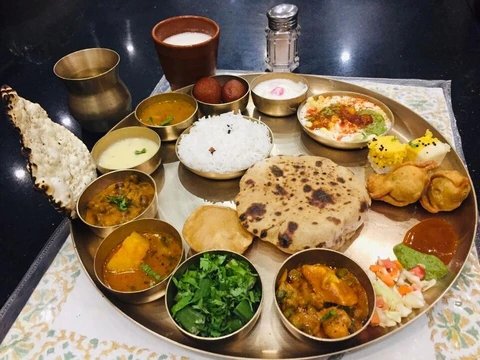
Bhakri
A traditional Indian flatbread made from millet or rice flour.

Bhakri is a round, flatbread found in the cuisines of Maharashtra, Gujarat, Rajasthan, and Karnataka. Unlike the consistently hard khakhra, bhakri can be either soft or hard. It is made from grains like jowar (sorghum) or bajra (pearl millet), which give it a coarser texture than a standard wheat chapati.
Various millets are common for bhakris, especially in the Deccan Plateau (Maharashtra and northern Karnataka) and semi-arid Rajasthan. In the coastal Konkan and Goa regions, rice flour is used instead. Specific types include jowar bhakri (the most common, made with hot water dough), bajra bhakri (mainly prepared in winter, especially around Sankranti), makai bhakri (cornmeal, also a winter dish, called makai no rotlo in Gujarati), ragi bhakri (from red finger millet), rice bhakri (common in Konkan), wheat bhakri (larger and thicker than a wheat roti, with more oil), and pulse bhakri (from urad dal or a mix of urad and jowar, known as kalna bhakri in the Khandesh region).
To prepare bhakri, the flour is mixed with a little salt and hot water to form a stiff dough. This dough is divided into balls, which are then flattened by hand—either on a surface with the palm or, requiring more skill, between both palms. The flattened bread is cooked on a heated tava (pan), with a little water spread on the upper surface using the cook's fingers. After cooking both sides on the tava, it is finished by roasting directly over a flame. A hard bhakri has a crunchy outer layer.
Bhakri is typically served with yogurt, garlic chutney, pithla, baingan bharta, thecha (green chili and peanut chutney), leafy green preparations, or raw onion. In northern Karnataka, it accompanies stuffed brinjal curry, while in Vidarbha it is eaten with jhunka (a thick pithla variant). In the Khandesh region, bhakri and shev bhaji are common. In coastal Konkan and Goa, rice flour bhakris are often paired with fish curry. Traditionally a rural staple, bhakri was carried to the fields at dawn for both breakfast and lunch, sometimes even serving as a plate for chutney or thecha. Today, while wheat rotis and phulkas have become more common, bhakri remains popular in many regions and as a specialty dish.
Quick Facts
- Country
- India
- Region
- Maharashtra, Gujarat, Rajasthan, Malwa, Central India, Karnataka, and Goa
- Main Ingredient
- Flour
Facts from the source article.
Lore & Background
Bhakri is prepared using various grains depending on the region. Jowar bhakri is the most common type, made by mixing jowar flour with hot water and flattening by hand. Bajra bhakri is mainly prepared in winter, especially near the festival of Sankranti. In coastal Konkan and Goa, rice flour is used. The dough is kneaded with hot water and a small amount of salt, then flattened by hand on a surface or between the palms. It is cooked on a heated tava, with water spread on the upper surface using the cook's fingers, then roasted directly over flame.
Reader's Guide
Bhakri has traditionally been a rural staple in the Deccan Plateau and semi-arid regions of India, often carried to farms for breakfast and lunch. In the fields, it even served as a plate on which chutney or thecha was eaten. It is typically served with yogurt, garlic chutney, pithla, baingan bharta, thecha, green leafy vegetables, and raw onion. In northern Karnataka, it is served with stuffed brinjal curry; in Vidarbha, with jhunka; in Khandesh, with shev bhaji; and in coastal regions, with fish curry. In modern days, bhakri has increasingly been replaced by wheat rotis and phulkas but still retains popularity in many regions and as a specialty dish. Its significance lies in its use of locally available millets and its role in traditional rural diets.
Did You Know?
- Bhakri can be either soft or hard in texture, unlike khakhra, which is always hard.
- In the fields, bhakri used to serve as a plate on which chutney, kharda, or thecha was served and eaten together.
- Rice flour bhakris are common in the Konkan and Goa regions and are mainly served with fish curry.
More in Indian cuisine 1-24
Spotted an error? Know more?
Reader corrections go straight into our review queue. Suggest an edit · How this site is sourced