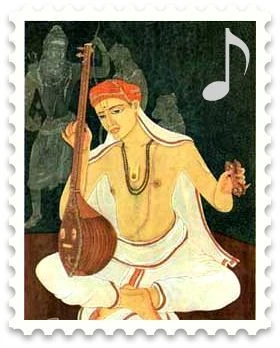
Tyagaraja
Composer of Carnatic music and one of its Trinity.

Sadguru Sri Tyāgarāja Swāmi (4 May 1767 – 6 January 1847), also known as Tyāgayya and in full as Kākarla Tyāgabraḥmaṁ, was a composer of Carnatic Music, a form of Indian Classical Music. He is regarded as one of the Trinity of Carnatic Music, along with his contemporaries Śyāma Śāstri and Muthuswāmi Dikshitar. Tyāgarāja composed hundreds of devotional kṛti (compositions), mostly in Telugu and in praise of Rāma, many of which remain popular today.
Quick Facts
- Birth Name
- Kākarla Tyāgabraḥmaṁ
- Birth Date
- 4 May 1767
- Birth Place
- Tiruvarur, Thanjavur, Maratha Kingdom
- Death Date
- 6 January 1847 · 1767 · 5 · 4
- Death Place
- Thiruvaiyaru, Thanjavur Maratha kingdom
- Resting Place
- Thiruvaiyaru, Thanjavur District, Tamil Nadu, India
- Occupation
- Carnatic composer
Facts from the source article.
Lore & Background
Tyāgarāja was born in 1767 to a Telugu Vaidiki Mulakanādu Brahmin family in Thiruvarur, present-day Tamil Nadu, though some scholars propose Thiruvaiyaru as his birthplace. His family migrated from Andhra Pradesh after the fall of the Vijayanagara Empire. He learned music from his father Ramabrahmam and later from Sonthi Venkata Ramanayya. He married Parvati and, after her death, her sister Kamala. He spent most of his life in Thiruvaiyaru in a house donated to his father by King Thuljaji.
Tyāgarāja began musical training under Sonthi Venkata Ramanayya. He regarded music as a way to experience divinity and composed his first kriti in Sanskrit. The use of saṇgati in the sāhityaṃ of a krithi existed before his time, though he employed it masterfully. When King Serfoji II invited him to court, Tyāgarāja rejected the invitation, composing the krithi 'Nidhi Chala Sukhama' on that occasion. He taught music freely to many disciples, who codified his compositions on palm leaves and copper plates. He took siddhi (attained liberation) on 6 January 1847, a day after taking sanyāsa, and was interred on the banks of the Kāveri river.
Reader's Guide
Tyāgarāja's significance lies in his vast output of devotional kritis that remain central to Carnatic music performance and practice. His compositions, numbering about 720 available today, are noted for their expression (bhāva) and technical mastery. He is especially remembered for the Pañcaratna Kṛti (five gems), often sung in programs held in his honor, and for his Utsava Sāmpradāya Kṛti and Divya Nāma Saṅkīrtana. His rejection of royal patronage in favor of creative and spiritual freedom is a defining aspect of his legacy. The preservation of his works was not streamlined during his lifetime, but early 20th-century scholars such as T. S. Parthasarathy, K. V. Srinivasa Iyengar, and Rangaramanuja Iyengar compiled his compositions from manuscripts held by disciples' families. These manuscripts are now preserved in the Saraswathi Mahal Library in Thanjavur. Tyāgarāja's music continues to be widely performed and studied, and his life exemplifies the integration of devotion, music, and asceticism.
Did You Know?
- Tyāgarāja composed his first kriti, 'Namo Namo Raghavaaya', in Sanskrit and inscribed it on the walls of his house.
- Though saṇgati existed before Tyāgarāja, his masterful use of it in the sāhityaṃ of a krithi became a hallmark of his style.
- The exact last composition of Tyāgarāja is uncertain; 'Giripai Nelakonna' in Rāga Sahānā is one candidate among others.
- Around 700–800 of his compositions are available today; the claim of 24,000 pieces is apocryphal and not part of established canon.
Musical Training & Artistic Revolution
Tyagaraja's musical education took shape in the court of Thanjavur ruler Thuljaji, where his father Ramabrahmam also served. His principal teacher was Sonthi Venkata Ramanayya, the court's chief vidwan. Beyond formal instruction, Tyagaraja's deep identification with the celestial sage Narada shaped his entire artistic identity. Tradition holds that a hermit taught him a mantra invoking Narada, and through sustained meditation on that mantra, Tyagaraja received a vision of the sage and was gifted the text Svarārnavam, from which he absorbed the finer nuances of music. He treated music as a direct channel to the divine, and his compositions emphasized bhāva—emotional expression—alongside technical precision. His very first kriti, "Namo Namo Raghavaaya," set in the Desika Todi raga, was inscribed on the walls of his own home. A landmark contribution was his introduction of saṇgati into the lyrical body of the krithi, a structural shift widely regarded as a paradigm change in Carnatic composition. He also explored ninda stuti, the art of lovingly chiding the divine, and extended his devotional range to Krishna, Shiva, Devi, Ganesha, Muruga, Saraswati, and Hanuman. Most of his kritis were written in vernacular Telugu, making them easy to learn and sing, which fueled their enduring popularity.
A Life of Devotion & Simplicity
Born in 1767 as the third son of Kakarla Ramabrahmam and Sitamma, Tyagaraja grew up in a Telugu Vaidiki Mulakanadu Brahmin family rooted in the Smārta tradition. His maternal grandfather, Kāḷahastayya, was a celebrated vīṇa player who taught the young Tyagaraja to play the instrument. After his grandfather's death, Tyagaraja is said to have discovered the musical treatise Nāradīyam, which further deepened his understanding. He married Parvati and, after her passing, took her sister Kamala as his second wife. For the bulk of his adult life, Tyagaraja dwelt in a single-room house at number 31, Thirumanjana Veedhi, Thiruvaiyaru—a dwelling originally donated to his father by Thuljaji. He lived a deliberately spartan existence, wholly absorbed in his devotion to Rama. He welcomed any student who came to him, teaching without discrimination. In his final days, he took the vow of sanyāsa and was initiated into the Advāita Daśanāmi Saṁpradāya. His last composition, Giripai Nelakonna, was set in the raga Sahānā with Ādi Tāḷa. He attained siddhi on 6 January 1847 at the age of seventy-nine and was interred the following day on the banks of the Kāveri at Thiruvaiyaru.
Rejection of Royal Patronage
Throughout his life, Tyagaraja lived under the successive reigns of four Thanjavur Maratha rulers—Thuljaji, Amarasimha, Serfoji II, and Shivaji II—yet he served none of them. As his musical reputation spread across Thanjavur and its principalities, including Thiruvarur and Thiruvaiyaru, it eventually reached the ears of King Serfoji II. The monarch dispatched an invitation laden with gifts, urging Tyagaraja to join the royal court. Tyagaraja turned the offer down flatly. He believed that courtly life would tether his creative freedom and, more importantly, obstruct his pursuit of the divine. On that occasion, he is said to have composed the kriti Nidhi Chala Sukhama, a reflective piece that questions whether material wealth truly brings happiness. This single act of refusal encapsulates his lifelong philosophy: that artistic and spiritual independence mattered far more than royal favor. He chose the quiet of his small house in Thiruvaiyaru over the gilded halls of any palace, remaining free to compose, teach, and worship entirely on his own terms.
Legacy, Disciples & Enduring Influence
Alongside Śyāma Śāstri and Muthuswāmi Dikshitar, Tyagaraja is honored as one of the Trinity of Carnatic Music. His output of hundreds of devotional kṛtis, predominantly in Telugu and centered on praise of Rāma, continues to be performed across the subcontinent. Five of his compositions, known as the Pañcaratna Kṛti or "five gems," are regularly featured in programs held in his honor. He also composed Utsava Sāmpradāya Kṛtis for temple rituals and Divya Nāma Saṅkīrtana pieces meant for concerts and everyday devotion. His teaching legacy is equally vast: he willingly instructed anyone who sought his guidance, producing disciples such as the Walajapet father-son duo Venkataramana and Krishnaswamy Bhagavathar, his cousin Thanjavur S Ramarao, Veena Kuppayyar, Manambuchavadi Venkatasubbayyar, and Subbaraya Sastri, son of Śyāma Śāstri. Several of these students meticulously transcribed his compositions onto palm leaves and copper plates, preserving them for future generations. His former residence in Thiruvaiyaru, after years of neglect, has been renovated and opened to music lovers. Records also note his pilgrimages to Sri Raṅgaṁ, Tirumala, and Kāñcipuraṁ, where he met the seer Upanishad Brahmayogin at the Braḥmendraḷ Maṭha.
Frequently Asked Questions
Who is Tyagaraja?
Tyagaraja (1767–1847) was a prolific Indian composer of Carnatic music, born in the Thanjavur Maratha region. His full name was Kakarla Tyagabrahmam, and he is widely revered as one of the foundational figures of the Carnatic tradition.
What is the Pancharatna Kiti?
The Pancharatna Kiti is a set of five of Tyagaraja's most treasured devotional compositions, often called the 'five gems' of his catalogue. They stand as some of the most frequently performed works in the Carnatic concert repertoire.
Who are the Trinity of Carnatic Music?
The Trinity consists of three great composers from the late 18th and early 19th centuries: Tyagaraja, Syama Shastri, and Muthuswami Dikshitar. These three contemporaries are credited with shaping the modern form of Carnatic music as it is practiced today.
In what language did Tyagaraja compose?
Tyagaraja wrote the vast majority of his kritis in Telugu, with his lyrics centered on devotion to the deity Rama. His compositions remain deeply popular among both musicians and devotees to this day.
Why is Tyagaraja important in Indian classical music?
Tyagaraja is regarded as one of the three pillars of Carnatic music and is credited with composing hundreds of devotional kritis that form the backbone of the concert tradition. His works continue to be performed and studied across India and the global diaspora.
More in Indian Classical Musicians 1-18
Spotted an error? Know more?
Reader corrections go straight into our review queue. Suggest an edit · How this site is sourced