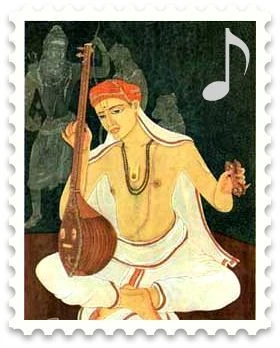
Syama Sastri
Oldest of the Trinity of Carnatic music, known for complex compositions.

Syama Sastri (26 April 1762 – 1827) was a musician and composer of Carnatic music. He was the oldest among the Trinity of Carnatic music, the other two being Tyagaraja and Muthuswami Dikshitar. His compositions are noted for their literary, melodic, and rhythmic proficiency.
Quick Facts
- Other Names
- Syama Krishna
- Birth Name
- Venkata Subrahmanya Iyer
- Birth Date
- 26 April 1762
- Birth Place
- Thiruvarur, Thanjavur Maratha kingdom
- Death Date
- 1827 (aged 64–65)
- Occupation
- Carnatic music composer
Facts from the source article.
Lore & Background
Syama Sastri, whose birth name was Venkata Subrahmanya, was born on 26 April 1762 in a Tamil speaking Smartha Vadama Brahmin family to Visvanatha Iyer and Vengalakshmi. He was born in Tiruvarur, in what is now the state of Tamil Nadu. He received instruction in the vedas, astrology, and other traditional subjects early on and learned music from his maternal uncle. He was later trained in music by Adiappayya, a noted durbar musician of Thanjavur. He is known by his adopted name Syama Sastri or by his musical mudra (signature) Syama Krishna.
Although he did not compose as many kritis as his two prolific contemporaries, his compositions are still well known due to their literary, melodic, and rhythmic proficiency. Only about 60–70 of his compositions are extant. He did not have many disciples to propagate his compositions, nor was the printing press widely accessible during his time. The scholarly nature of his compositions made them more appealing to the learned than to the lay, and they feature a more formal form of Telugu which borrows heavily from Sanskrit. Most of his compositions propitiate the Goddess Kamakshi.
He was probably the first to compose in a new form of the svarajati musical genre, where the compositions could be rendered solely in a singing or instrumental manner. His set of three famous svarajatis, sometimes referred to as 'Ratnatrayam' (Three jewels), are intended to be sung in concert rather than danced. He is known for his ability to compose in the most complex of talas.
Reader's Guide
Syama Sastri holds a significant place in Carnatic music as the oldest member of the Trinity, alongside Tyagaraja and Muthuswami Dikshitar. His compositions, though fewer in number than those of his contemporaries, are highly regarded for their literary, melodic, and rhythmic proficiency. He was a pioneer in the svarajati genre, transforming it from a primarily dance form into one suitable for concert singing or instrumental performance. His three famous svarajatis, known as 'Ratnatrayam,' exemplify this innovation. Despite limited disciples and the lack of widespread printing during his time, his works have endured, particularly those propitiating the Goddess Kamakshi. His legacy is carried on by disciples such as Alasur Krishna Iyer, Porambur Krishna Iyer, Tarangambadi Panchanada Iyer, and his son Subbaraya Sastri, who was also a notable composer. His ability to compose in complex talas further underscores his technical mastery.
Frequently Asked Questions
Who is Syama Sastri?
Syama Sastri (1762–1827) was an Indian composer and performer in the Carnatic music tradition. He is best remembered as the eldest member of the celebrated Trinity of Carnatic music, alongside Tyagaraja and Muthuswami Dikshitar.
What is Syama Sastri known for?
He is renowned for composing kritis, varnas, and svarajatis that display a remarkable blend of poetic craft, melodic depth, and rhythmic intricacy. Fans and scholars often single out his works as among the most structurally complex in the entire Carnatic canon.
Who are the Trinity of Carnatic music?
The Trinity refers to three 18th-century Indian composers—Tyagaraja, Muthuswami Dikshitar, and Syama Sastri—whose collective output laid the groundwork for modern Carnatic music. Syama Sastri, born in 1762, was the oldest of the three.
What types of compositions did Syama Sastri write?
His repertoire spans kritis, varnas, and svarajatis, each form demanding a different balance of lyrical, melodic, and rhythmic skill. These pieces continue to anchor the performance and teaching tradition of Carnatic music today.
Why is Syama Sastri considered important in Carnatic music?
As the senior figure of the Trinity, he helped codify compositional standards around literary richness, melodic sophistication, and rhythmic precision that still guide the art form. His legacy endures through the countless performers who keep his kritis and varnas alive on stage.
More in Indian Classical Musicians 1-18
Spotted an error? Know more?
Reader corrections go straight into our review queue. Suggest an edit · How this site is sourced