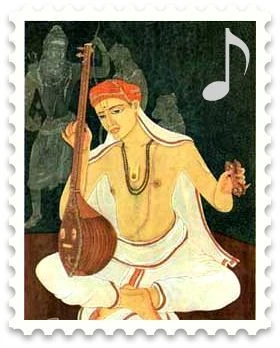
Purandara Dasa
Founder of Carnatic music pedagogy and devotional composer.

Purandara Dasa (c.1470 – c.1564) was a composer, singer, and Haridasa philosopher from what is now Karnataka, India. He adhered to Madhvacharya's Dvaita philosophy and is considered a key founder of modern Carnatic music, earning the title Pitamaha, or "grandsire," of that tradition. Legend holds him to be an incarnation of Narada.
Originally a wealthy merchant of gold, silver, and jewelry, he gave up all his material possessions to become a Haridasa—a devotional singer serving Vishnu or Krishna. He made the complex Sanskrit teachings of the Bhagavata Purana accessible to all through simple, melodic songs. As one of medieval India's most important music scholars, he structured the basic lessons of Carnatic music by creating graded exercises called Svaravalis and Alankaras.
He is traditionally said to have been born to a wealthy merchant named Varadappa Nayaka in a Kannada Deshastha Madhva Brahmin family. His birthplace is disputed: some point to Purandara gada, about 40 km from Pune in present-day Maharashtra, while others suggest Purandaraghatta in Karnataka. In 2018, a five-member committee set up by the Government of Karnataka—including singer RK Padmanabha, scholars Aralumallige Parthasarathi, AV Navada, Veeranna Rajora, and former minister Leeladevi Navada—submitted a report asserting Tirthahalli as the likeliest birthplace. It is now determined that he was born in Araga, in the Vijayanagara Empire (modern-day Thirthahalli, Shivamogga District, Karnataka).
His son Madhvapati recorded Dasa's death in 1564, but his birth year is unknown. Various dates have been proposed. B. N. K. Sharma initially said 1484, later changing to 1494. Scholars Guy L. Beck and William Joseph Jackson gave 1480–1564 CE, as did Amaresh Datta in the Encyclopaedia of Indian Literature. The Tirumala Tirupati Devasthanams has suggested 1470 based on a historical meeting between Purandara Dasa and Annamacharya at Tirumala, but this is not a universally accepted fact.
Dasa systematized Carnatic music teaching methods still used today.
Quick Facts
- Spouse
- Saraswati Bai
- Birth Name
- Srinivasa Nayaka
- Birth Place
- Purandaragada (near present-day Pune, Maharashtra, India) or Shimoga district (present-day Karnataka, India)
- Death Date
- 1564-01-02
- Death Place
- Vijayanagara, Vijayanagara Empire (Modern Day Hampi, Karnataka, India)
- Occupation
- Carnatic Vocalist, scholar, Saint, poet, composer
- Teacher
- Vyasatirtha
- Religion
- Hinduism
- Philosophy
- Dvaita, Vaishnavism
Facts from the source article.
Lore & Background
Purandara Dasa was a wealthy merchant of gold, silver, and jewellery from Karnataka who renounced all material riches to become a Haridasa (servant of Vishnu or Krishna). He made the difficult Sanskrit tenets of the Bhagavata Purana accessible to all through simple, melodious songs in Kannada. He was born to a wealthy merchant named Varadappa Nayaka in a Kannada Deshastha Madhva Brahmin family, though his birthplace is disputed—some sources point to Purandara gada about 40 km from Pune, others to Purandaraghatta in Karnataka. A 2018 committee of the Government of Karnataka asserted Tirthahalli (Araga, Vijayanagara Empire) as the likeliest candidate. His year of birth is uncertain; scholars have proposed 1484 or 1494, while the Tirumala Tirupati Devasthanams has suggested 1470 based on his meeting with Annamacharya, though this is not universally accepted.
Reader's Guide
Purandara Dasa's significance lies in systematizing Carnatic music instruction. He introduced the raga Mayamalavagowla as the basic scale and created graded lessons such as swaravalis, alankaras, and geetas that remain in use. He fused bhava, raga, and laya in his compositions, incorporated colloquial language and folk ragas, and composed lakshya and lakshana geetas. His sooladis are considered musical masterpieces and standards for raga lakshana. He also fought casteism through his songs, emphasizing that birth does not determine human worth. His legacy includes a stamp issued by India in 1964, multiple biographical films, and memorials such as the Purandara Mantapa at Hampi. He is honored as the Sangeeta Pitamaha (grandfather) of Carnatic music.
Did You Know?
- Purandara Dasa is considered an incarnation of Narada according to legend.
- He formulated the basic lessons of Carnatic music, including Svaravalis and Alankaras.
- His year of birth is disputed; Tirumala Tirupati Devasthanams gives 1470 based on his meeting with Annamacharya.
- A 2018 Karnataka government committee identified Tirthahalli as his likely birthplace.
Frequently Asked Questions
Who is Purandara Dasa?
Purandara Dasa (c.1470–c.1564) was a composer, singer, and devotional philosopher from Karnataka who is widely recognized as the foundational figure of modern Carnatic music. He earned the honorific Pitamaha, meaning 'grandsire,' for establishing the structural and pedagogical backbone of that tradition.
What was Purandara Dasa's life before he became a musician?
He was originally a prosperous merchant trading in gold, silver, and jewelry. He renounced all his material wealth to become a Haridasa, a devotional singer devoted to the worship of Vishnu or Krishna.
What are Svaravalis and Alankaras, and why are they linked to Purandara Dasa?
These are graded vocal exercises he composed as a progressive teaching tool so students could build their technique step by step. They remain a standard part of Carnatic music training and are a central reason he is credited with founding its modern pedagogy.
Which philosophical tradition did Purandara Dasa follow?
He adhered to the Dvaita (dualist) school of thought originally articulated by Madhvacharya. His devotional compositions in Kannada were designed to make the dense Sanskrit teachings of the Bhagavata Purana understandable to ordinary listeners.
Is there a legendary origin story for Purandara Dasa?
Popular tradition holds that he was a reincarnation of the celestial sage Narada, who descended to earth to spread devotional music and philosophy. This narrative reinforces his status as a near-divine figure within the Haridasa lineage.
More in Indian Classical Musicians 1-18
Spotted an error? Know more?
Reader corrections go straight into our review queue. Suggest an edit · How this site is sourced