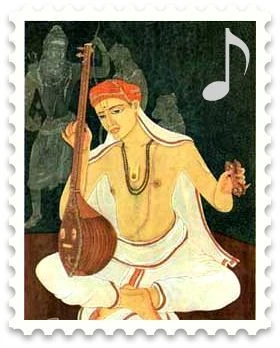
Muthuswami Dikshitar
Youngest of the Carnatic Trinity, composer of around 500 Sanskrit kritis.

Muthuswami Dikshitar (24 March 1775 – 21 October 1835) was a South Indian Hindu poet, singer, veena player, and prolific composer of Indian classical music. He is the youngest member of the Trinity of Carnatic music, alongside Tyagaraja and Syama Sastri, and is credited with around 500 compositions, mostly in Sanskrit, noted for their elaborate poetic descriptions of Hindu deities and detailed architectural depictions of temples.
Quick Facts
- Other Names
- Guruguha
- Birth Date
- 1776-03-24
- Birth Place
- Thiruvarur, near Thanjavur, Tamil Nadu
- Death Date
- 1835-10-21
- Death Place
- Ettayapuram, India
- Father
- Ramaswami Dikshitar
- Occupation
- Carnatic music composer, Vainika
Facts from the source article.
Lore & Background
Muthuswami Dikshitar was born into an Auttara Vadama Tamil Brahmin family on 24 March 1775 in Tiruvarur, near Thanjavur, in what is now Tamil Nadu. His father, Ramaswami Dikshitar, educated him in the Vedas, poetry, music, and astronomy. Dikshitar later moved to Manali near Madras with the support of zamindar Venkatakrishna Mudaliar, where he was introduced to Western orchestral music and the violin. An ascetic named Chidambaranatha Yogi then took him to Benares, where he was instructed in music, esotericism, philosophy, and yoga, and exposed to Hindustani classical music, particularly the Dhrupad style. According to hagiographical tradition, the deity Murugan placed a piece of sugar candy in his mouth and commanded him to sing, marking the start of his music career and leading him to adopt the mudra 'Guruguha'.
Reader's Guide
Muthuswami Dikshitar's significance lies in his role as a foundational figure of Carnatic music, one of its Trinity. His approximately 500 compositions, mostly in Sanskrit, are distinguished by their elaborate poetic descriptions of Hindu deities and detailed architectural depictions of temples. He composed in all 72 Melakarta ragas under his unique Asampurna Mela scheme, preserving rare ragas, and is the only recorded composer to have kritis in all seven basic talas of the Carnatic scheme. His works, often in a slower tempo (chowka kala), capture the essence of ragas in the vainika (veena) style, highlighting gamakas. He also pioneered the Samashti Charanam format. His legacy is carried forward by disciples including the Tanjore quartet brothers, and his compositions remain widely performed in Carnatic music concerts. His brother Balaswami pioneered the use of the violin in Carnatic music.
Did You Know?
- Dikshitar used the signature name 'Guruguha' as a mudra in all his compositions.
- He composed kritis in all eight grammatical declensions of Sanskrit.
- His first composition was 'Śrināthādi guruguho jayati jayati' in the raga Maya Malavagaula and Adi tala.
- He died on 21 October 1835 (Deepavali) in Ettayapuram, where a samadhi was erected in his memory.
Compositional Voice and Musical Identity
Muthuswami Dikshitar left behind an estimated 500 kritis that remain a cornerstone of the Carnatic concert repertoire. What sets his output apart from the other two members of the Carnatic Trinity—Tyagaraja and Syama Sastri—is his almost exclusive use of Sanskrit, with a small number of works in Manipravalam, a hybrid literary register blending Sanskrit and Tamil. His lyrics are celebrated for their richly detailed devotional imagery, often painting elaborate portraits of Hindu deities and even rendering the architectural features of the temples where those deities reside. Musically, his compositions are deeply rooted in the veena tradition; the flowing gamakas that characterise his melodic lines reflect the phrasing of a string instrument rather than a purely vocal approach. He favoured the slower chowka kala tempo, frequently weaving in mid-tempo stanzas to create internal contrast. The result is a body of work that captures the structural essence of each raga with a patience and ornamentation that continue to define how his music is performed in concert halls across South India.
Formative Training and Intellectual Breadth
Dikshitar's musical education began in the household of his father, Ramaswami Dikshitar, who instructed him in the Vedas, Sanskrit poetry, music, and astronomy. Ramaswami himself had studied the veena under Venkata Vaidyanatha Dikshitar, a lineage tracing back to the great theorist Venkatamakhin; that raga system is clearly the structural backbone of Muthuswami's compositions. A pivotal shift came when the young Dikshitar moved to Manali near Madras under the patronage of the zamindar Venkatakrishna Mudaliar. There, at Fort St. George, he and his brothers encountered Western orchestral music and the violin for the first time. His intellectual horizons expanded further when the ascetic Chidambaranatha Yogi took him to Varanasi, where he studied music, esoteric philosophy, and yoga, and was exposed to the Dhrupad tradition of Hindustani classical music—an influence some scholars trace in his later melodic choices. Hagiographical accounts add a divine dimension: the deity Murugan at Tiruttani is said to have placed sugar candy in Dikshitar's mouth and commanded him to sing, an event that also gave rise to his signature mudra, Guruguha.
Temple Pilgrimage and Landmark Compositions
Dikshitar's creative life was inseparable from the sacred geography of the subcontinent. His very first known kriti, set in the raga Maya Malavagaula and Adi tala, addressed the Lord in the first Sanskrit declension. He went on to compose kritis in all eight grammatical declensions, a feat showcasing his command of the language. Travelling to temples in Varanasi, Tirupati, Srirangam, Chidambaram, Kanchipuram, Thanjavur, Palani, Tiruvannamalai, and Kalahasthi, he composed works honouring each site's presiding deity and its unique traditions. Back in his hometown of Tiruvarur, he composed on every deity in the Thyagaraja Temple, producing the celebrated Kamalamba Navavarna Kritis—nine songs in all eight declensions dedicated to the goddess Kamalambal and the deities of the Sri Chakra, still performed as a highlight of the annual Guruguha Jayanti. His Navagraha Kritis, steeped in Mantra and Jyotisha knowledge, praised the nine planets, while the Nilotpalamba Kritis revived nearly forgotten ragas such as Narayanagaula, Purvagaula, and Chayagaula. In the kriti Balagopala he styled himself a vainika gayaka, a veena-playing singer, and he also experimented with the violin.
Discipleship, Death, and Enduring Influence
Dikshitar died on 21 October 1835, the day of Deepavali, in Ettayapuram, where a samadhi was raised in his honour and continues to draw musicians and devotees. He left no children, so the transmission of his art fell entirely to his disciples. Among them were the four brothers of the Tanjore Quartet—Ponnayya Pillai, Vadivelu, Chinnayya, and Sivanandam—along with the mridangam virtuoso Tambiyappa and the veena player Venkatarama Ayyar of Avudayarkoil. The broader cultural impact of his circle extended beyond pure music: his brother Balaswami is credited with pioneering the violin's role in Carnatic ensembles, an instrument Dikshitar himself had first encountered at Fort St. George and briefly experimented with. As the youngest of the Carnatic Trinity, Dikshitar occupies a distinctive niche: his Sanskrit-centric, veena-inflected, temple-rooted compositions offer a counterpoint to the Telugu devotional focus of Tyagaraja and Syama Sastri. More than two centuries after his death, his kritis remain staples of concert programmes, and the Kamalamba Navavarna set continues to be performed as a ceremonial highlight every year.
Frequently Asked Questions
Who is Muthuswami Dikshitar?
He was a South Indian Hindu poet, veena virtuoso, and prolific Carnatic composer who lived from 1775 to 1835. He is recognized as the youngest of the three great composers who form the Trinity of Carnatic music.
What makes Muthuswami Dikshitar's kritis stand out from other Carnatic compositions?
His roughly 500 works are written almost entirely in Sanskrit and are celebrated for their richly detailed poetic imagery of Hindu deities and elaborate architectural descriptions of temples. This sets his lyrical style apart from the more conversational Tamil of his fellow Trinity members.
Who are the Trinity of Carnatic music and where does Dikshitar fit?
The Trinity refers to Tyagaraja, Syama Sastri, and Muthuswami Dikshitar, three 18th-century composers whose collective output forms the bedrock of the Carnatic repertoire. Dikshitar, born in 1775, was the youngest of the three.
What is the Asampurna Mela scheme associated with Muthuswami Dikshitar?
It is his personal framework for organizing and classifying ragas, under which he composed kritis across a wide range of Melakarta parent scales. This system gave his body of work remarkable melodic diversity.
What does the mudra 'Guruguha' mean in Dikshitar's compositions?
It is the composer's signature mark embedded in his kritis, a poetic self-designation meaning 'abode of the guru.' It signals his identity as a devoted disciple and teacher within the Carnatic tradition.
More in Indian Classical Musicians 1-18
Spotted an error? Know more?
Reader corrections go straight into our review queue. Suggest an edit · How this site is sourced