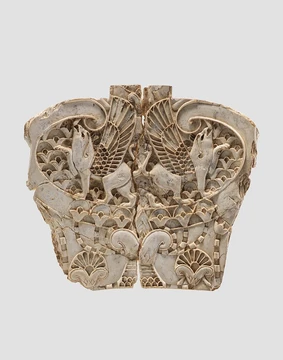
Fork
Utensil with tines for spearing and lifting food.

A fork is a utensil, now usually made of metal, with a long handle terminating in a head that branches into several narrow, often slightly curved tines. It is used to spear foods either to hold them while cutting with a knife or to lift them to the mouth. The fork has a long history, with early examples found in Bronze Age China and Mycenaean Greece, and it became a common table utensil in the Eastern Roman (Byzantine) Empire by the 4th century.
Archaeological evidence reveals bone forks from the Bronze Age Qijia culture and the Shang dynasty in China, as well as later Chinese dynasties. A stone carving from an Eastern Han tomb depicts three hanging two-pronged forks in a dining scene, and similar forks appear on a stove in another tomb from the same period. In Ancient Egypt, large forks were used as cooking utensils. A bronze fork dating to the 16th century BC was found in a Mycenaean Greek grave. During the Roman Empire, bronze and silver forks were used, with many surviving examples displayed in museums across Europe; their use varied by local custom, social class, and food type, but they were primarily cooking and serving utensils. The personal table fork was likely invented in the Eastern Roman (Byzantine) Empire, where it was common by the 4th century. By the 9th century, a similar utensil called a barjyn was in limited use among elite circles in Persia, and by the 10th century, the table fork was common throughout the Middle East. The Byzantine princess Theophanu caused astonishment at the court of the Holy Roman Emperor Otto II by using a fork instead of her hands. Another Byzantine princess, Maria Argyropoulina, brought golden forks to Venice in 1004, an act condemned as vanity by Peter Damian. By the 11th century, the fork became increasingly prevalent in Italy due to ties with the Byzantine Empire and the growing popularity of pasta, for which its three tines were better suited than the long wooden spike previously used. By the 14th century, the table fork was commonplace in Italy, and by 1600 it was almost universal among the merchant and upper classes. Guests often brought their own fork and spoon in a box called a cadena, a practice introduced to the French court by Catherine de' Medici's entourage. In Portugal, forks were first used around 1450 by Infanta Beatrice, but only entered common use in southwestern Europe in the 16th century, spread
- field
- Cutlery / Kitchenware
- material
- Originally bone, bronze, silver; now usually metal
- region_of_origin
- Multiple: China, Ancient Egypt, Mycenaean Greece, Roman Empire, Byzantine Empire
- known_for
- Personal table fork; four-tine design became current in early 19th century
Lore & Background
A stone carving from an Eastern Han tomb in Ta-kua-liang, Suide County, Shaanxi, depicts three hanging two-pronged forks in a dining scene. In Ancient Egypt, large forks were used as cooking utensils. A bronze fork dating from the 16th century BC was found in a Mycenaean Greek grave. In the Roman Empire, bronze and silver forks were used, many surviving examples displayed in museums across Europe; they were mostly used as cooking and serving utensils. The personal table fork likely originated in the Eastern Roman (Byzantine) Empire, where it was common by the 4th century. By the 9th century, a similar utensil called a barjyn saw limited use in Persian elite circles, and by the 10th century the table fork was widespread across the Middle East. The fork’s adoption in northern Europe was slow; it was first described in English in 1611 by Thomas Coryat after his Italian travels, but was long viewed as an unmanly Italian affectation. Some Roman Catholic writers, including St. Peter Damian, expressly disapproved of its use. It did not become common in Great Britain until the 18th century, and not popular in North America until near the American Revolution. The four-tine design became current in the early 19th century. Forks are now usually made of metal, with a long handle ending in a head that branches into several narrow, often slightly curved tines used to spear food.
Reader's Guide
The personal table fork was most likely invented in the Eastern Roman (Byzantine) Empire, where it was in common use by the 4th century. By the 9th century, a similar utensil called a barjyn was in limited use in elite circles of Persia, and by the 10th century the table fork was common throughout the Middle East. The fork spread to Italy by the 11th century, aided by ties with the Byzantine Empire and the growing popularity of pasta. It did not become commonly used in Great Britain until the 18th century, and in North America until near the time of the American Revolution. The four-tine design became current in the early 19th century.
Did You Know?
- A bronze fork dating from the 16th century BC was found in a Mycenaean Greek grave.
- Byzantine princess Theophanu caused astonishment at the court of the Holy Roman Empire by using a fork instead of her hands.
- The four-tine fork design became current in the early 19th century.
Frequently Asked Questions
What is a fork?
A fork is a table utensil with a long handle ending in a head that splits into several narrow, often slightly curved tines. Its primary job is to spear food so you can hold it while cutting or lift it straight to your mouth.
What materials are forks made from?
Modern forks are almost always metal, but historically they were crafted from bone, bronze, or silver depending on the time period and culture.
Where did the fork originate?
Early fork-like implements have been found in Bronze Age China and Mycenaean Greece, with related designs also appearing in Ancient Egypt and the Roman Empire. It became a standard personal table utensil in the Byzantine (Eastern Roman) Empire by the 4th century.
When did the fork become a common dining tool?
Although proto-forks existed as far back as the Bronze Age, widespread everyday table use really took hold in the Eastern Roman (Byzantine) Empire around the 4th century.
How many tines does a standard fork have, and when did that become the norm?
The familiar four-tine shape we recognize today became the current standard design in the early 19th century. Before that, tine counts varied widely across different cultures and eras.
More in Home And Furniture 1-23
Spotted an error? Know more?
This is a living reference — every entry is fact-audited, and reader corrections feed straight into our audit queue. Suggest an edit · See this site's audit record