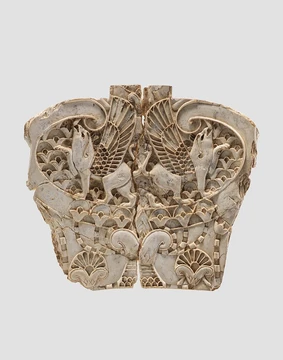
Cup
A drinking vessel used since prehistory across cultures worldwide.

A cup is a small vessel for drinking liquids, usually shaped like a flattened hemisphere with an open top. Its capacity typically ranges from about 6 to 16 US fluid ounces (177 to 473 ml). Cups can be made from many materials, including pottery (such as porcelain), glass, metal, wood, stone, polystyrene, plastic, or lacquerware. Unlike jugs and other drinkware, a cup is normally brought to the mouth for drinking, though a straw or lid may also be used. Many cups have handles, but many do not—beakers lack both a handle and a stem, and small bowl-like shapes are common in Asia.
Different cultures have specific terms for various cup types, often based on the drink they are used for or the material they are made from. In modern English, glass cups are usually called "glasses." Different styles of cups may be used for different liquids or foods (like teacups and measuring cups), in different settings (such as water stations or ceremonies), or simply as decoration.
The history of cups stretches back well into prehistory, where they first appeared as handleless beakers or bowls. Cups have been found across most cultures worldwide, in a wide range of shapes and materials. While simple cups were widespread, high-status cups made from expensive materials have served as important status symbols since at least the Bronze Age, and many have been discovered in burials.
Modern household cups generally lack a stem, but this was not always the case. Large metal standing cups or covered cups—with a base, stem, and often a lid—were prestigious items in medieval households that could afford them, used as "welcome cups" or for toasts. This form survives today in sporting trophies and church chalices. The 15th-century silver Lacock Cup is a rare surviving English secular example. Such cups were offered by cup-bearers, a role historically important in royal courts.
The English word "cup" has meant a drinking vessel since at least 1000 AD. Its definition is flexible, especially in specialist fields like archaeology, where it is broader than in everyday speech. For instance, Anna Wierzbicka (1984) noted that in the 1970s, the "older generation" expected a cup to be made of porcelain and have both a handle and a saucer, so a plastic cup without these features was not a "real cup." The "younger generation" made no such distinction, using "coffee cup" or "teacup" for traditional ones. Twelve-year-olds had two different cup shapes in mind: one for hot liquids, one for juices.
Names for cup types vary by region and can overlap. In American English, "cups" include "mugs." Any transparent cup, regardless of material, is more likely called a "glass"; a flat-bottomed paper cup is a "paper cup," but a transparent one of similar shape is often called a "tumbler" or another term for glasses. Lexicographer Penelope Stock found that cups, mugs, and glasses are "near-synonyms," though with "sufficient differences" to group them separately.
Wierzbicka and Keith Allan (in "On Cup," 2020) compare definitions. Many languages—including English, French, Italian, Polish, Russian, and German—use separate words for mugs and cups. Wierzbicka suggests this reflects different functionality: traditional cups are designed for drinking while seated at a table, while mugs are meant for use anywhere. This explains several features: the saucer protects the table but is inconvenient away from it; the tapered cup shape accommodates the saucer, while the cylindrical mug does not; a mug’s larger handle allows carrying it when setting it down isn’t possible; thicker mug walls let you cup it with a second hand and reduce breakage during extended handling; sitting at a table implies formality, so cups are more elegant and sold in sets (like tea or coffee services), while mugs are informal and sold individually; and a mug holds more liquid than a cup, since the cup is used near a teapot. To limit the liquid’s exposed surface area and retain heat, mugs are taller, while tapered cups are lower for stability.
Cups have been used since the Stone Age and found at archaeological sites worldwide. Many of the earliest cups come from burials, possibly holding offerings or supplies for the afterlife. Cups are not prominent in the earliest pottery from most areas, which was thick and heavy, as were carved stone vessels from early cultures. Cups made from organic materials—wood, bamboo, dried gourds—were probably common but have since decomposed. Large shells and birds’ eggs have been used in some regions almost to the present. Very simple, single-use *kulhar* cups made from unglazed terracotta (and sometimes unfired clay) are still used in South Asia, mainly at tea stalls, and closely resemble those found at Bronze Age Indus Valley Civilization sites. The Bell Beaker culture, an important archaeological culture, is named after its distinctive inverted-bell pottery beaker cups, marking the start of the European Bronze Age around 2800 BC. The Ringlemere Cup is a solid gold cup with a handle from around 1600 BC, and the Rillaton Gold Cup is one of two such cups.
- earliest_known_use
- Stone Age
- typical_materials
- pottery, glass, metal, wood, stone, polystyrene, plastic, lacquerware
- notable_archaeological_culture
- Bell Beaker culture (c. 2800 BC)
- key_ancient_shapes
- kylix, kantharos, skyphos, lip cup, mastos
- modern_english_term_for_glass_cups
- glass
Lore & Background
Cups have been used since the Stone Age and have been found at archaeological sites throughout the world. A large number of the earliest cups are excavated from burials, and may have held offerings or supplies for the afterlife. Cups do not feature strongly in the earliest pottery found in most areas; the wares were thick and heavy, as were the carved stone vessels found in several early cultures. Probably cups in organic materials that have now decomposed, such as wood, bamboo and dried gourds were widely used. Large shells and birds' eggs have been used in some areas almost up to the present. Very simple single-use kulhar cups in unglazed terracotta, and sometimes unfired clay, are still used in South Asia, now mainly at tea stalls, and are very similar to those found at sites of the Bronze Age Indus Valley Civilization.
Reader's Guide
The cup is a fundamental drinking vessel with a history stretching back to the Stone Age, found in nearly every culture. Its definition is fluid, varying by generation and region; for example, in the 1970s older generations expected a cup to be porcelain with a handle and saucer, while younger generations did not. The Bell Beaker culture (c. 2800 BC) marks an important archaeological phase named after its distinctive beaker cups. High-status cups in expensive materials have been important status symbols since at least the Bronze Age, with examples like the Ringlemere Cup and Rillaton Gold Cup. Ancient Greek drinking cups were often wide, shallow bowls on short stems with two horizontal handles, while Roman elites preferred glass cups by the 2nd century AD. The cup's legacy includes modern sporting trophies and church chalices, which derive from medieval standing cups.
Did You Know?
- The Bell Beaker culture is named after its distinctive inverted-bell pottery beaker cups, marking the beginning of the European Bronze Age from around 2800 BC.
- In the 1970s, the older generation expected a cup to be made of porcelain and have both a handle and a saucer, while the younger generation made no such distinction.
Origins and the Road to a National Name
Within just a year, production had scaled to between five hundred and a thousand chairs per day, signaling immediate commercial momentum. Finch, acquired the operation and steered it through its formative decades. The company's growth was not solely organic; it absorbed competitors over time. Huntley Furniture—a Winston-Salem-based maker that had grown into the nation's largest bedroom and dining room furniture producer—merged with Thomasville Furniture Co. to form Thomasville Furniture Industries.
Corporate Ownership and the Long Decline
By the 2010s, the company's physical footprint in Thomasville was shrinking. The remaining hundred employees were slated for a move to Eastchester Drive in High Point. The final blow came on January 21, 2014, when Heritage Home Group, the company's new owner, announced that all Thomasville Furniture operations would cease by March 21, eliminating 84 local jobs and effectively ending the furniture-making industry in the city that had borne its name for over a century.
The Big Chair and the Identity of Chair City
Few symbols capture the intertwined identity of a product and a place quite like the Big Chair. Standing in the town square of Thomasville, North Carolina, this eighteen-foot-tall reproduction of a Duncan Phyfe design has served as a public monument to the town's furniture heritage. It was conceived as a celebration of mutual prosperity: the chair company that gave the town its economic identity, and the town that proudly embraced the nickname Chair City. The Big Chair was never merely decorative; it embodied the shared pride of workers, merchants, and residents who built their livelihoods around seating. Even after the factory closed its doors in 2014 and the physical manufacturing sites in North Carolina and Virginia were redeveloped or demolished for new industrial purposes, the oversized chair remained in the square—a tangible reminder that the town's story was, for more than a hundred years, inseparable from the craft of making chairs.
A Brand That Outlives the Factory
Even after Thomasville Furniture ceased manufacturing in 2014, the name continued to appear in American homes through licensed and branded product lines. At its peak, the company maintained dedicated galleries in more than four hundred retail furniture stores nationwide, plus thirty Thomasville Home Furnishing stores that carried exclusively Thomasville products. The cabinetry segment survived in a different form: Thomasville Cabinetry is produced by MasterBrand Cabinets, a division of Fortune Brands Home and Security, at several North American facilities. These cabinets are sold exclusively through The Home Depot, and manufacturers such as Schrock Cabinetry of Illinois produce units bearing the Thomasville name. umbrella.
Frequently Asked Questions
What is a cup in the context of home furnishings?
A cup is a small drinking vessel that has been a staple of household life since prehistory. It is one of the most universally recognized kitchen and dining items found across virtually every culture on Earth.
What materials are cups traditionally made from?
Cups have been fashioned from pottery, glass, metal, wood, stone, and lacquerware throughout the ages, while modern production also uses plastic and polystyrene. The chosen material often reflects the era, culture, and intended use of the vessel.
How far back does the history of cups go?
Cups trace their origins to the Stone Age, making them among the oldest household objects still in continuous use. A large number of the earliest examples have been excavated from burials, likely serving as offerings or provisions for the afterlife.
What are some notable ancient cup shapes?
Ancient Greek culture produced several distinctive forms, including the kylix, kantharos, skyphos, lip cup, and mastos. Each differed in rim width, handle placement, and overall silhouette, serving slightly different drinking or ritual roles.
Which archaeological culture is especially associated with early cups?
The Bell Beaker culture, dating to roughly 2800 BC, is one of the most notable prehistoric groups linked to widespread cup use. Their characteristic bell-shaped vessels have been uncovered across a broad stretch of Europe and North Africa.
More in Home And Furniture 1-23
Spotted an error? Know more?
This is a living reference — every entry is fact-audited, and reader corrections feed straight into our audit queue. Suggest an edit · See this site's audit record