
The Mansion of Happiness
A moral race to virtue on a spiral track.

William and Stephen B Ives (Life time: William Ivews died at age 81 before Decem · Public domain
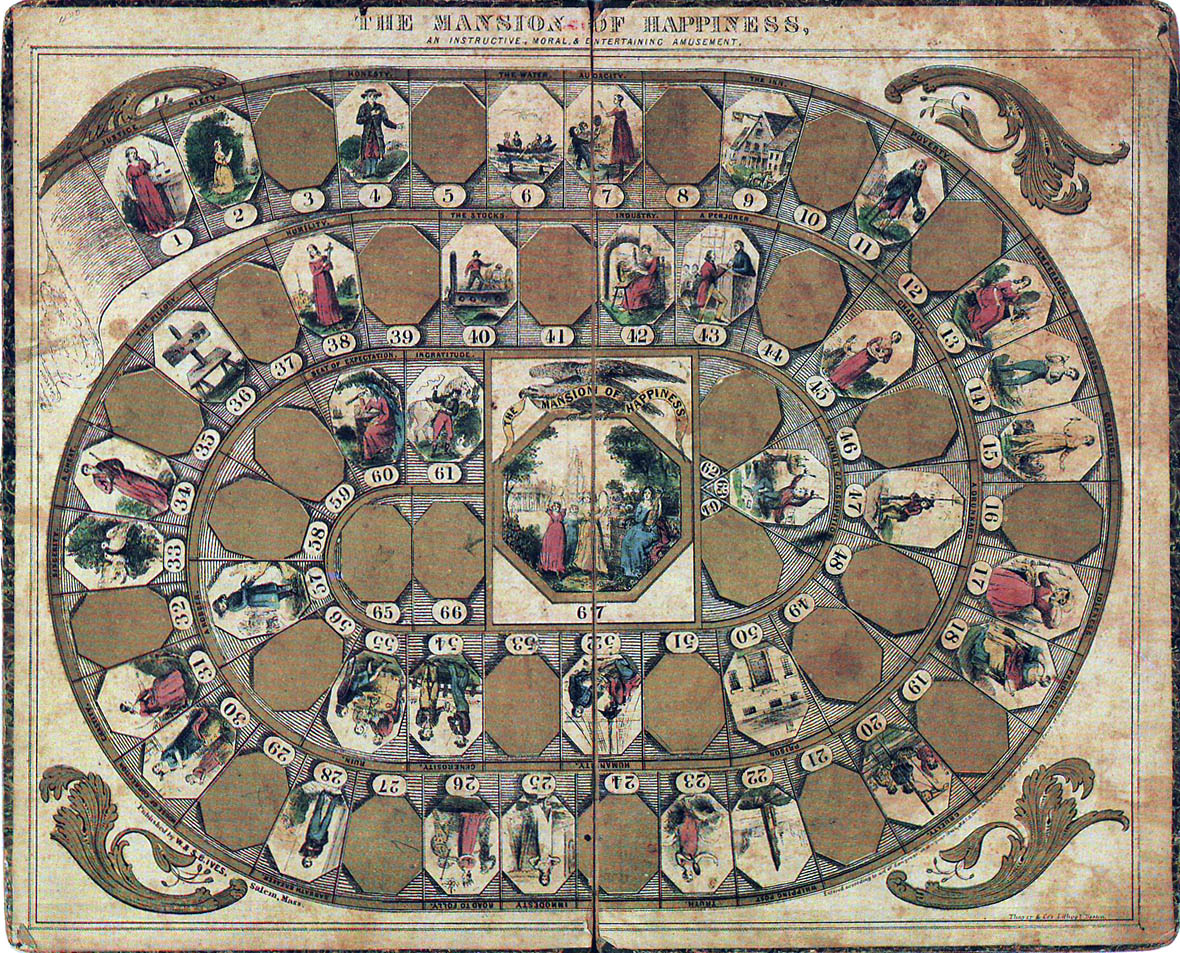
The Mansion of Happiness: An Instructive Moral and Entertaining Amusement is a children's board game inspired by Christian ethics. Designed by Anne Abbott (credited as 'A Lady' in some early editions), it features a 67-space spiral track depicting virtues and vices, with the goal being the Mansion of Happiness at the track's end. The game was first published in the United States in 1843 by W. & S.B. Ives, and later became influential in both America and England.
Quick Facts
- Designer
- George Fox
- Publisher
- Laurie and Whittles (1800–1843) / W. & S.B. Ives (1843–1860) / Henry P. Ives (1860–1866) / Parker Brothers (1886–1926)
- Years
- 1800–1926
- Genre
- Board game
- Language
- English
Facts from the source article.
Lore & Background
The Mansion of Happiness was designed by Anne Abbott and first published in the United States in 1843 by W. & S.B. Ives. Early editions credited the designer as 'A Lady,' but historical attribution has since been given to Anne Abbott. The game's moral track and use of a teetotum (instead of dice) reflected its Christian ethical roots. Parker Brothers later acquired the rights and published editions in the late 19th century, continuing the game's legacy into the early 1900s.
Reader's Guide
The Mansion of Happiness is significant as one of the earliest commercially published board games, directly influencing later games such as The Checkered Game of Life. Its moral framework—rewarding virtue and punishing vice—set a template for didactic entertainment in the 19th century. The game's publication history illustrates the evolution of printing techniques, from hand-colored copperplate engravings to lithography, and the shift from luxury items for nobility to mass-produced goods for the middle class. The American editions by W. & S.B. Ives, starting in 1843, saw at least thirteen editions through 1926, with Parker Brothers and McLoughlin Brothers also publishing versions. The use of a teetotum instead of dice reflected contemporary moral objections to dice, which were associated with gambling. The game's longevity and multiple editions demonstrate its enduring appeal and its role in the development of the board game industry.
Did You Know?
- The game used a teetotum instead of dice because dice were called 'the bones of the Devil' due to their use in determining which Roman soldier kept Christ's loin cloth.
- Parker Brothers acquired the rights to The Mansion of Happiness in the late 19th century and published editions into the early 1900s.
Moral Architecture of the Game
The Mansion of Happiness is structured around a 67-space spiral track on which players race toward a final destination bearing the game's namesake. The track is populated with spaces depicting virtues and vices, and the core mechanic is deceptively simple: landing on a virtue space propels a player forward, while a vice space forces them to retreat. This creates a moral progression system in which ethical choices literally determine one's pace toward the goal. Inspired by Christian ethics, the game was conceived as both an instructive moral exercise and an entertaining amusement for children. In the period when it was first published, morality was considered the paramount element of any board game. Dice were deliberately avoided because they were regarded as the bones of the Devil, a reference to the Roman soldiers who gambled for Christ's loin cloth. Instead, players relied on a teetotum, a spinning top-like device, to determine their moves. This combination of moral instruction and mechanical gameplay made the title both didactic and engaging for its young audience.
Luxury Production for the English Nobility
The first edition of The Mansion of Happiness was a genuinely lavish object, produced in only a few hundred copies. It was printed using two separate copperplate engravings, one yielding gold ink described as containing real gold and the other producing black ink. After printing, water coloring was applied by hand to complete the board, resulting in a brilliant, colorful product. The paper was glued to linen so it could fold neatly into a heavy, attractively labeled cardboard case. The gold ink served a dual purpose: it elevated the visual splendor and price of the item while simultaneously paying homage to royalty, as the game honored the Duchess of York. By the second edition, also printed in 1800 by Laurie and Whittle, production was simplified to a single copper plate for black ink with no water coloring, suggesting a shift toward wealthy but non-noble buyers. The third edition reintroduced two copper plates, one for black and one for green lines marking blank spaces, with water colors added again. All three editions credited George Fox as the inventor.
The American Lithographic Saga
When W. & S.B. Ives first published The Mansion of Happiness in Salem, Massachusetts on November 25, 1843, the game entered a long and complex production history in the United States. The American edition featured a folding board with a cloth and cardboard pocket holding the rules, implements, and a distinctive teetotum: an ivory dowel sharpened to a point, inserted into an octagonal ivory plate. The paper stock of that era contained generous amounts of fiber, sometimes sourced from mummy wrappings, giving it remarkable resistance to fading compared to modern wood pulp. Over the following decade, at least seven distinct editions emerged. Thayer and Company handled the first two print runs, with the 1844 second run selling between 3,000 and 4,000 copies by September. John Bufford, a former Thayer employee, produced the third edition featuring a green circular end space. Thayer returned in 1847 for a fourth edition with entirely new litho stones, and later editions showed progressive simplification of green printing as stones wore or were damaged. S. W. Chandler, Thayer's brother-in-law, took over the business in late 1853 and produced a seventh edition by early 1854.
Legacy and Enduring Influence
The Mansion of Happiness left a mark that extended well beyond its own playing life. It directly influenced later titles, most notably The Checkered Game of Life, demonstrating how its moral-race structure became a template for subsequent board game design. The game's journey from a hand-colored, gold-inked luxury item for the English nobility in 1800 to a widely printed American product sold by the thousands by the mid-1840s illustrates a broader cultural shift in who could afford and enjoy such entertainments. A Laurie relative reissued the game in England as late as 1851, and the Ives editions continued through at least 1854, demonstrating remarkable commercial longevity for a single title. The physical construction, with linen-backed paper folding into a sturdy cardboard case, set a standard for portable board games that persisted for generations. In an era when dice were considered morally suspect and morality was the defining feature of any game, The Mansion of Happiness embodied the period's values while establishing mechanical and aesthetic conventions that future designers would inherit.
Gallery



Frequently Asked Questions
Who designed The Mansion of Happiness?
The game was created by Anne Abbott, an American designer, though some of the earliest printings credited the author simply as 'A Lady.' Her work reflects a clear interest in using play to teach Christian moral lessons to children.
How does The Mansion of Happiness gameplay work?
Players move along a 67-space spiral track in which each square represents a virtue or a vice. The objective is to reach the Mansion of Happiness at the very end of the path, making the whole experience a moral race to virtue.
When was The Mansion of Happiness first published?
It was first released in the United States in 1843 by the publisher W. & S.B. Ives. The original full title was 'An Instructive Moral and Entertaining Amusement.'
Why is The Mansion of Happiness important in board game history?
It became a notable influence on children's game design in both America and England, helping to establish the moral-instruction genre that shaped family games for decades. Its spiral-track layout and virtue-versus-vice space structure became a template that later designers followed.
What is the theme or purpose of The Mansion of Happiness?
The game is grounded in Christian ethics and was intended as a children's pastime that reinforced moral behavior through play. Every space on the track nudges the player toward good conduct or warns against vice, with the Mansion itself serving as the ultimate reward for a virtuous journey.
More in History of board games 1-21
Spotted an error? Know more?
Reader corrections go straight into our review queue. Suggest an edit · How this site is sourced