
Liubo
Ancient Chinese board game played with six sticks.

BabelStone · CC BY-SA 3.0
Liubo was a two-player board game from ancient China. Its name comes from the six sticks used to determine moves, which functioned like dice in other race games. Each player had six pieces that moved along points on a square board marked with a distinctive symmetrical pattern. The exact rules are mostly unknown today.
The game appeared no later than the middle of the first millennium BCE. It became especially popular during the Han dynasty, which lasted from 202 BCE to 220 CE. After that period, interest in Liubo faded quickly, likely because the game of weiqi (go) gained more followers, and eventually Liubo was completely forgotten.
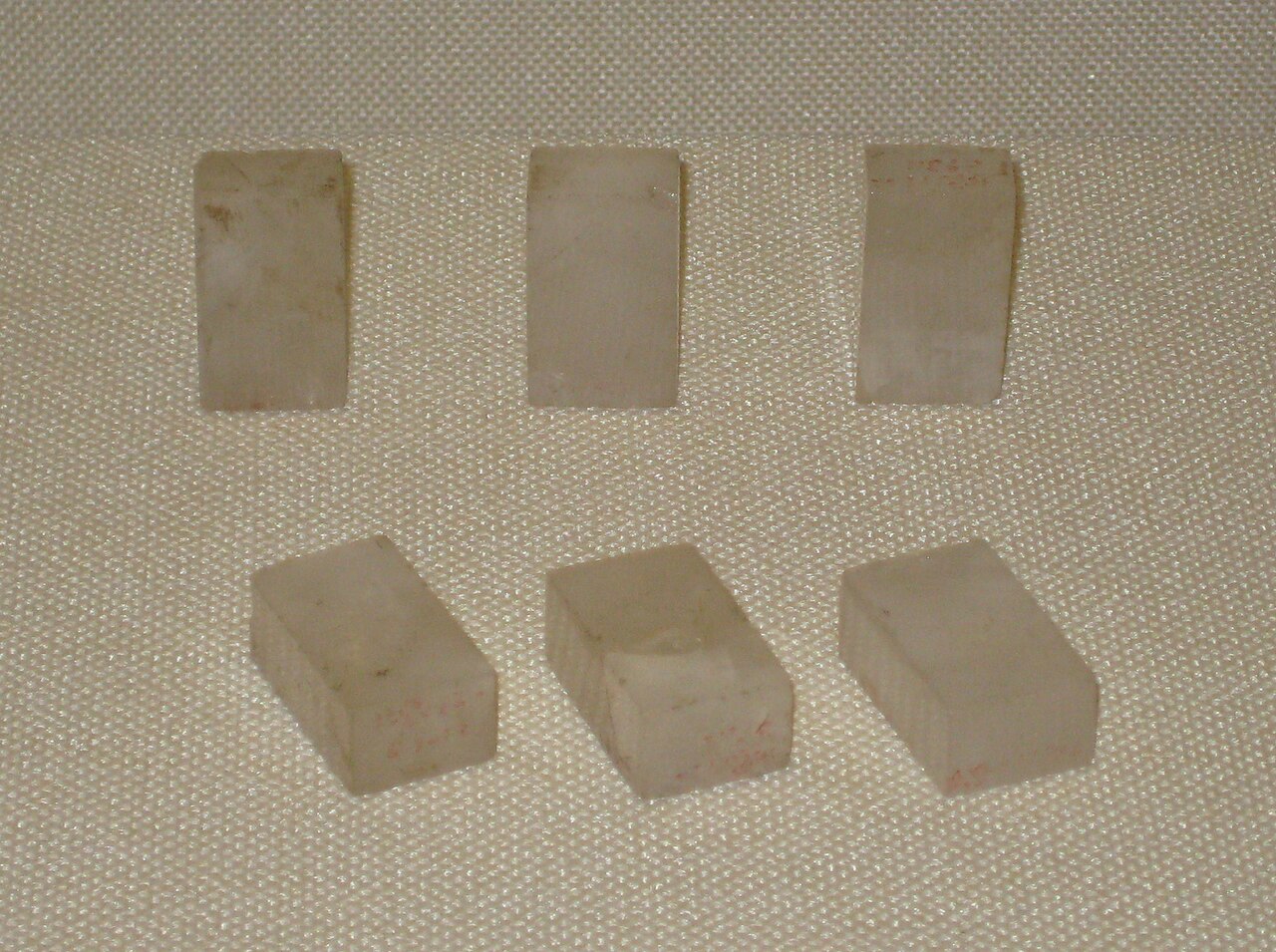
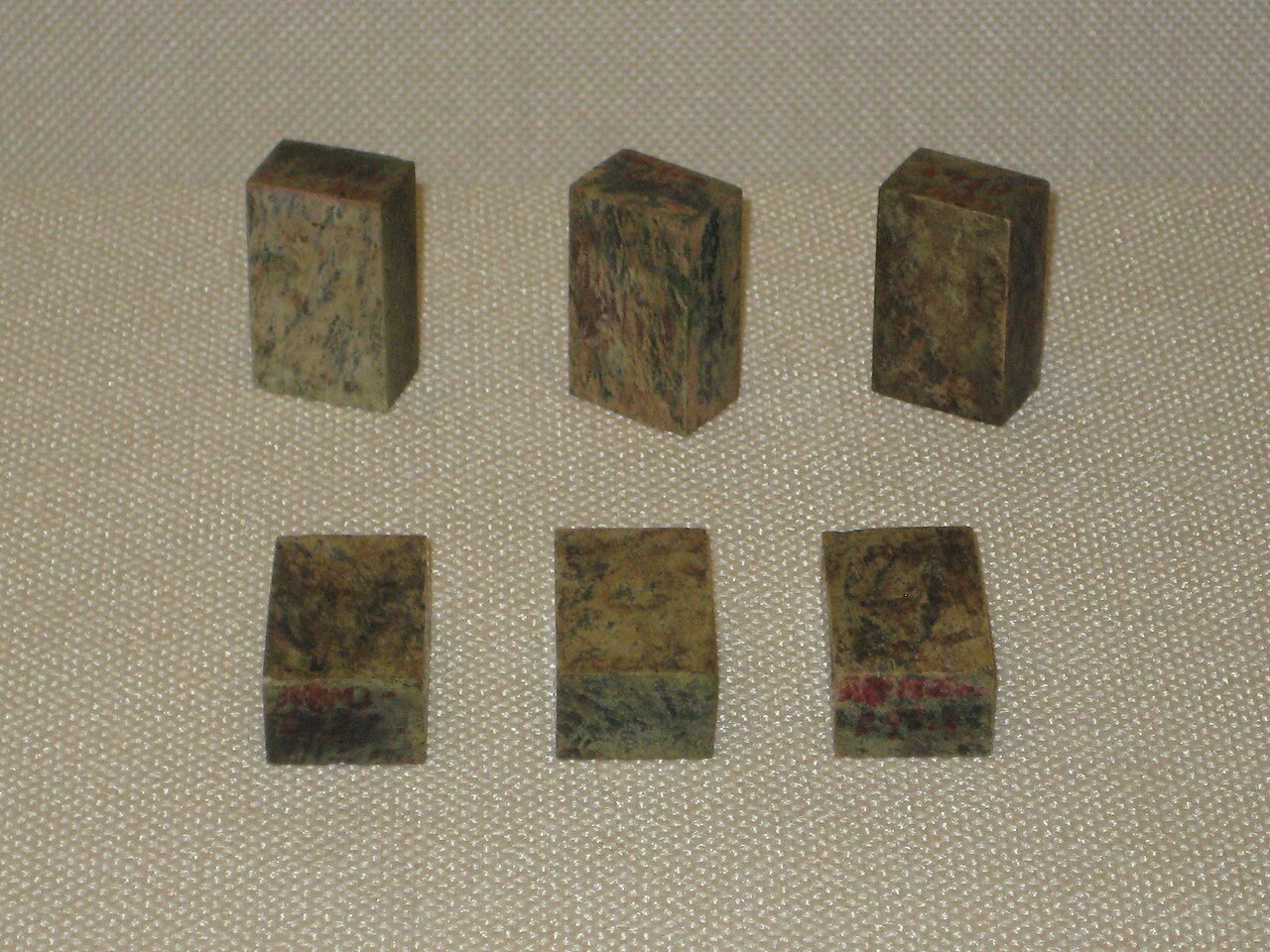
In recent years, archaeologists have uncovered Liubo boards and equipment in ancient tombs, along with Han-dynasty stone carvings and bricks that show people playing the game. These finds have revived knowledge of it.
No one knows exactly when Liubo began. A legend credits its invention to Wu Cao, a minister under King Jie, the last ruler of the Xia dynasty, who supposedly reigned around 1728–1675 BCE. But there is no solid evidence linking the game to the Shang dynasty (1600–1046 BCE). Early Chinese records do confirm that Liubo was already common by the Warring States period (476–221 BCE). For instance, the *Records of the Grand Historian* mentions a speech from the reign of King Xuan of Qi (319–301 BCE) claiming that the capital Linzi was so prosperous that its citizens could afford pastimes like cockfighting, dog racing, kickball, and Liubo.
The game also appears in the mid-3rd century BCE poem "Summons of the Soul" from the *Songs of Chu*. It describes bamboo dice and ivory pieces, players advancing together, and shouts of "five white!" when a piece was "kinged"—a term that translates the Chinese phrase *cheng xiao*, meaning "become an owl." The oldest known Liubo boards are a pair of ornate stone ones from a 4th-century BCE tomb in the royal complex of the State of Zhongshan at Pingshan, Hebei.
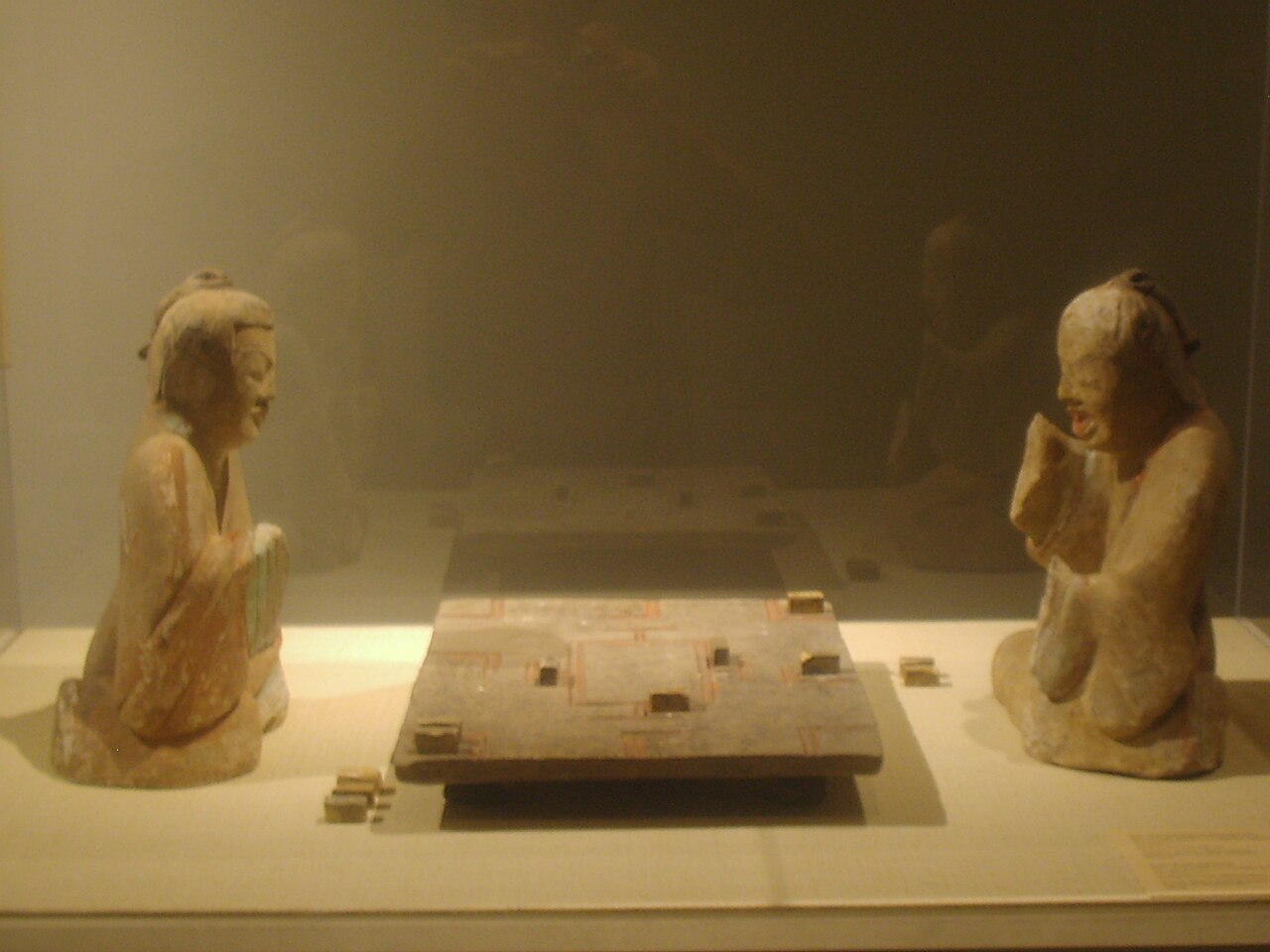
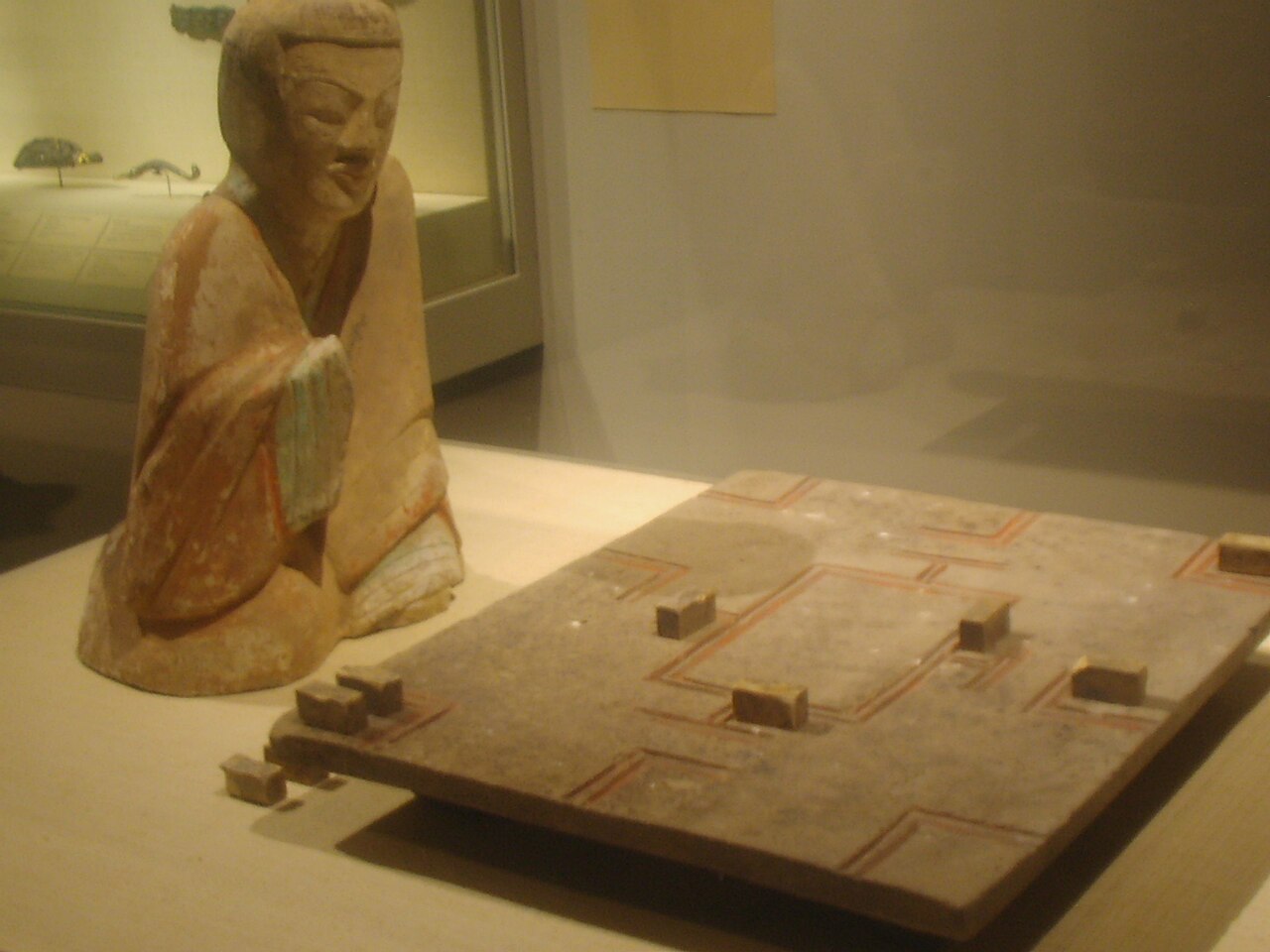
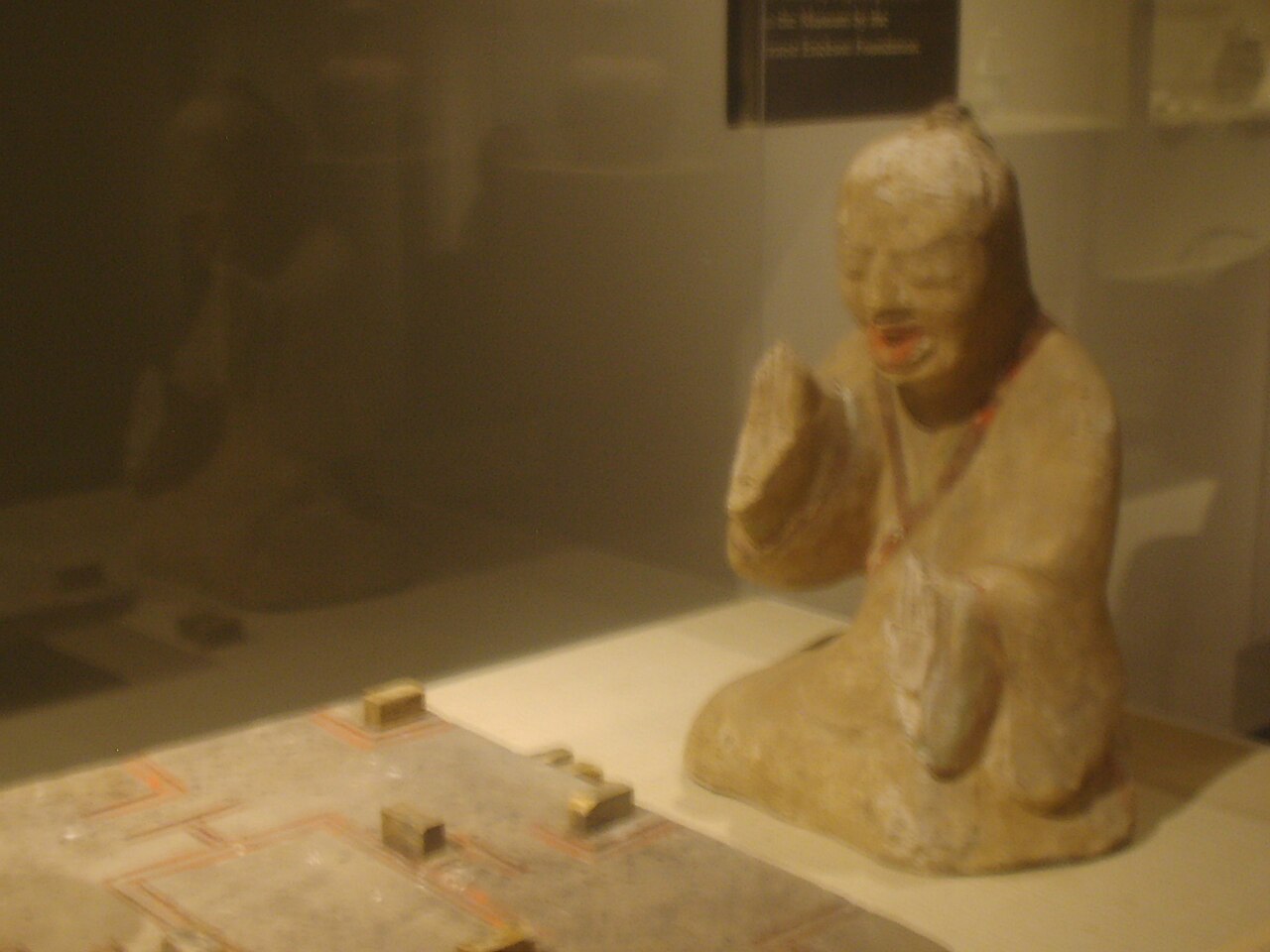
Liubo reached its peak during the Han dynasty. Many high-status tombs from that era contain Liubo boards or game pieces as grave goods. Some tombs also hold pottery or wooden figurines of players with model boards. Engraved picture stones and molded picture bricks, widely used to decorate Han tombs and temples, often show people playing Liubo.
Quick Facts
- L
- six sticks
- P
- liùbó
- W
- liu / 4 / -po / 2
- Mi
- l · iu · 4 · b · o · 2
- Y
- luhkbok
- J
- luk6bok3
- Ci
- l · uk · 6 · . · b · ok · 3
- Mc
- lɨuk̚.pwɑk̚
- Oc-Bs
- kruk pˤak
- Oc-Zz
- ruɡ.paːɡ
Facts from the source article.
Lore & Background
The game of Liubo is not known to have a precise origin, though legend attributes its invention to Wu Cao, a minister to King Jie of the Xia dynasty. Early Chinese records indicate Liubo was already popular by the Warring States period (476–221 BCE). The Records of the Grand Historian mentions a speech from the reign of King Xuan of Qi (reigned 319–301 BCE) claiming the capital Linzi was so wealthy that citizens played Liubo. The mid-3rd century BCE poem 'Summons of the Soul' in the Songs of Chu describes the game: 'Then with bamboo dice and ivory pieces the game of Liu Bo is begun; Sides are taken; they advance together; keenly they threaten each other. Pieces are kinged and the scoring doubled. Shouts of “five white!” arise.' The earliest discovered Liubo boards are a pair of ornately decorated stone boards from a 4th-century BCE tomb in the royal tomb complex of the State of Zhongshan at Pingshan in Hebei.
Reader's Guide
Liubo reached its greatest popularity during the Han dynasty, as evidenced by many boards and game pieces found as grave goods in high-status tombs, as well as pottery or wooden figurines of players and engraved picture stones and bricks depicting the game. After the Han dynasty, Liubo rapidly declined, possibly due to the rise of weiqi (go), and by the Yuan dynasty (1271–1368) all knowledge of the game had been lost. Archaeological discoveries in recent years have revived knowledge of Liubo, including a unique complete set from a 2nd-century BCE tomb at Mawangdui, comprising a lacquered wooden game box, board, twelve cuboid ivory game pieces (six black, six white), twenty smaller ivory pieces, thirty rod-shaped counting chips, twelve ivory throwing rods, an ivory knife and scraper, and an eighteen-sided die. The exact rules remain unknown, and surviving descriptions are conflicting, suggesting the game may have been played in variant forms. Liubo may have spread beyond China, as the Old Book of Tang mentions Tibetans playing it, and the Chinese version of the Mahayana Mahaparinirvana Sutra mentions Liubo, possibly indicating transmission to India, though no boards have been found outside China.
Did You Know?
- The game is named after its six throwing sticks (Liubo means 'six sticks').
- The earliest discovered Liubo boards are from a 4th-century BCE tomb in the State of Zhongshan at Pingshan in Hebei.
- A complete Liubo set from a 2nd-century BCE tomb at Mawangdui includes an eighteen-sided die with numbers 1 through 16 and characters meaning 'win' and 'lose'.
- Some Han dynasty picture stones show two winged immortals playing Liubo on a mountain, often as part of a scene depicting the Queen Mother of the West.
Mysterious Origins and Early Testimony
The exact birth of Liubo remains shrouded in deep antiquity. A traditional legend attributes its invention to Wu Cao, a minister serving King Jie of the Xia dynasty, placing the game's creation around the late second millennium BCE. Yet no archaeological or documentary evidence confirms a Shang dynasty origin, and scholars can only state with confidence that the game existed no later than the middle of the first millennium BCE. By the Warring States period, however, Liubo was firmly embedded in elite leisure culture. The Records of the Grand Historian preserves a boast from the court of King Xuan of Qi, listing Liubo alongside musical performance, cockfighting, and dog racing as pastimes available to the citizens of the wealthy capital Linzi. A mid-third-century BCE poem from the Songs of Chu, the Summons of the Soul, offers a vivid literary snapshot of a game in progress, describing bamboo dice, ivory pieces, players advancing and threatening one another, and the exclamation of five white. The oldest physical boards yet recovered are a pair of ornately carved stone slabs from a fourth-century BCE royal tomb at Pingshan in Hebei, belonging to the State of Zhongshan.
Anatomy of the Board and the Mawangdui Treasure
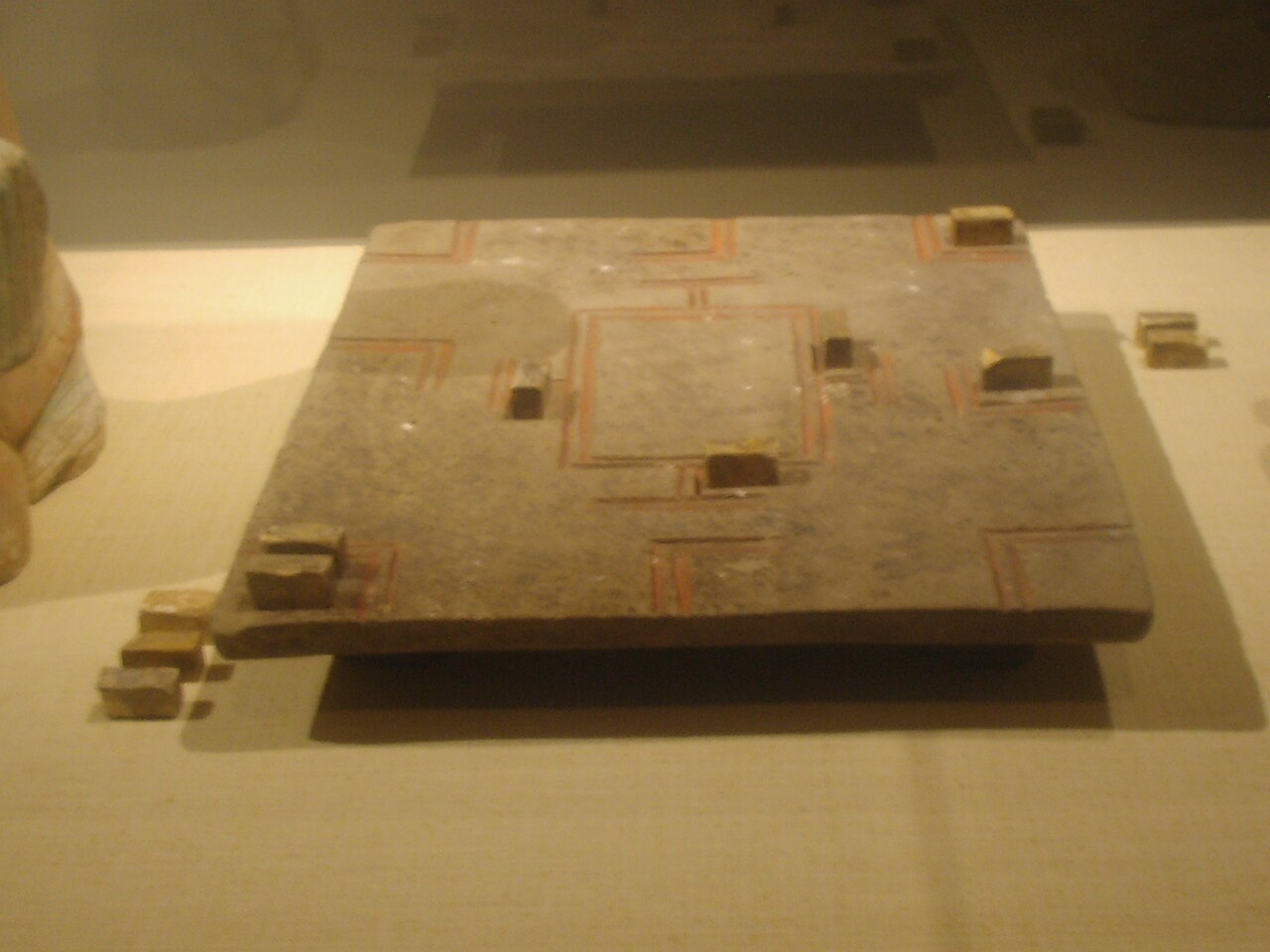
Every surviving Liubo board, regardless of material or era, shares a single defining feature: a symmetrical geometric pattern carved or painted across its surface. The standard layout includes angular V-shaped marks at each corner, L-shaped marks at the midpoint of each edge, a central square, and T-shaped protrusions. Most boards also carry four additional marks, typically circular dots though sometimes decorative motifs, positioned between the corner symbols and the inner square. A few variants replace these dots with straight lines connecting corner to square, and in rare cases the intermediate marks are absent entirely. Boards themselves ranged from plain stone or wooden slabs to elaborate tables with long legs or corner knobs, crafted from wood, lacquered wood, pottery, stone, or bronze. The most remarkable find came in 1973 at Mawangdui, where a second-century BCE tomb believed to belong to the son of the Marquis of Dai yielded a complete game set sealed in a lacquered wooden box measuring forty-five by forty-five by seventeen centimeters. This single discovery, including the board and associated pieces, remains the only fully intact Liubo equipment ever recovered from the ground.
Liubo in the Han World: Status, Art, and the Immortal Realm
During the Han dynasty, Liubo transcended mere pastime and became a marker of social prestige and cosmological imagination. High-status tombs across the empire contained Liubo boards and ivory game pieces as deliberate grave goods, ensuring the deceased could continue playing in the afterlife. Pottery and wooden figurines depicting seated players with miniature boards have also surfaced in Han burial contexts. The visual record is especially rich in the Eastern Han period, when engraved picture stones and moulded picture bricks adorned tombs and temples. In these reliefs, Liubo appears either as a small detail within a bustling multi-activity scene or as the commanding focal point, with players shaded in a pavilion and attended by servants. Perhaps most striking are engravings from Sichuan and Yunnan showing two winged immortals engaged in a game atop a mountain, set within larger compositions featuring the Queen Mother of the West and an entourage of mythical creatures. These images reveal that Liubo was not simply a parlor diversion but a thread woven into the spiritual and aesthetic fabric of Han culture.
Fading, Forgetting, and the Long Road Back
Once the Han dynasty ended, Liubo entered a swift and irreversible decline. No funerary objects or artistic depictions of the game are known after the Jin dynasty, and although the name still surfaces in historical texts and poetry during the Tang era, the game had been effectively supplanted by weiqi, the strategy game later known as Go. By the Yuan dynasty, every practical knowledge of Liubo's rules and equipment had vanished from living memory. Faint traces suggest the game once reached beyond China's borders: the Old Book of Tang records Tibetans enjoying both Go and Liubo, and a Chinese translation of the Mahayana Mahaparinirvana Sutra lists Liubo among pastimes, hinting at possible transmission to India. Yet no board has ever been found outside Chinese territory. The game's modern resurrection is entirely owed to archaeology. Excavations of Han tombs have progressively yielded boards, pieces, figurines, and picture stones, piecing together a picture of a sophisticated two-player race game in which six sticks, functioning as dice, governed the movement of six pieces across a patterned square grid. What was once a forgotten name in classical poetry is now a subject of active scholarly reconstruction.
Gallery
Frequently Asked Questions
What is Liubo?
Liubo is a two-player race game from ancient China in which each competitor advances six pieces along a square board bearing a distinctive symmetrical design. Instead of dice, players used six throwing sticks to determine their moves.
How do you play Liubo?
The precise rules are lost, but we know each player had six pieces moving along marked points on a square board, with six sticks serving the role that dice fill in other race games. Counting chips were also part of the equipment.
When was Liubo popular?
The game had been in existence by the middle of the first millennium BCE at the latest, and it reached its peak of popularity during the Han dynasty, spanning 202 BCE to 220 CE.
Why did Liubo disappear?
After the Han dynasty ended, interest in the game declined rapidly, most likely because weiqi (go) captured the attention of players and gradually supplanted it as the preferred board game.
How do we know Liubo existed?
Archaeological discoveries of boards, game pieces, and throwing sticks have brought this ancient game back to modern attention, even though its full rule set remains unknown.
More in History of board games 1-21
Spotted an error? Know more?
Reader corrections go straight into our review queue. Suggest an edit · How this site is sourced