Alquerque
Strategy board game, parent of draughts and Fanorona.

Sqjaques · CC BY-SA 4.0
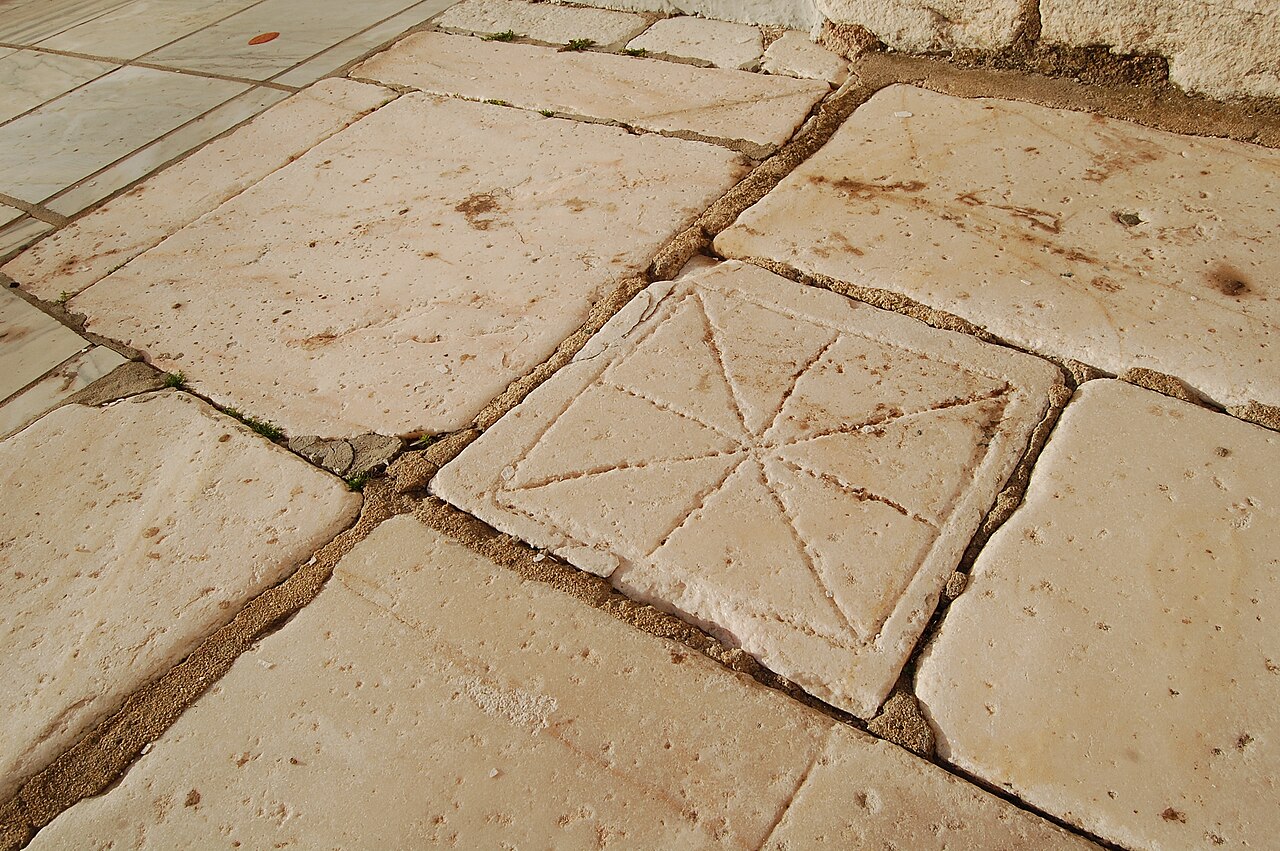
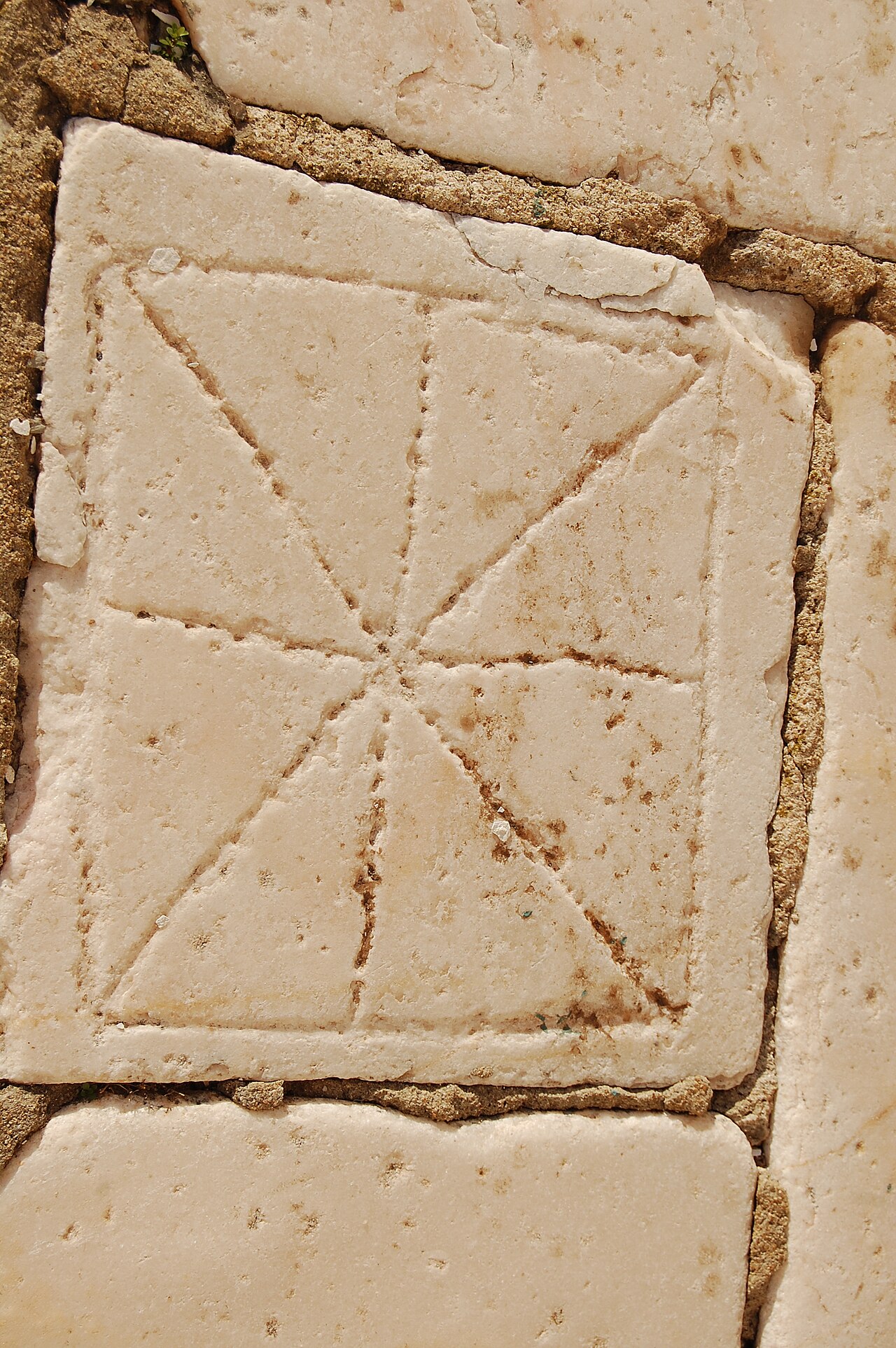
Alquerque, also called al-qirkat, is a strategy board game that likely began in the Middle East. It is regarded as the forerunner of draughts (known as checkers in the United States) and Fanorona, and the diagonal lines on its playing surface paved the way for the checkered pattern on a draughts board.
The game first shows up in written records near the end of the 10th century, when Abu al-Faraj al-Isfahani mentioned qirkat in his 24-volume work *Kitab al-Aghani* ("Book of Songs"). That text, however, did not describe the rules—probably because it was a work of poetry, and the rules were common knowledge among its original audience. According to R. C. Bell's *Board and Table Games from Many Civilizations*, the Moors brought El-quirkat with them when they invaded Spain. Rules later appeared in the 13th-century *Libro de los juegos* ("Book of Games"), commissioned by King Alfonso X of Castile. Spanish settlers in New Mexico later introduced a four-player version of alquerque to the Zuni people.
To set up, each player places twelve pieces on the two rows closest to them, plus the two rightmost spaces in the center row. Players take turns, one using white pieces and the other black. A piece may move from its current point to any empty adjacent point connected by a line. It can also jump over an adjacent opposing piece and remove it, provided the landing point beyond is empty. Multiple captures in a single turn are allowed and are required if possible. If a player can make a capture but does not, that piece is removed from the board (or "huffed"). The aim is to eliminate all of the opponent's pieces.
R. C. Bell later added extra rules, arguing that the ones from Alfonso X were insufficient for actual play. Under Bell's additions, a piece cannot move backward (so a piece in the middle of an empty board would have five possible moves). No piece may return to a point it has already occupied. Once a piece reaches the opponent's back row, it can only move to capture opposing pieces. The game ends when either the opponent has lost all pieces or none of their pieces can move. Bell also devised a scoring system to rate games.
Quick Facts
- Title
- Alquerque
- Italic Title
- no
- Genre
- Board game · Abstract strategy game
- Players
- 2
- Setup Time
- ~1 minute
- Random Chance
- None
- Skills
- Strategy, tactics
- Aka
- Qirkat
Facts from the source article.
Lore & Background
Alquerque first appears in literature late in the 10th century when Abu al-Faraj al-Isfahani mentioned qirkat in his 24-volume work Kitab al-Aghani ('Book of Songs'). That work made no direct mention of the rules, most likely because it is poetry and they would have been common knowledge in the context the book originated in. R. C. Bell writes that 'when the Moors invaded Spain they took El-quirkat with them.' Rules are included in Libro de los juegos ('Book of games') commissioned by Alfonso X of Castile in the 13th century. Spanish settlers in New Mexico introduced a four-player variant of alquerque to the Zuni.
The game is played on a grid of points connected by lines. Before starting, each player places their twelve pieces in the two rows closest to them and in the two rightmost spaces in the center row. A piece can move from its point to any empty adjacent point connected by a line, and can jump over an opposing piece to remove it if the point beyond is empty. Multiple capturing jumps are permitted and compulsory if possible; if a capture is possible it must be made, or else the piece is removed (or huffed). The goal is to eliminate the opponent's pieces.
R. C. Bell developed additional rules, saying those given by Alfonso X 'are not sufficient to play a game.' These extra rules include: a piece cannot move backward; no piece can return to a point it has previously occupied; once a piece has reached the opponent's back row it can only move to capture opposing pieces; and the game is won when either the opponent has lost all pieces or none of the opponent's pieces are able to move. Bell also includes a scoring system for rating games.
Reader's Guide
Alquerque holds a significant place in the history of board games as the recognized parent of draughts (checkers) and Fanorona. Its grid diagonals directly prefigure the checkered pattern of the modern draughts board. The game's earliest known literary reference appears in the late 10th century in Abu al-Faraj al-Isfahani's Kitab al-Aghani, though without explicit rules, suggesting the game was widely understood. Its transmission to Europe occurred through the Moorish invasion of Spain, as noted by R. C. Bell, and formal rules were later recorded in the 13th-century Libro de los juegos commissioned by Alfonso X of Castile. The game also spread to the New World, where Spanish settlers introduced a four-player variant to the Zuni people. The rules themselves, particularly the compulsory capture and the 'huff' penalty for failing to capture, are foundational mechanics that influenced later games. R. C. Bell's additional rules, developed because he found Alfonso X's original rules insufficient for play, further shaped modern understanding of the game. Alquerque's legacy is thus twofold: as a direct ancestor of two major board games and as a key link in the historical chain of strategy games across cultures.
Origins & Historical Documentation
Alquerque is a strategy board game whose roots trace back to the Middle East, though its exact birthplace and era remain uncertain. The earliest surviving literary reference to the game appears in the late tenth century, when the scholar Abu al-Faraj al-Isfahani mentioned qirkat within his monumental twenty-four-volume anthology, Kitab al-Aghani, commonly translated as the Book of Songs. Notably, this text offered no explanation of how the game was actually played. Given that the work was primarily poetic in nature, the omission likely reflects the assumption that the rules were already widely understood among the audience for whom the book was composed. The game's journey westward is tied to the Moorish invasion of the Iberian Peninsula, during which, as R. C. Bell observed, the Moors carried El-quirkat into Spain. By the thirteenth century, the game had become established enough in the Christian kingdoms to warrant inclusion in the Libro de los juegos, a codex of game rules commissioned by King Alfonso X of Castile. This document stands as one of the earliest surviving written rule sets for the game, preserving the mechanics as they were understood in medieval Iberia.
Rules & Gameplay Mechanics
Each player begins with twelve pieces arranged in the two rows nearest to them, plus the two rightmost positions in the center row. Play proceeds in alternating turns, with one side designated white and the other black. On a player's turn, a piece may advance to any empty adjacent point connected by a line on the board. The defining tactical element is the capture: a piece may leap over an immediately adjacent opposing piece and remove it from play, provided the space directly beyond the jumped piece is vacant. Chained captures across multiple jumps are not only allowed but mandatory whenever the opportunity arises. The rules enforce a strict obligation—if a legal capture exists, the player must execute it; failing to do so results in the offending piece being removed from the board, a penalty sometimes called huffing. The ultimate objective is straightforward: reduce the opponent to zero pieces on the grid. This combination of positional movement, compulsory jumping, and elimination creates a game of sharp tactical calculation where every turn demands both offensive and defensive awareness.
Legacy & Influence on Modern Games
Alquerque occupies a foundational position in the genealogy of board games. It is widely regarded as the direct ancestor of draughts, known in the United States as checkers, as well as the Malagasy game Fanorona. The structural link is particularly visible in the board design: the diagonal lines that connect the playing points on an alquerque grid are considered the direct predecessor of the checkered squares that define the modern draughts board. In other words, the very pattern of alternating colors on a checkers board can be traced back to the diagonal connectivity of alquerque's point-and-line layout. This lineage underscores how a single strategic concept—pieces moving along fixed paths with the possibility of jumping and capturing—evolved over centuries into one of the most widely played parlor games in the Western world. The fact that alquerque predates its descendants by many generations makes it a crucial reference point for historians of games, offering a window into the earliest formalized systems of positional strategy that would later inspire entire families of competitive board games across multiple continents.
Cross-Cultural Transmission & Modern Interpretations
Alquerque's influence extended far beyond its original cultural sphere. In the American Southwest, Spanish settlers carried a four-player variant of the game to the Zuni people, introducing a new form of competitive play into their communities. In the modern era, the game has attracted the attention of scholars and developers alike. The game historian R. C. Bell, while acknowledging the rules preserved in Alfonso X's thirteenth-century codex, argued that they were insufficient for a complete and playable game. He proposed a set of supplementary regulations, including restrictions on backward movement, a prohibition against returning to a previously occupied point, and a rule that pieces reaching the opponent's back row become capture-only. Bell also expanded the victory conditions to include a stalemate scenario where no opponent pieces can move, and introduced a scoring system for rating individual games. In the digital age, alquerque has found new life through open-source implementations in Microsoft C#, an Android application, and a browser-based HTML5 and JavaScript version that supports human-versus-AI play, ensuring that this ancient strategy game remains accessible to a global audience.
Gallery




Frequently Asked Questions
What is Alquerque and where did it come from?
Alquerque, also known as al-qirkat, is an ancient two-player strategy board game that most likely originated in the Middle East. It is played on a grid of intersecting diagonal lines and is widely regarded as the direct ancestor of both draughts (checkers) and the Malagasy game Fanorona.
When was Alquerque first mentioned in a written source?
The earliest known literary reference dates to the late 10th century, when Abu al-Faraj al-Isfahani noted qirkat in his 24-volume anthology Kitab al-Aghani. Because that work was a poetry collection, it did not actually spell out the rules of play.
How does Alquerque connect to modern checkers or draughts?
Alquerque's diagonal-line grid is the direct precursor to the alternating colored squares on a draughts board. The game's structure and movement principles evolved over centuries into what we now call checkers in the United States and draughts elsewhere.
How many pieces does each player use in Alquerque?
Each player fields 12 pieces on the board. The contest is a pure strategy duel in which players maneuver their pieces along the diagonal lines to capture the opponent's.
Where can I find the earliest surviving written rules for Alquerque?
The first detailed rules description appears in the Libro de los juegos, a manuscript commissioned by Alfonso X of Castile in the 13th century. That text laid out the board layout, piece count, and movement mechanics that distinguish Alquerque from simpler path games.
More in History of board games 1-21
Spotted an error? Know more?
Reader corrections go straight into our review queue. Suggest an edit · How this site is sourced