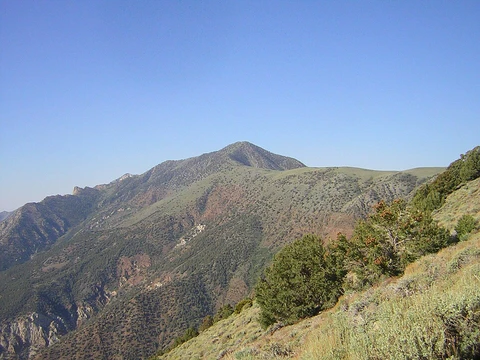
Mount Redoubt
Active stratovolcano and highest summit in the Aleutian Range.

via Wikipedia: Mount Redoubt · see source
Redoubt Volcano, also called Mount Redoubt and known in Dena'ina as Bentuggezh K’enulgheli, is an active stratovolcano in Alaska's Aleutian Range. It sits at the head of the Chigmit Mountains within Lake Clark National Park and Preserve, just west of Cook Inlet in the Kenai Peninsula Borough, about 110 miles southwest of Anchorage. Rising 10,197 feet, it gains 9,150 feet of prominence over its surroundings in just over five miles, making it the highest peak in the Aleutian Range. The National Park Service named it a National Natural Landmark in 1976.
Quick Facts
- Elevation (ft)
- 10197
- Prominence (ft)
- 9147
- Range
- Chigmit Mountains, Aleutian Range
- Listing
- North America prominent 22nd
- Location
- Lake Clark National Park and Preserve, Kenai Peninsula Borough, Alaska, United States
- Formed by
- Subduction zone volcanism
- Age
- 890,000 years
- Volcanic arc
- Aleutian Arc
Facts from the source article.
Did You Know?
- The 1989 eruption caught KLM Flight 867 in its plume; the plane descended 13,000 feet before pilots restarted the engines and landed safely at Anchorage.
- As of 2018, the US Geological Survey rated Mount Redoubt a 'very high threat' to people and infrastructure.
Name
The official name of the mountain is Redoubt Volcano, a translation of the Russian name "Sopka Redutskaya", referring to, as does the word "redoubt", "a fortified place". A local name, "Ujakushatsch", also means "fortified place", but it is difficult to determine if one name is derived from the other. The Board on Geographic Names decided on the name "Redoubt Volcano" in 1891. The Global Volcanism Program of the Smithsonian Institution refers to the mountain simply as "Redoubt", and lists these alternate names: Burnt Mountain, Goreloi, Mirando, Ujakushatsch, Viesokaia, and Yjakushatsch. The Alaska Volcano Observatory also uses simply "Redoubt"; it lists the same alternate names in addition to: Goryalaya, Redoute Mtn., and Redutskaya, Sopka.
Geology
The volcano is about 3.7 mi in diameter at its base with a rough volume of 7.2. The sides of the upper cone are relatively steep (in comparison to volcanoes in general). Made up of pyroclastic flow deposits and lava flows, and resting on Mesozoic era rocks of the Aleutian Mountain Range batholith, the mountain has been somewhat weathered by movement of several glaciers that reside on it. The current main vent is on the north side of the crater by the head of the Drift glacier. Also present on the mountain are Holocene lahar deposits that extend as far as the Cook Inlet. This mountain has produced andesite, basalt and dacite, with relatively silicic andesite dominant in recent eruptions. The earliest eruptions of the volcano were approximately 888,000 years ago. The current volcanic cone started to build 340,000 years ago.
Eruptions
Captain James Cook saw Mt. Redoubt during the summer of 1778, describing it as "emitting a white smoke but no fire which made some think it was no more than a white thick cloud such as we have frequently seen on the Coast, for the most part appearing on the sides of hills and often extends along a whole range and at different times falls or rises, expands or contracts itself and has a resemblance to Clouds of white smoke. But this besides being too small for one of those clouds, remained as it were fixed in the same spot for the whole time the Mountain was clear which was above 48 hours."
However, several sources call this a "discredited eruption". In 1819, smoke was observed at the mountain, but this is often not recorded as an eruption as the information was insufficient to identify it as such. There was apparently an eruption described in 1881 when "a party of native hunters half-way up its slopes were overwhelmed by a lava-flow and only two escaped," though this eruption is not well documented by other sources. The volcano erupted rather abruptly in 1902, spewing out ash from January 18 to June 21.
A local newspaper stated, "Word has just been received that Redoubt, one of the volcanoes at Cook's Inlet had an eruption on January 18, and the country for 150 mi around was covered with ashes and lava." The eruption in 1989 spewed volcanic ash to a height of 45,000 ft. It caught KLM Flight 867, a Boeing 747 aircraft, in its plume. After the plane descended 13,000 feet, the pilots restarted the engines and landed the plane safely at Anchorage.
The ash blanketed an area of about 7,700 mi2. The 1989 eruption is also notable for being the first ever volcanic eruption to be successfully predicted by the method of long-period seismic events developed by Swiss/American volcanologist Bernard Chouet. Mount Redoubt erupted explosively late in the evening of March 22, 2009. AVO recorded numerous volcanic eruptions and/or explosions at Redoubt volcano from March 22 through April 4.
External links and resources
The Alaska Volcano Observatory provides live updates and reports on volcanic activity, including via its Twitter page. Webcams include the Redoubt Volcano Webcam from the USGS, viewing the north flank from the Redoubt Hut about 7.5 mi from the summit crater, and the Redoubt-CI webcam from Chevron via the Alaska Volcano Observatory, viewing the northeast face from an oil platform in Cook Inlet. A daily time-lapse animation of the Mount Redoubt Hut Web Cam is available, as are near-real-time seismic records from a station near the peak. Satellite imagery of the March 2009 eruptions and a time-lapse video from Ninilchik are also accessible.
More in Highest Points of United States National Parks
Spotted an error? Know more?
Reader corrections go straight into our review queue. Suggest an edit · How this site is sourced