Self-healing
Recovery motivated and directed by the patient, often guided by instinct.

Self-healing is the process by which a person recovers from psychological disturbances or trauma, driven and directed by their own motivation, often relying solely on instinct. Because it is an amateur undertaking, the results can be unpredictable, though self-motivation itself is a significant advantage. The main benefit of this approach is that it can be customized to fit an individual’s specific experiences and needs. Introspective practices like meditation can support and speed up the process.
The term "self-healing" has several meanings. It can refer to the body’s automatic, homeostatic processes, which are governed by inherent physiological mechanisms. Disorders of the spirit or a lack of faith may also be addressed through self-healing. Figuratively, self-healing properties are attributed to systems or processes that naturally or by design correct disruptions—for example, skin regenerating after a cut or a limb regrowing. In such cases, the injured living organism repairs itself.
Beyond the body’s innate restorative abilities, psychological factors can influence self-healing. Hippocrates, often regarded as the father of medicine, noted that a physician must not only fulfill their own duties but also ensure the cooperation of the patient, attendants, and external factors. Self-healing can also be achieved through deliberately applied psychological methods, which may improve both mental and physical conditions. Research confirms that techniques such as relaxation, breathing exercises, fitness routines, imagery, meditation, yoga, qigong, tai chi, biofeedback, and various forms of psychotherapy can facilitate this.
Proposed mechanisms for self-healing include reductions in stress hormones that otherwise impair physiological functions during chronic stress; decreased muscle tension, which can cause pain in muscles, tendons, and joints when chronic and stress-related; improved sleep through relaxation, enhancing physiological functions; and relief from emotional tensions like depression and anger, which can damage social relationships and work performance, creating cycles of worsening psychological symptoms.
The concept of self-healing is closely related to self-help, which Kathryn Schulz described in 2013 as an $11 billion industry.
- Field
- Psychology, medicine, self-help
- Known for
- Process of recovery motivated by the patient, often guided by instinct; includes psychological and physical self-healing mechanisms
- Related concepts
- Self-help, meditation, yoga, biofeedback, psychotherapy
Lore & Background
Self-healing encompasses both automatic homeostatic processes of the body and deliberately applied psychological mechanisms. The process encounters mixed fortunes due to its amateur nature, although self-motivation is a major asset. Hippocrates observed that the physician must secure the co-operation of the patient, attendants, and externals. Self-healing may also be achieved through relaxation, breathing exercises, fitness exercises, imagery, meditation, yoga, qigong, tai chi, biofeedback, and various forms of psychotherapy.
Reader's Guide
Self-healing is significant as a concept that bridges innate bodily repair and intentional psychological recovery. It includes decreases in stress hormones, muscle tension, improved sleep, and improvements in emotional tensions such as depression and anger. The term is also used figuratively for systems that correct disturbances, such as skin regeneration. In 2013, Kathryn Schulz examined self-help, a related phrase, as an $11 billion industry. The concept remains important for its emphasis on patient-directed recovery and the integration of psychological and physical health.
Did You Know?
- Self-healing can be helped and accelerated with introspection techniques such as meditation.
- Self-healing may involve decreases in stress hormones, muscle tension, and improvements in sleep and emotional tensions.
- In 2013, Kathryn Schulz examined self-help as an $11 billion industry.
The Ordered Cascade of Tissue Repair
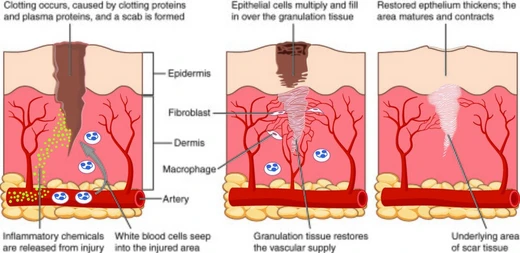
When intact skin is breached, the body launches a tightly choreographed biochemical response to replace the lost tissue. The process unfolds through predictable phases. First comes hemostasis: within minutes of injury, platelets adhere to the wound site, shift into a more amorphous shape, and release chemical signals that activate fibrin. The fibrin weaves a mesh that glues platelets together, forming a clot that seals the broken vessel and halts bleeding. Next, the inflammatory phase clears away dead cells, bacteria, and debris through phagocytosis performed by white blood cells. Platelet-derived growth factors released during this stage set the stage for the next wave. In the proliferative phase, new blood vessels sprout, fibroblasts lay down a provisional extracellular matrix of collagen and fibronectin, epithelial cells crawl across the wound bed to re-cover the surface, and myofibroblasts grip the wound edges and contract them inward. Finally, during maturation, collagen fibers realign along lines of mechanical tension, and cells that have served their purpose are eliminated through apoptosis.
When the Process Breaks Down
Despite its elegance, the wound-healing cascade is remarkably fragile and can be interrupted or derailed, giving rise to non-healing chronic wounds. Several systemic conditions are known to sabotage the repair sequence. Diabetes impairs the body's ability to mount an effective healing response. Venous and arterial disease compromise the blood supply that delivers oxygen and nutrients to the wound site. Infection introduces foreign pathogens that overwhelm the inflammatory cleanup phase, while the metabolic deficiencies that accompany old age reduce the cellular machinery needed for proliferation and remodeling. When any of these factors persist, the orderly progression from clotting through remodeling stalls, and the wound remains open indefinitely. This vulnerability is precisely why wound care exists as a clinical discipline: it works to clean the wound, protect it from reinjury and further infection, and thereby encourage and accelerate the body's own repair mechanisms. Depending on the severity of the injury and the patient's overall health, that care can be as simple as basic first aid or as complex as the full spectrum of specialized nursing found in wound, ostomy, and continence units or dedicated burn centers.
A Two-Phase View of Cellular Coordination
While the classic four-stage model remains useful, a complementary framework divides wound healing into two broader phases that more clearly delineate the cellular events involved. The early phase begins the instant the skin is injured and is dominated by cascading molecular and cellular events that achieve hemostasis and construct an early, makeshift extracellular matrix. This provisional scaffold provides the structural staging necessary for cells to attach and begin proliferating. The cellular phase that follows is a tightly timed collaboration among several cell types. Within one to two days, macrophages and other inflammatory components arrive to clear debris and release signaling molecules. Re-epithelialization begins almost immediately, with a phenotype change within hours and visible migration by day one or two. Between days four and fourteen, fibroblasts and myofibroblasts progressively align, produce collagen, and contract the matrix. Endothelial cells initiate angiogenesis around day four, and the dermal matrix undergoes fabrication for roughly two weeks before entering a remodeling period that can last weeks to months, depending on the wound's size. This two-phase construct has proven particularly valuable in regenerative medicine and tissue engineering, where understanding the precise timing of each cellular contribution is essential for designing effective interventions.
The Race Between Regeneration and Scarring
One of the most consequential variables in wound healing is the speed at which the epithelial layer re-covers a denuded wound area. If re-epithelialization proceeds slowly, the body defaults to a scar-forming pathway, and the repair may take many weeks or even months to complete. Conversely, when epithelial cells migrate and proliferate rapidly over the wound bed, the outcome shifts toward true regeneration rather than scarring. This timing sensitivity underscores why the proliferative phase is so critical: it is during this window that epithelial cells crawl atop the new granulation tissue, providing a protective cover, while myofibroblasts simultaneously reduce the wound's size by gripping its edges and contracting through a mechanism that closely resembles smooth-muscle contraction. Once the cells have fulfilled their roles, unneeded cells are removed through programmed cell death, or apoptosis, a cleanup step that also features prominently in the final maturation phase. Understanding this delicate balance between speed and thoroughness is central to both basic wound biology and the clinical strategies that aim to tip the outcome toward regeneration.
Frequently Asked Questions
What is Self-healing?
Self-healing is a recovery process in which an individual takes full ownership of working through psychological trauma or disturbance, steering the journey with personal drive and instinct rather than professional guidance. It covers both mental and physical recovery and sits alongside practices like self-help, biofeedback, and yoga.
How does Self-healing differ from professional therapy?
Unlike structured psychotherapy, self-healing is a self-directed, amateur effort where the person sets the pace and relies on internal motivation as the primary engine. This independence makes outcomes less predictable, yet it also allows the approach to be shaped precisely around one person's unique history and triggers.
What practices can support the Self-healing process?
Introspective activities such as meditation, yoga, and biofeedback are commonly used to complement and accelerate natural self-recovery. These tools help the individual stay attuned to the body's homeostatic mechanisms while working through psychological distress.
What is the main advantage of Self-healing over other approaches?
Its greatest strength is deep personalization—because the individual is simultaneously patient and practitioner, the process naturally adapts to their specific experiences and needs. Self-motivation also acts as a powerful internal driver that sustains progress even without external accountability.
Where does Self-healing fit in the broader field?
It occupies a space at the intersection of psychology, medicine, and the self-help movement, bridging clinical concepts like homeostasis with everyday practices people can try on their own. It is typically discussed alongside related ideas such as yoga, biofeedback, and psychotherapy as a complementary rather than replacement approach.
More in Healing 1-19
Spotted an error? Know more?
Reader corrections go straight into our review queue. Suggest an edit · How this site is sourced