Regeneration (biology)
Regeneration is the process of renewal and tissue growth across species.

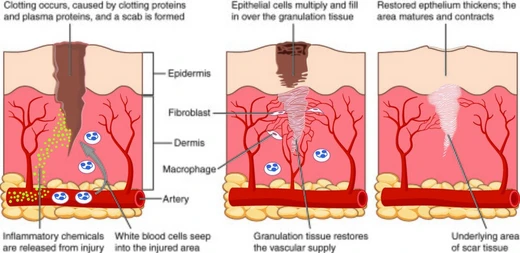
Regeneration is the biological process by which living things repair, replace, or regrow tissues, cells, or body parts. It helps organisms—from bacteria to humans—bounce back from injury or natural disturbances. Regeneration can be complete, meaning the new tissue matches what was lost, or incomplete, where scar tissue forms instead.
At the most basic level, regeneration is driven by gene regulation and involves cell division, shape formation, and cell specialization. But in biology, the term usually refers to the larger-scale processes that let multicellular organisms fix and maintain their bodies. These processes are controlled by cellular activities, not just genetics. Regeneration is not the same as reproduction: hydra can regenerate, but they reproduce by budding.
The process happens in two main phases. First, after an amputation, skin cells move in to form a wound covering. This covering thickens as cells divide, creating a cap over the injury. Underneath, cells from skin, muscle, and cartilage start dividing rapidly and lose their specialized identities, becoming more like stem cells. These de-differentiated cells multiply until there are enough, then they re-specialize into the same types they were before—skin becomes skin, muscle becomes muscle. This forms a cone-shaped structure called a blastema. Once the blastema flattens out, the second phase begins: the missing limb or part is rebuilt. Genes direct cells to form the correct structures, and the result is a new limb that looks and works just like the original, with no visible sign it was regrown.
Hydra and planarian flatworms are classic examples because of their powerful regenerative abilities. When injured, their cells activate and restore organs to their original state. Among vertebrates, salamanders and newts (the group Caudata) are especially good at regeneration, regrowing limbs, tails, jaws, eyes, and internal organs. Many animals can also reproduce asexually through fragmentation, budding, or fission—a planarian, for instance, can split in half, and each half grows into a complete clone.
Sea stars, crayfish, many reptiles, and amphibians show striking regeneration. Some use autotomy, deliberately detaching a limb or tail to escape a predator. After the part is shed, cells move in and regrow it. In some cases, a lost limb can even grow into a whole new individual.
- Field
- Biology
- Known for
- Process of renewal, restoration, and tissue growth; includes epimorphosis, morphallaxis, and ecosystem regeneration
- Types
- Physiological (homeostatic) and reparative; epimorphosis and morphallaxis
- Model organisms
- Hydra, planarian flatworm, Caudata (salamanders and newts)
- Key phases
- Preparation phase and redevelopment phase
Lore & Background
Regeneration is mediated by molecular processes of gene regulation and involves cell proliferation, morphogenesis, and cell differentiation. The regenerative process occurs in two multi-step phases: the preparation phase and the redevelopment phase. Regeneration begins with an amputation that triggers the first phase, during which migrating epidermal cells form a wound epithelium that thickens into a cap. Cells underneath rapidly divide and form a blastema, containing skin, muscle, and cartilage cells that de-differentiate and become similar to stem cells. These cells divide until enough are available, then differentiate again, and the blastema flattens, initiating the second phase of limb redevelopment. The hydra and planarian flatworm have long served as model organisms for their highly adaptive regenerative capabilities. The Caudata (salamanders and newts) is possibly the most adept vertebrate group at regeneration, capable of regenerating limbs, tails, jaws, eyes, and internal structures. Echinoderms, crayfish, many reptiles, and amphibians exhibit remarkable tissue regeneration. In reptiles, many lizards, geckos, and iguanas possess regeneration capacity, often involving tail autotomy as a defense mechanism.
Reader's Guide
Regeneration is a fundamental biological process that enables organisms to repair and maintain physiological and morphological integrity. It is distinct from reproduction, as seen in hydra which perform regeneration but reproduce by budding. The process involves two main types: physiological regeneration (cell renewal during normal aging) and reparative regeneration (restoring function after injury). Reparative regeneration includes epimorphosis, where proliferation precedes new tissue development, and morphallaxis, where existing tissue is re-patterned with little new growth. Epimorphic regeneration can be further divided into compensatory regeneration (e.g., liver regeneration) and blastema-mediated regeneration (e.g., salamander limb regrowth). Ecosystems also exhibit regeneration, as after disturbances like fire, pioneering species occupy and establish themselves in newly opened habitats. The study of regeneration has implications for understanding tissue repair, developmental biology, and potential medical applications, though mammals have limited reparative capabilities compared to organisms like salamanders and planarians.
Did You Know?
- Every species is capable of regeneration, from bacteria to humans.
- Hydra perform regeneration but reproduce by the method of budding.
- The Caudata (salamanders and newts) can regenerate limbs, tails, jaws, eyes, and a variety of internal structures.
- In reptiles, many lizards, geckos, and iguanas possess regeneration capacity, often involving dropping a section of their tail as a defense mechanism.
The Two-Phase Architecture of Limb Regrowth
When a limb is severed, the organism launches a coordinated two-stage program that ultimately rebuilds the missing structure from scratch. The preparation phase kicks off almost immediately: epidermal cells migrate to the wound site and form a protective epithelial cap, which thickens as cells divide beneath it. Underneath this cap, a remarkable transformation unfolds. Skin, muscle, and cartilage cells reverse their specialization, adopting a stem-cell-like state that grants them the flexibility to become multiple cell types. These de-differentiated cells proliferate rapidly, building up a cone-shaped mass called a blastema. Once sufficient cell numbers are reached, the blastema flattens and the second phase—redevelopment—begins. At this stage, genetic signals direct each cell to re-specialize into its original role. The outcome is a fully functional limb that is virtually indistinguishable from the one lost, with no visible scar or mark betraying its recent reconstruction. The entire process is orchestrated by gene regulation, cell proliferation, morphogenesis, and differentiation working in concert.
A Spectrum of Regenerative Mastery Across Species
Regenerative capacity varies enormously across the tree of life, and certain lineages have become iconic for their extraordinary abilities. The hydra and the planarian flatworm have long served as laboratory workhorses because their cells, once activated by injury, can restore entire organs to their pre-wound configuration. Among vertebrates, the order Caudata—salamanders and newts—stands out as perhaps the most accomplished, capable of rebuilding limbs, tails, jaws, eyes, and even internal organs. Echinoderms like sea stars, crayfish, and many reptiles also display striking tissue regrowth. In the lizard world, geckos and iguanas commonly shed a tail section when grabbed by a predator and then regrow a replacement, while chelonians, crocodilians, and snakes lack this ability entirely. Fishes show only limited limb regrowth, and frogs regenerate tails only during their larval stage. Remarkably, in some species a detached limb can itself grow into a brand-new individual, blurring the line between repair and reproduction.
Taxonomy of Repair: Epimorphosis, Morphallaxis, and Molecular Triggers
Biologists sort regenerative strategies into several mechanistic categories. Epimorphic or compensatory regeneration relies on the direct proliferation of already-differentiated cells rather than stem cells; the liver's ability to restore lost volume through hepatocyte division is the classic example, though it does not rebuild the organ's original shape. Blastema-mediated epimorphic regeneration, by contrast, recruits lineage-restricted progenitor cells into a growing blastema that matures and reshapes the missing structure—this is the pathway used by salamanders regrowing limbs and by human fingertips recovering from full-thickness wounds. Morphallaxis takes a different route: existing tissue is re-patterned with minimal new growth, a strategy common among invertebrates. At the molecular level, the process draws on the same genetic toolkit used during embryonic development. Neural cells, for instance, upregulate growth-associated proteins like GAP-43, tubulin, actin, neuropeptides, and cytokines to coordinate the physiological response. Many genes that originally directed tissue formation are reinitialized during repair, effectively replaying developmental programs in an adult body.
Regeneration Beyond the Individual: Ecosystems and the Repair-Reproduction Boundary
Regeneration is not confined to single organisms; it operates at the level of entire ecosystems. After a forest fire or a pest outbreak strips away mature vegetation, pioneering species move in, compete for the newly available space, and establish themselves. The subsequent growth of seedlings and the gradual reassembly of a functional community is what ecologists term regeneration. This ecological parallel mirrors the cellular logic of repair: a disturbance creates an opening, and a structured, multi-step process rebuilds complexity. It is also important to keep regeneration distinct from reproduction. A hydra, for example, regenerates damaged tissue but reproduces through budding; a planarian can split in two, with each half growing a new end, yet that fragmentation is asexual reproduction rather than repair. Every species from bacteria to humans possesses some form of regenerative capacity, and the outcome can be complete—new tissue matching the lost tissue exactly—or incomplete, leaving behind fibrotic scar tissue where necrotic material was once present.
Frequently Asked Questions
What is Regeneration (biology)?
It is the biological mechanism by which organisms repair, replace, or regrow damaged tissues, cells, or even entire body parts. It spans everything from bacterial recovery to human wound healing and splits into two broad categories: physiological (maintaining daily cell turnover) and reparative (fixing injury).
What are Regeneration (biology)'s core abilities and how do they work?
The process is driven by gene regulation orchestrating cell division, shape formation, and cell specialization to rebuild lost structures. Depending on the organism, the outcome can be complete regeneration (epimorphosis), where new tissue matches the original, or incomplete regeneration (morphallaxis), where the body reorganizes existing material rather than growing a full replica.
Who are the fan-favorite model organisms in the Regeneration (biology) 'universe'?
Hydra, planarian flatworms, and Caudata (salamanders and newts) are the go-to species studied in regeneration research. Hydra can regrow its entire body from a small fragment, while axolotls—a Caudata—can regrow limbs with full nerve and muscle function.
How does Regeneration (biology)'s 'story' unfold step by step?
The process typically moves through a preparation phase, where the wound is cleaned and signaling molecules are released, followed by a redevelopment phase in which cells proliferate, differentiate, and reassemble the missing structure. In some contexts the concept even scales up to whole-ecosystem recovery after a disturbance.
Why is Regeneration (biology) important to the healing field?
It is the foundational concept behind every repair and renewal process in living systems, from skin closing over a cut to a newt regrowing a leg. Understanding its mechanisms—epimorphosis, morphallaxis, and ecosystem-level renewal—directly drives medical research into tissue engineering and regenerative medicine.
More in Healing 1-19
Spotted an error? Know more?
Reader corrections go straight into our review queue. Suggest an edit · How this site is sourced