Scar free healing
Healing without permanent tissue damage through complete regeneration.

Scar free healing is the process by which significant injuries can heal without permanent damage to the tissue, involving complete regeneration rather than scar formation. It occurs in fetal life but progressively diminishes into adulthood, and is observed in certain animals such as amphibians, notably the adult axolotl.
- Field
- Wound healing and tissue regeneration
- Known for
- Complete tissue regeneration without scarring, observed in fetal mammals and certain amphibians
- Key mechanisms
- Blastema formation, anti-inflammatory macrophages, high hyaluronic acid levels, rapid fibronectin and tenascin deposition
Lore & Background
Scar free healing has been documented in fetuses across the animal kingdom, including mice, rats, monkeys, pigs, and humans. The ability is wound size dependent and age-dependent, with scar formation typically occurring after about 24 weeks gestation in humans. Research has focused on the underlying mechanisms separating scarless fetal wound repair from adult wound healing, including the role of the extracellular matrix, inflammatory response, and specific growth factors.
In other animals, such as urodele amphibians (salamanders), complete regeneration of limbs, tails, and internal organs occurs into adulthood through blastema formation. This process involves a wound cap of epithelial cells, innervation, and the reversion of differentiated cells to mesenchymal cells. Anti-inflammatory macrophages have been shown to be key to their regeneration capabilities; limbs would not regenerate in urodeles with depleted macrophages and instead would scar with permanent loss of functionality.
The intrauterine environment was originally thought responsible for fetal scar free healing, but this theory was discredited by studies on marsupial pouch wounds, which healed without scarring despite exposure to maternal faeces and urine. Differences between fetal and adult healing include the fetal immune system being 'immunologically immature' with reduced neutrophils, macrophages, and inflammatory mediators, and fetal fibroblasts migrating faster and synthesizing collagen simultaneously, unlike adult fibroblasts where collagen synthesis is delayed.
Reader's Guide
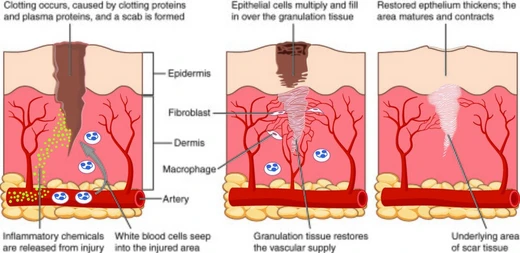
Scar free healing represents a significant area of biomedical research because scarring creates both physical and psychological problems and is a significant clinical burden. Severe scarring, known as hypertrophic scarring, has an incidence ranging from 32–72% worldwide. Understanding how regeneration occurs in animals such as urodeles may have great implications for how wound-healing is tackled in medicine. Key differences identified between scarless fetal healing and adult scarring include the rapid expression of cell adhesion proteins like fibronectin and tenascin in fetal wounds, higher levels of hyaluronic acid which down-regulates pro-inflammatory cytokines, and gene expression profiles showing up-regulation in genes associated with cell growth and proliferation in scarless healing. The ability of fetal fibroblasts to migrate faster and synthesize collagen simultaneously contrasts with adult healing where collagen deposition is delayed, contributing to scar formation. Research has been aimed at this area to potentially translate these mechanisms into clinical therapies.
Did You Know?
- Scar free healing occurs in fetal life but the ability progressively diminishes into adulthood.
- The adult axolotl can regenerate skin without scarring through blastema formation.
- Fetal fibroblasts can migrate and synthesize collagen simultaneously, unlike adult fibroblasts where collagen synthesis is delayed.
Frequently Asked Questions
What is Scar free healing?
Scar free healing is a regenerative process in which a significant wound is fully restored to its original tissue architecture, leaving no scar behind. Rather than patching the damage with fibrous tissue, the body rebuilds the structure from scratch.
In which organisms does Scar free healing occur?
It is a hallmark of fetal mammals, where wounds close seamlessly during development. Among adult animals, the most celebrated example is the axolotl, an amphibian that retains this ability throughout its entire lifespan.
What mechanisms drive Scar free healing?
Several coordinated processes are at work: a blastema of undifferentiated cells forms at the wound site, anti-inflammatory macrophages keep the environment from tipping into fibrosis, and the local matrix is rich in hyaluronic acid, fibronectin, and tenascin. Together these factors steer regeneration instead of scar deposition.
Why do humans lose this ability as we grow?
The capacity for scar-free repair is robust during fetal life but steadily declines through infancy and childhood until it is essentially gone in adulthood. The shift is tied to a change in macrophage behavior and a drop in the regenerative extracellular-matrix factors that fetal tissue normally maintains.
Why is Scar free healing important to the field of wound healing and tissue regeneration?
It represents the biological ceiling for what a wound can achieve—perfect restoration rather than compromise. Understanding its mechanisms gives researchers a blueprint for engineering therapies that coax adult human tissue back into that fetal-like regenerative mode.
More in Healing 1-19
Spotted an error? Know more?
Reader corrections go straight into our review queue. Suggest an edit · How this site is sourced