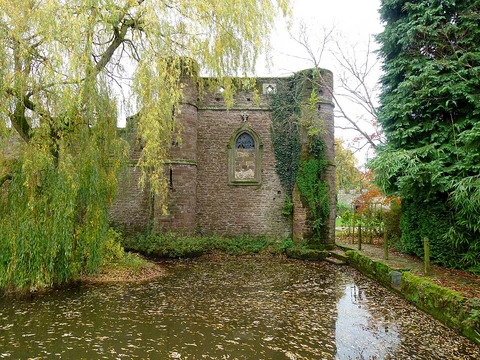
Hawarden Castle (18th century)
Mid-18th-century house, later Gothicised, home of William Gladstone.
Last updated
The mid-18th-century house known as (New) Hawarden Castle, or Castell Penarlâg (Newydd), stands in Hawarden, Flintshire, Wales. Originally owned by Catherine Glynne’s family, it became the estate of her husband, former prime minister William Ewart Gladstone. The building was later expanded and given a Gothic exterior makeover.
Quick Facts
- Location
- Hawarden, Flintshire, Wales
- Original construction
- 1752–57
- Original architect
- Samuel Turner the elder of Whitchurch, Shropshire
- Original client
- Sir John Glynne, 6th baronet
- Gothic revival remodelling
- 1809–1810
- Remodelling architect
- Thomas Cundy the elder
- Notable resident
- William Ewart Gladstone
Facts from the source article.
History
The mansion at the core of today’s Hawarden Castle was built between 1752 and 1757 for Sir John Glynne, the 6th baronet, based on plans by Samuel Turner the elder of Whitchurch, Shropshire. It sits very near the site of the original medieval castle, replacing the 16th-century Broadlane Hall—home of the Ravenscroft family—which stood a bit to the south. Glynne had come into the estate through marriage. The original structure was brick with stone trim, three storeys high and seven bays wide, featuring a central three-bay pediment.
Two matching side pavilions were envisioned but may never have been finished. Sir Stephen Richard Glynne, the 8th baronet, inherited the property in the early 1800s. Between 1809 and 1810, he hired London architect Thomas Cundy the elder to enlarge the house and completely redo its exterior in a crenellated Gothic Revival style, though the Georgian interiors stayed intact. After his early death, the 9th baronet, also named Sir Stephen Glynne, carried on with improvements.
He served as Lord Lieutenant of Flintshire and as MP for Flint Boroughs (1832–1837) and then for the County of Flint (1837–1847). Around 1830, he shifted the main entrance from the south side to the north and added a vaulted porch. When the 9th baronet died in June 1874, the estate went to his brother-in-law, Liberal politician William Gladstone. During Gladstone’s time there, further changes were made: a library wing designed by George Shaw of Saddleworth went up in the mid-1860s, a muniment room for his papers was added in 1887–88, and the porch was enlarged in 1889—the last two projects by Douglas and Fordham.
In 1896, Archbishop of Canterbury Edward White Benson died at the castle, and his body was taken by train from nearby Sandycroft station back to London. That same year, the castle hosted Qing dynasty reformer Li Hongzhang during his diplomatic tour of Britain.
More in Grade I Listed Castles in Wales
Sources
Compiled from Wikipedia and the sources listed below. Text from Wikipedia is available under CC BY-SA 4.0; this entry is adapted from it.
- Wikipedia: Hawarden Castle (18th century) (CC BY-SA 4.0).
Spotted an error? Know more?
Reader corrections go straight into our review queue. Suggest an edit · How this site is sourced