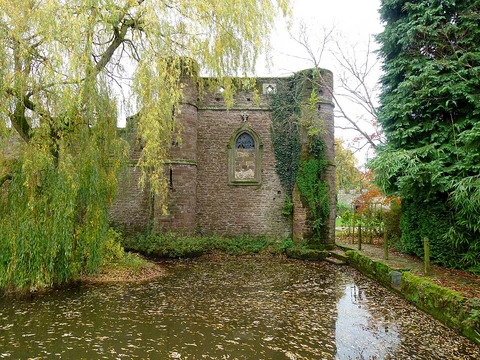
Ogmore Castle
Grade I listed Norman castle ruin in the Vale of Glamorgan.
Last updated
Ogmore Castle (Castell Ogwr) is a Grade I listed castle ruin in the Vale of Glamorgan, Wales, sitting on the south bank of the Ewenny River and the east bank of the River Ogmore. Its construction might have begun in 1106, and it was one of three castles built in the area in the early 12th century, the others being Coity Castle and Newcastle Castle. It was in use until the 19th century for purposes including a court of justice and a prison, but is now a substantial set of remains and a local landmark. The castle is owned by the Duchy of Lancaster and managed by Cadw, with free admission at all reasonable times.
Quick Facts
- Grade
- I listed
- Location
- Near Ogmore, Vale of Glamorgan, Wales
- Owner
- Duchy of Lancaster
- Managed by
- Cadw (Welsh Historic Monuments)
- Admission
- Free
Facts from the source article.
History
Construction of the Norman castle might have started around 1106, but its foundation predates the Norman Invasion of Wales, as archaeological remains of earlier structures include two parts of two stone crosses. One remnant, now in the National Museum of Wales, bears inscriptions in Latin, one of which translates as "Be it [known to all men] that Arthmail gave (this) field to God and Glywys and Nertat and his daughter." According to Caradoc of Llancarfan's work, the manor and castle were given to William de Londres, one of the legendary Twelve Knights of Glamorgan, by Robert Fitzhamon, the Norman conqueror of Glamorgan.
In 1116, William de Londres was forced to abandon the castle when the Welsh appeared in force; his butler, Arnold, is credited with protecting the castle during his absence and was knighted Sir Arnold Butler, receiving the castle and manor of Dunraven. William de Londres or his descendant John built Ewenny Abbey 1 mile from the castle, and a religious place was appended to Ogmore Castle by Morris de Londres or his descendant John in 1141. Because Thomas' heiress, his daughter Hawyse de Londres, married into the Chaworth family, the lands passed in 1298 to Henry, 3rd Earl of Lancaster, husband of Maud de Chaworth, and ownership remains with the Duchy of Lancaster.
Architecture
The castle began as a steep, oval earthwork enclosure measuring 164 feet long and 115 feet wide, with a flat inner ward built from timber. After this ringwork was finished, builders switched to stone. The oblong keep, likely the oldest Norman keep in Glamorgan, was built north of the main gateway by William’s son Maurice, probably in the 1120s. It remains the castle’s tallest standing structure and one of the oldest buildings in South Wales.
Only three of its original walls survive, made from irregular field stones, glacial pebbles, Lias limestone slabs, and brown mortar. Around 1200, Thomas de Londres replaced a timber palisade with a stone wall. In the early 1200s, a second storey was added, housing private apartments, with garderobes on two levels and an exterior latrine tower. A well-preserved lime kiln was later built over an unidentified 13th-century structure.
A 14th-century courthouse, rebuilt in the mid-1400s, was probably the third building on that spot. After damage during Owain Glyndŵr’s revolt, a new courthouse was built in the outer bailey in 1454 and used until at least 1631. Today, only the keep and some outer walls remain.
Grounds
A deep, rock-cut ditch surrounded the castle grounds, dry except when the River Ewenny flooded during high tide; an embedded stone wall blocked rising waters so the interior did not flood. Looking towards the sea, the view includes sandhills proceeding up the coast nearly as far as Briton Ferry. Opposite is Merthyr Mawr, reachable by a footpath, and near the castle are a popular set of stepping stones across the river, a Scheduled Ancient Monument. A short distance to the southeast are several shallows filled with water said to have sunk spontaneously, one circular and approximately 7 ft in diameter.
Y Ladi Wen
The ghost Y Ladi Wen ("the White Lady") is said to guard the castle's hidden treasure. In the story, a spirit long wandered the area until a man approached her; she led him to a cauldron filled with gold hidden under a heavy stone in the old castle tower and allowed him to take half. The man later returned and took more, angering the spirit, who attacked him with claw-like fingers as he returned home.
He became gravely ill and died only after confessing his greed. After that, an ailment known as Y Ladi Wen's revenge was said to befall any person who died before disclosing hidden treasure. The stories are likely related to a tradition that the River Ogmore contains spirits of those who died without revealing hidden treasures, and these spirits may rest only when their treasures are found and thrown downstream into the river.
More in Grade I Listed Castles in Wales
Sources
Compiled from Wikipedia and the sources listed below. Text from Wikipedia is available under CC BY-SA 4.0; this entry is adapted from it.
- Wikipedia: Ogmore Castle (CC BY-SA 4.0).
Spotted an error? Know more?
Reader corrections go straight into our review queue. Suggest an edit · How this site is sourced