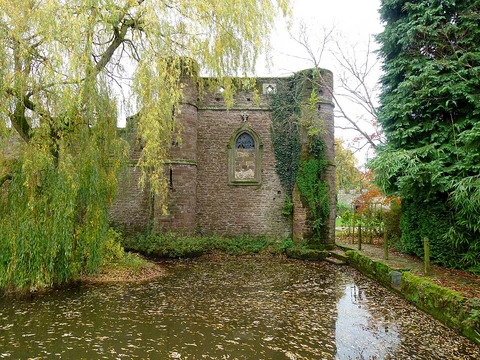
Oystermouth Castle
Norman stone castle overlooking Swansea Bay on Gower.
Last updated
Where it is
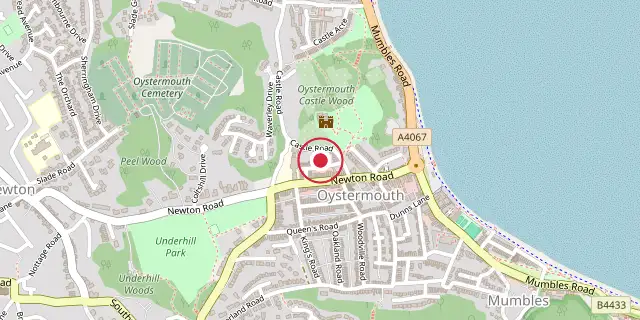
Coordinates: 51°34′34″N 4°00′11″W (51.5760, -4.0030) · Open in OpenStreetMap
Coordinates and connected clubs: the infobox of Wikipedia: Oystermouth Castle (CC BY-SA 4.0). Map: drawn by Codexery from OpenStreetMap tiles.
Oystermouth Castle, also known as Castell Ystum Llwynarth, is a Norman stone castle in Wales, sitting in the village of Mumbles and overlooking Swansea Bay on the east side of the Gower Peninsula. Several antiquarians have claimed the Norman castle was built on the site of an earlier Welsh fortification, which 19th-century writers Samuel Lewis and Nicholas Carlisle identified as the "Caer Tawy" of medieval Welsh literature—a Welsh fort guarding the river Tawe long before the Normans arrived.
The early castle
The first Norman castle was established by William de Londres of Ogmore Castle soon after 1106, following the Norman capture of Gower. In 1116 the Welsh of Deheubarth retook the peninsula, forcing William to flee and burning the castle.
It was rebuilt but likely destroyed again in 1137 when Gower was retaken by the Princes of Deheubarth. The Londres family line ended in 1215 when Llywelyn the Great captured Gower. In 1220 the Welsh were expelled, and Henry III returned the barony to John de Braose, who rebuilt both Swansea and Oystermouth castles.
In de Braose hands
During the 13th century the Braose family, as Lords of Gower, rebuilt Oystermouth in stone, adding a high curtain wall, internal buildings, a chapel, basements, and three-storey residential quarters with fireplaces and garderobes. It became their principal residence toward the end of the century, and Edward I visited briefly in December 1284.
By 1331 the Lords of Gower had moved elsewhere, and the castle declined. Aline de Breos, daughter of the last de Breos lord, improved the chapel. Through her marriage to John de Mowbray, the castle passed to the de Mowbrays, then the Herbert family, and finally the Somersets, who became Dukes of Beaufort.
2000s restoration
In 2009 the National Assembly for Wales invested £19 million in heritage sites to boost tourism. Oystermouth Castle closed in 2010 for a £1 million refurbishment and reopened in July 2011. The project added visitor facilities, an educational space, improved access, and a 30-foot high glass viewing platform and bridge leading to Alina's Chapel.
Notable features of the castle
On either side of the entrance gate the walls curve inward, suggesting two round towers were planned for the gatehouse, though it is unknown if they were ever built. The chapel, on the second floor of the chapel block, has 14th-century traceried windows and is traditionally attributed to Aline de Mowbray. Remnants of an ornate medieval painting from the 14th century were found during conservation; expert analysis suggests it depicts a double-arched canopy containing angel figures, with surviving elements including a feathered wing and a head with yellow hair surrounded by a nimbus.
Did You Know?
- A 1650 survey described the castle as 'an old decayed castle of no use, but of a very pleasant situation'.
- During World War II, the Royal Navy operated the naval trawler HMT Oystermouth Castle.
- The castle was given to Swansea Corporation by the Duke of Beaufort in 1927.
More in Grade I Listed Castles in Wales
Sources
Compiled from Wikipedia and the sources listed below. Text from Wikipedia is available under CC BY-SA 4.0; this entry is adapted from it.
- Wikipedia: Oystermouth Castle (CC BY-SA 4.0).
Spotted an error? Know more?
Reader corrections go straight into our review queue. Suggest an edit · How this site is sourced