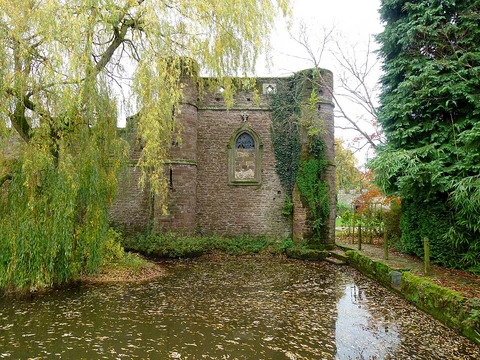
Rhuddlan Castle
Edward I's diamond-shaped concentric castle on the River Clwyd.
Last updated
Where it is
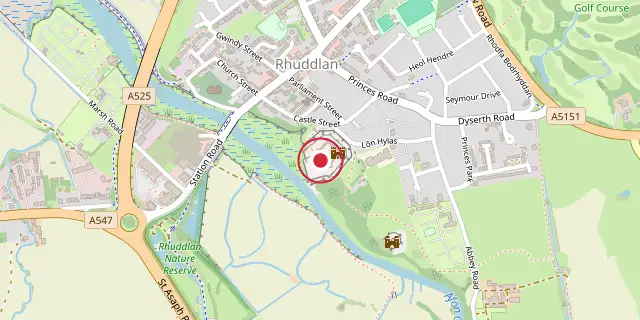
Coordinates: 53°17′20″N 3°27′54″W (53.2890, -3.4650) · Open in OpenStreetMap
Coordinates and connected clubs: the infobox of Wikipedia: Rhuddlan Castle (CC BY-SA 4.0). Map: drawn by Codexery from OpenStreetMap tiles.
Rhuddlan Castle, known in Welsh as Castell Rhuddlan, is a fortress in Denbighshire, Wales. Edward I selected this location for a castle in 1277, and much of the building work was directed by master mason James of Saint George.
Completed in 1282, it was constructed at the same time as Flint Castle while King Edward I was consolidating his conquest of Wales. The castle briefly served as his residence, and his daughter Elizabeth is presumed to have been born there. Today, the site is managed by Cadw, a division of the Welsh Government.
History
Rhuddlan's story extends far before Edward I's stone fortress. The town began as a Saxon burgh founded by Edward the Elder. In the late 11th century, after the Norman invasion of Gwynedd, the site's strategic position made it a prize fought over by the Princes of Gwynedd and the Earls of Chester. Gruffydd ap Llywelyn, who had been driven out by Harold Godwinson, later retook the town.
Just south of the current castle lie the remains of Twthill, a Norman castle built in 1086 by Robert of Rhuddlan, a supporter of King William I. In July 1277, as the Welsh Wars began, Edward I left Chester and established an advance base at Flint, where work on Flint Castle started immediately. With naval support from 25 ships of the Cinque Ports fleet, his army pushed along the coast. By August, Edward had moved his forces to Rhuddlan, which he could supply by river.
Three months later, the town was ceded to the English Crown under the Treaty of Aberconwy between Llywelyn ap Gruffudd and Edward I. Castle construction began under Master Bertram, a Gascon engineer, but was soon handed over to Savoyard master mason James of St George, who remained in charge until labor ceased in 1282. During the Welsh rebellion that year, the castle was besieged until relieved by an English force led by the future Amadeus V, Count of Savoy.
Edward I also created a new borough north of the castle, away from the pre-existing Norman town and Dominican Friary, and its 13th-century street layout is still visible today. The borough was defended with a pair of ditch-separated earthworks and a timber palisade. Rhuddlan Castle became part of Edward's Ring of Iron fortifications.
Construction
Rhuddlan was designed as a concentric castle with a distinctive diamond layout: its gatehouses occupy the corners of the square baileys rather than the sides, unlike Flint, Harlech, or Beaumaris. Records of construction costs indicate it was the major English building project of the late 1270s. The inner ward features defensive walls with twin-tower gatehouses, while the outer ward is enclosed by a curtain wall with small towers and turrets. According to 18th-century traveler Thomas Pennant, one tower is called Twr-y-Silod (Grain Tower) and another Twr-y-Brenin (The King's Tower).
A three-sided moat protected the castle, with the River Clwyd guarding the fourth side. Inside the inner ward were a great hall, kitchens, private apartments, and a chapel; the outer bailey held a granary, stables, and a smithy. During the lengthy construction, the River Clwyd was straightened and dredged to create a man-made channel, allowing ships to bring provisions and troops inland even if overland routes were blocked. An additional earthwork and timber structure was built around the castle in 1280–82.
More in Grade I Listed Castles in Wales
Sources
Compiled from Wikipedia and the sources listed below. Text from Wikipedia is available under CC BY-SA 4.0; this entry is adapted from it.
- Wikipedia: Rhuddlan Castle (CC BY-SA 4.0).
Spotted an error? Know more?
Reader corrections go straight into our review queue. Suggest an edit · How this site is sourced