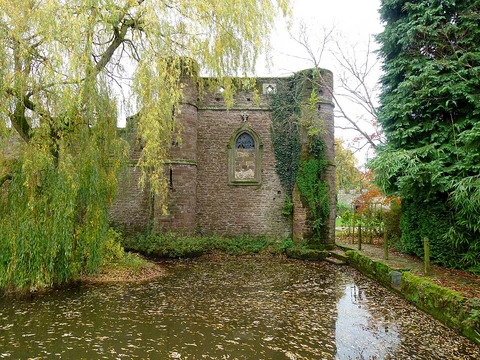
Pembroke Castle
Medieval castle on a rocky promontory, seat of the Earls of Pembroke.
Last updated
Where it is
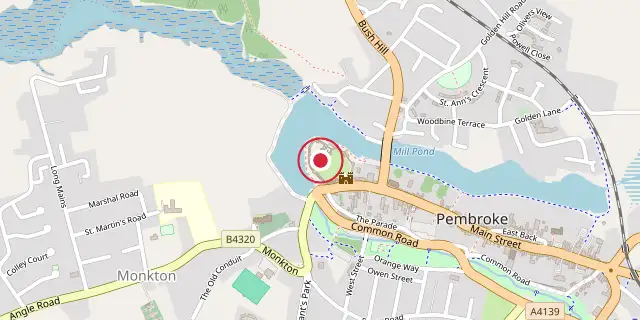
Coordinates: 51°40′37″N 4°55′16″W (51.6770, -4.9210) · Open in OpenStreetMap
Coordinates and connected clubs: the infobox of Wikipedia: Pembroke Castle (CC BY-SA 4.0). Map: drawn by Codexery from OpenStreetMap tiles.
Pembroke Castle (Castell Penfro) is a medieval castle in the centre of Pembroke, Pembrokeshire, Wales. It was the original family seat of the Earldom of Pembroke and is a Grade I listed building since 1951. The castle underwent major restoration during the early 20th century and is the largest privately owned castle in Wales, held in trust and open to the public.
History
The site was occupied during the Roman period, and discoveries in Wogan Cave show human habitation at the end of the last ice age. Roger of Montgomery founded the first castle here in 1073, at the heart of Norman-controlled southwest Wales. His son Arnulf strengthened it and appointed Gerald de Windsor as castellan; the castle withstood a major siege in 1092. Henry appointed his own castellan, but when that ally proved incompetent, he reappointed Gerald in 1102.
By 1138 King Stephen gave the castle to Gilbert de Clare, who used it as a base for the Norman invasion of Ireland. In August 1189 Richard I arranged the marriage of Isabel, de Clare's granddaughter, to William Marshal, who received the castle and the title Earl of Pembroke. Marshal rebuilt it in stone and established the great keep. He was succeeded by each of his five sons; his third son, Gilbert Marshal, enlarged and strengthened the castle between 1234 and 1241.
All of Marshal's sons died childless, and in 1247 the castle passed to William de Valence, a half-brother of Henry III, who became Earl of Pembroke through marriage to Joan de Munchensi. The de Valence family held Pembroke for 70 years, fortifying the town with walls, three main gates, and a postern. The castle served as de Valence's military base during Edward I's conquest of North Wales between 1277 and 1295. On the death of Aymer de Valence, the castle passed through marriage to the Hastings family.
In 1389, 17-year-old John Hastings died in a jousting accident, ending a 250-year line of inheritance. Pembroke then reverted to Richard II, and short tenancies were granted by The Crown. By 1400 Owain Glyndŵr began a rebellion, but Pembroke escaped attack because the castle's Constable, Francis a Court, paid off Glyndŵr in gold. In 1452, the castle and earldom were presented to Jasper Tudor by his half-brother Henry VI.
Tudor brought his pregnant sister-in-law, Margaret Beaufort, to Pembroke, where in 1457 she gave birth to her only child, who became King Henry VII. During the English Civil War, Pembroke declared for Parliament and was besieged by Royalist troops but saved after Parliamentary reinforcements arrived by sea from Milford Haven. In 1648, at the start of the Second Civil War, commander Colonel John Poyer led a Royalist uprising. Oliver Cromwell arrived on 24 May 1648 and took the castle after a seven-week siege.
The three leaders were found guilty of treason, and Cromwell ordered the castle destroyed; townspeople were encouraged to disassemble it and reuse the stone. The castle was then abandoned and decayed until 1880, when a three-year restoration project began. Nothing further was done until 1928, when Major-General Sir Ivor Philipps acquired the castle and began an extensive restoration of its walls, gatehouses, and towers. After his death, a trust was set up, jointly managed by the Philipps family and Pembroke town council.
Construction
The castle sits on a strategic rocky promontory beside the Milford Haven Waterway. The first fortification was a Norman motte-and-bailey with earthen ramparts and a timber palisade. The inner ward, begun in 1189, contains a huge round keep with a domed roof, originally entered at first-floor level via an external stairwell. A spiral staircase connects the keep's four stories, and putlog holes in the dome supported a wooden fighting platform.
The inner ward's curtain wall includes a large horseshoe-shaped gateway, while the promontory side required only a thin wall with a small observation turret and a square stone platform. Domestic buildings such as William Marshal's Great Hall and private apartments stood within the inner ward. The keep rises 23 m, with walls up to 6 m thick at the base. Late 13th-century additions included a new Great Hall.
The outer ward was defended by a large twin-towered gatehouse, a barbican, and several round towers. Though a Norman-style enclosure castle with a great keep, its siting on a rocky promontory surrounded by water makes it more accurately a linear fortification.
Wogan Cavern
Beneath Pembroke Castle lies Wogan Cavern, a large limestone cave shaped by water erosion over hundreds of thousands of years. A 55-step spiral staircase, built in the 13th century, descends to the cavern. During medieval times, the cave was strengthened with a wall, a barred gate, and arrowslits, and it likely functioned as a boathouse or a sallyport for moving goods or people to the river. Archaeologists once believed Victorian excavators had stripped the cave of all artifacts, but digs started in 2021 uncovered untouched sediment layers, elevating it to one of Britain's most significant prehistoric sites.
A July 2022 survey, backed by the Natural History Museum and the British Cave Research Society, found remains of prehistoric megafauna like reindeer and woolly mammoths, along with seashells, pigs, and deer. The cave was inhabited during the Paleolithic and Mesolithic periods. In 2026, researchers reported the discovery of bones from a warm-weather hippopotamus that had lived in Welsh wetlands 120,000 years ago.
More in Grade I Listed Castles in Wales
Sources
Compiled from Wikipedia and the sources listed below. Text from Wikipedia is available under CC BY-SA 4.0; this entry is adapted from it.
- Wikipedia: Pembroke Castle (CC BY-SA 4.0).
Spotted an error? Know more?
Reader corrections go straight into our review queue. Suggest an edit · How this site is sourced