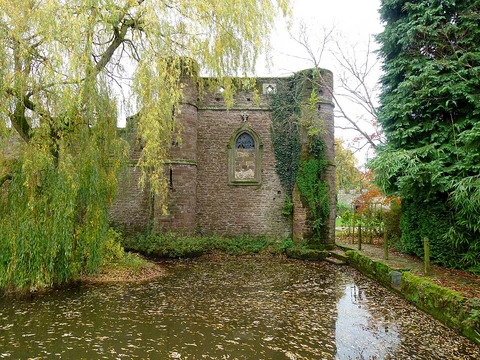
Crickhowell Castle
Ruined Norman castle in Crickhowell, Wales.
Last updated

via Wikipedia: Crickhowell Castle · see source
Crickhowell Castle (Castell Crucywel) is a largely ruined Grade I listed building in Crickhowell, Wales. It is sometimes referred to as Alisby's Castle, a name thought to derive from a former governor, Gerald Alisby.
Quick Facts
- Alternative name
- Alisby's Castle
- Grade
- I listed
- Location
- Crickhowell, Wales
- Initial construction
- c. 1121
- Builder (probable)
- Robert Turberville
- Destroyed
- c. 1403
- Listed
- 1963
Facts from the source article.
History
The castle began as a motte and bailey around 1121, probably built by Robert Turberville, a tenant of Marcher lord Bernard de Neufmarché. Welsh rebels under Seisyllt ap Rhirid attacked it in 1172. Richard Turberville held it during the time of Henry de Turberville, who served as Seneschal of Gascony. Later in the century Edmund de Turberville was lord of Crickhowell.
Hugh Turberville held the castle from 1273 as mesne lord and also became Seneschal of Gascony; King Edward I called on him to train Welsh men-at-arms and lead cavalry and 6,000 infantry from the Welsh Marches. Hugh later served as Constable of Castell y Bere, fought against Rhys ap Maredudd from 1287 to 1291, and died in 1293 as the last of his direct line. Stone refortification began in 1242 when Sybil Turberville married Sir Grimbold Pauncefote, who gained possession; substantial stone towers and a large bailey were added.
In the 14th century the castle passed to the Mortimer family and declined as a minor holding. In 1400 King Henry IV ordered Sir John Pauncefote, great-grandson of Sir Grimbold, to refortify it ahead of Owain Glyndŵr's uprising. Glyndŵr's forces largely destroyed the castle around 1403, after which it was abandoned and stone-robbed, leaving only the ruined stone double tower on Castle Green. 19th-century illustrations indicate its condition has worsened over the past century.
The so-called Ivy Tower, once thought to be a 14th-century castle structure, was later found by archaeological survey to be much later and unrelated.
Location
The castle's remaining walls and motte occupy a spur where a tributary stream meets the River Usk, on higher ground than the rest of the planned town. The oval motte remains visible, while the shell keep's foundations are mostly buried. Traces of the bailey have been identified in the nearby playing field.
More in Grade I Listed Castles in Wales
Sources
Compiled from Wikipedia and the sources listed below. Text from Wikipedia is available under CC BY-SA 4.0; this entry is adapted from it.
- Wikipedia: Crickhowell Castle (CC BY-SA 4.0).
Spotted an error? Know more?
Reader corrections go straight into our review queue. Suggest an edit · How this site is sourced