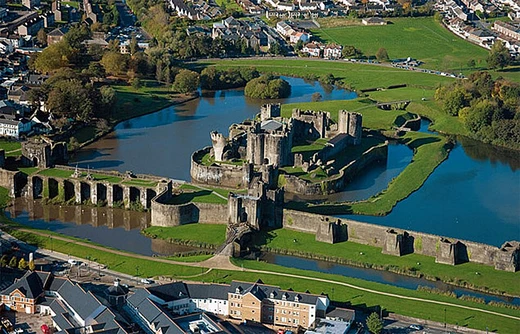
Castell y Bere
13th-century Welsh castle built by Llywelyn the Great.
Castell y Bere is a stone castle near Llanfihangel-y-pennant in Gwynedd, Wales, constructed by Llywelyn the Great in the 1220s. It was built to maintain his authority over the local people and defend the south-west part of the princedom of Gwynedd. After falling to English forces in 1282, it was expanded by Edward I, but following a siege and fire in 1294 it was not repaired and became ruined; today it is operated as a tourist attraction by Cadw.
Quick Facts
- Location
- Llanfihangel-y-pennant, Wales
- Built
- Began 1221
- Builder
- Llywelyn the Great
- Materials
- Siltstone
- In use
- Open to public
- Condition
- Ruined
- Owner
- Cadw
- Events
- Welsh Wars; Prince Madoc's Rebellion
Facts from the source article.
History
Castell y Bere was built in the 1220s by Llywelyn the Great on a rocky hillock overlooking the Dysynni Valley, near Llanfihangel-y-pennant. From the late 11th century Normans advanced into Wales, taking northern lands and establishing the Welsh Marches in the south. During the 12th century some timber and earthwork castles began to appear, but in small numbers. Llywelyn the Great initially controlled Gwynedd but grew more powerful, extending his influence over much of Wales in the early 13th century.
He faced challenges from English kings and maintaining authority over native Welsh. In 1221 Llywelyn took Meirionnydd from his son Gruffydd, after they fell out, and began building Castell y Bere to control the local population and secure his new south-west border, which included mountain trade routes between Gwynedd, Powys Wenwynwyn and Deheubarth. It was the first of several stone castles built by Llywelyn. After his death in 1240, Gwynedd's power declined and eastern lands were taken by Henry III in 1247.
Llywelyn ap Gruffudd took power in 1255, imprisoned his brother Owain, and extended the castle with an additional tower to the south.
Architecture
Castell y Bere’s remains sit on a rocky hill, with stone-cut defensive ditches on its south and east sides. The west entrance features a barbican, likely added by Edward I, with two gate towers that look down on the stone stairway leading to the inner gate. Beyond the barbican lies the courtyard, which holds a large well and the ruins of several buildings whose dates are unknown. The north tower is apsidal, or D-shaped, a style typical of early 13th-century Welsh castles; it may have once housed a hall or a chapel.
What is now the middle tower was originally the southernmost strongpoint, but today it connects through the Edwardian ditch yard to the south tower, another apsidal structure that provided spacious living quarters. Neither apsidal tower had fireplaces in its main rooms; instead, they were heated by central hearths. Unusually for an early Welsh castle, Castell y Bere shows signs of decorative stonework, including soldier statues, and ornamental floor tiles. Only Criccieth Castle shares these features.
Cultural references
Castell y Bere is the first track on the album Rhown Garreg ar Garreg (1981) by the Welsh folk group Plethyn, with lyrics by Myrddin ap Dafydd and a tune by Turlough O'Carolan. It plays a key role in Sharon Kay Penman's Welsh Princes trilogy, particularly in The Reckoning (1991). The castle was visited by Brian Johnson of AC/DC and Robert Plant of Led Zeppelin for Johnson's Life on the Road series; it is not far from Bron-Yr-Aur.
More in Castle Ruins in Wales
Spotted an error? Know more?
Reader corrections go straight into our review queue. Suggest an edit · How this site is sourced