
Breccia
Clastic rock of angular fragments bound by matrix or cement.

Unknown author · Public domain
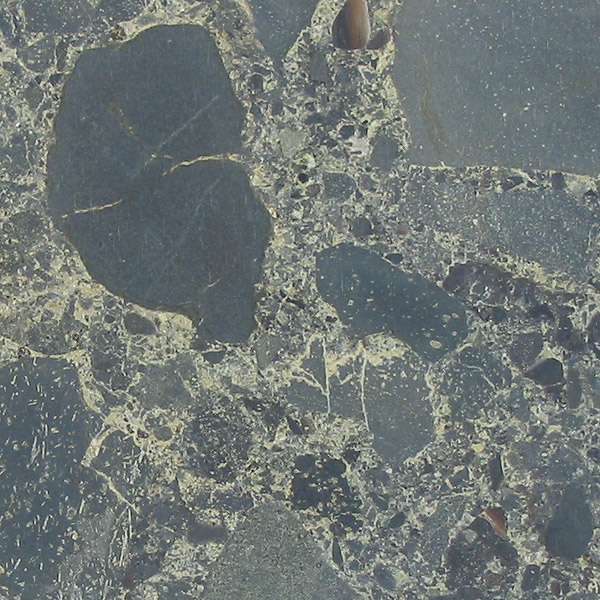
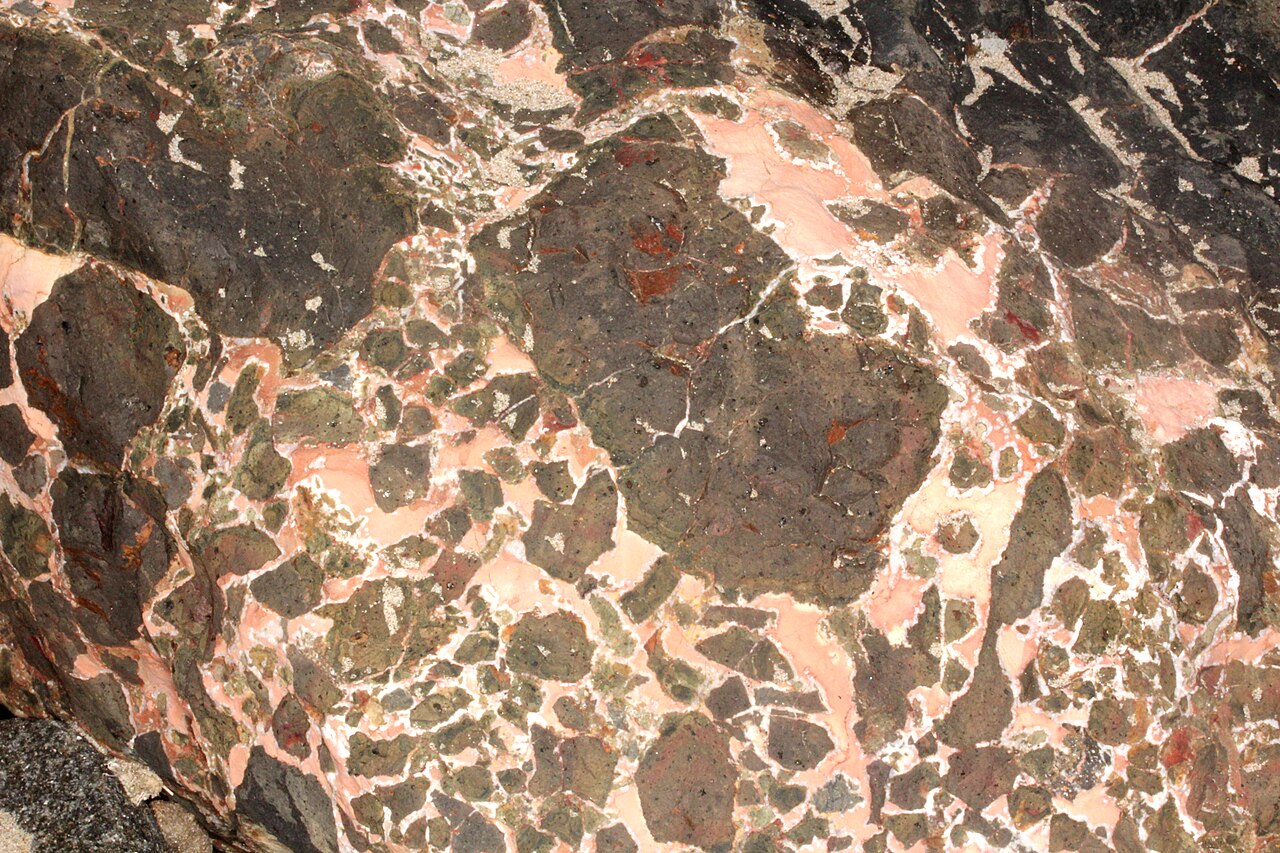
Breccia (pronounced BRETCH-ee-ə or BRESH-, from the Italian word for "rubble") is a type of clastic rock made up of angular, coarse fragments that are held together by a finer-grained matrix or cement. Unlike conglomerate, which has rounded pebbles, breccia's sharp-edged pieces show that the material was deposited very close to where it came from—if it had traveled far, the edges would have been worn smooth. A megabreccia is a version of this rock containing huge fragments, sometimes over a kilometer across, which can result from landslides, asteroid or comet impacts, or the collapse of a volcanic caldera.
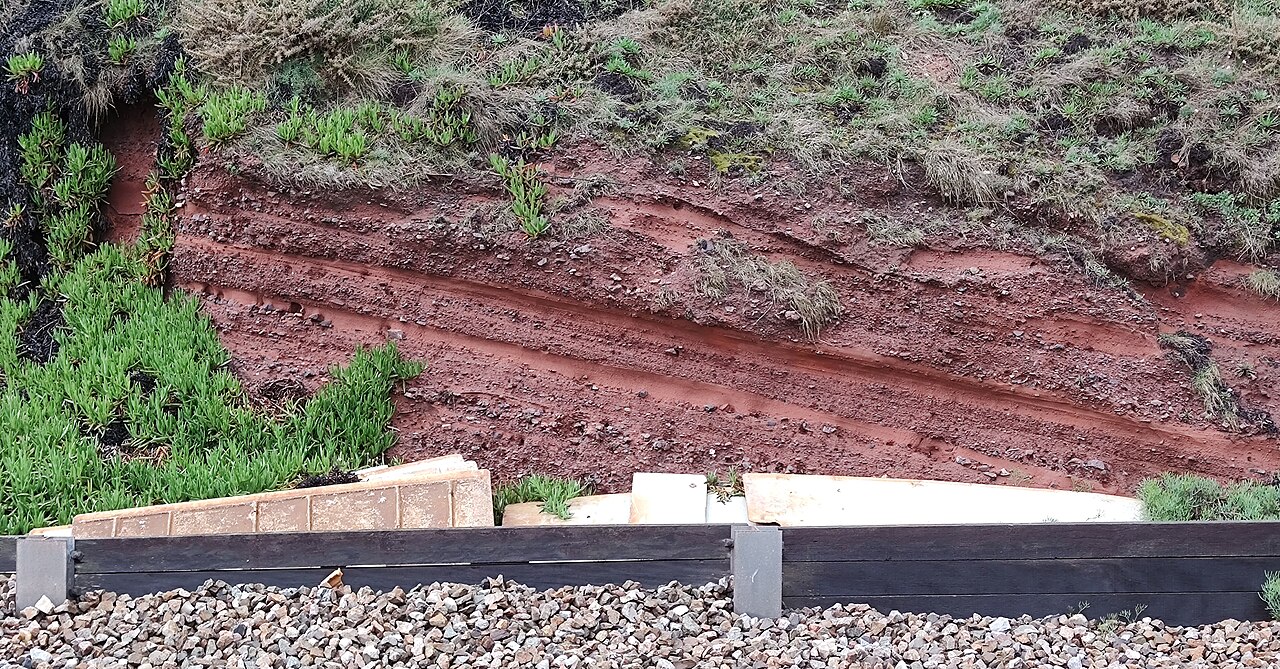
Breccias are classified by how they form. Sedimentary breccia, such as talus breccia, forms when scree at the base of a cliff becomes cemented without being transported. Thick sequences of this type often develop next to fault scarps in grabens, and they can also come from submarine debris flows, with turbidites forming fine-grained deposits around them. In karst terrain, collapse breccia appears when rock falls into sinkholes or caves, or when underlying evaporite beds dissolve.
Fault or tectonic breccia is created by the grinding of two fault blocks sliding past each other; the broken fragments are later cemented by minerals from groundwater.
Igneous breccias fall into two groups: those from volcanic eruptions (lava and pyroclastic types) and those from intrusive processes, often linked to plutons or porphyry stocks. Volcanic pyroclastic breccias form during explosive eruptions, incorporating rocks from the magma conduit or picked up by pyroclastic surges. Lava flows, especially rhyolite and dacite, can undergo autobrecciation, where thick, nearly solid lava breaks into blocks that mix back into the still-liquid magma, creating a breccia uniform in composition. Caldera collapse produces megabreccias—blocks of precaldera rock, sometimes over a kilometer long, from the unstable rim—while smaller mesobreccias (clasts under a meter) form layers in the caldera floor. In volcanic conduits, the environment merges with intrusive breccias as upwelling lava solidifies and is shattered by later eruptions, forming alloclastic volcanic breccia.
Intrusive breccias are common in shallow subvolcanic intrusions like porphyry stocks, granites, and kimberlite pipes. They can result from multiple stages of intrusion, such as later aplite veins cutting through earlier granite, creating a chaotic appearance. In mafic and ultramafic intrusions, breccias form through processes like consumption and melt-mingling with wall rocks (producing taxitic texture), accumulation of roof rock falling through the magma chamber, autobrecciation of partly consolidated cumulate by fresh magma, or accumulation of xenoliths in a feeder conduit to form a diatreme breccia pipe.
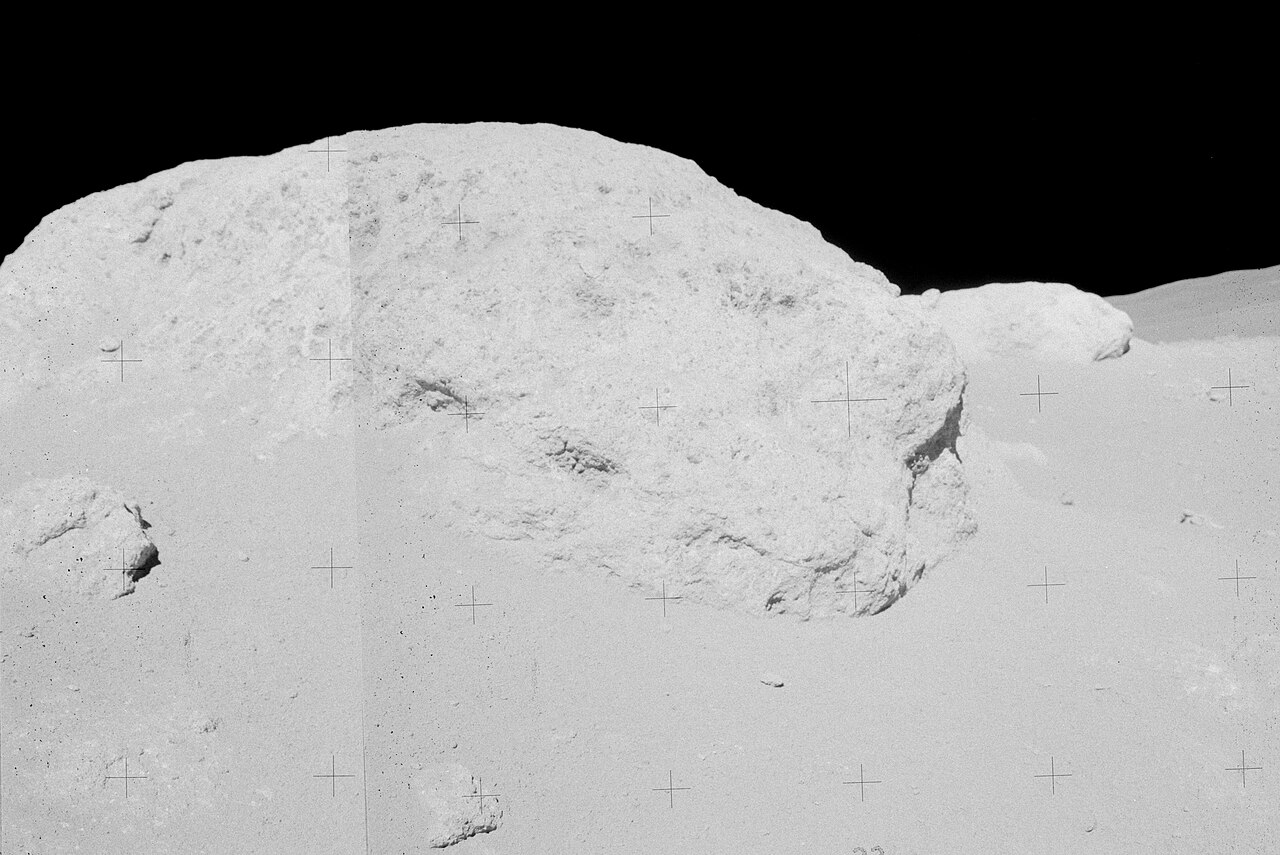
Impact breccias are diagnostic of asteroid or comet impacts and are found at impact craters. This type of impactite forms during cratering, appearing on or beneath the crater floor, in the rim, or in the ejected material. It can be identified by its location at a known impact crater and by associated features such as shatter cones, impact glass, and shocked minerals.
- field
- Geology
- type
- Clastic sedimentary rock
- key_feature
- Angular, coarse fragments
- minimum_gravel_content
- At least 30 percent particles over 2 mm
- origin_of_name
- Italian for 'rubble'
Lore & Background
Breccia forms through various processes, leading to named types including sedimentary breccia, fault or tectonic breccia, igneous breccia, impact breccia, and hydrothermal breccia. Sedimentary breccia can form from scree deposits at cliff bases, submarine debris flows, or collapse in karst terrain. Fault breccia results from grinding action of fault blocks, with subsequent cementation by mineral matter in groundwater. Igneous breccia includes volcanic pyroclastic rocks from explosive eruptions and intrusive breccia from processes within plutons or porphyry stocks. Impact breccia forms during asteroid or comet impacts, often found at impact craters. Hydrothermal breccia typically forms at shallow crustal levels when seismic or volcanic activity opens a void, causing hot water to boil and rock to implode.
Reader's Guide
Breccia holds significance as a diagnostic rock type for various geological processes. Its angular fragments indicate minimal transport, making it valuable for interpreting depositional environments near source areas. Impact breccias are key evidence of extraterrestrial impacts, often associated with shatter cones, impact glass, and shocked minerals. Hydrothermal breccias are important in ore geology, hosting deposits of copper, silver, and gold in epithermal environments, and gold in mesothermal regimes. For thousands of years, breccia's striking visual appearance has made it a popular sculptural and architectural material, used by ancient Minoans, Egyptians, and Romans. The study of breccia types helps geologists understand fault movements, volcanic eruptions, impact events, and hydrothermal systems, contributing to resource exploration and planetary science.
Did You Know?
- Breccia is distinguished from conglomerate because its rock fragments have sharp edges that have not been worn down by transport.
- Impact breccia may be identified by association with shatter cones, impact glass, shocked minerals, and chemical evidence of extraterrestrial material such as iridium.
Gallery


Frequently Asked Questions
What is Breccia?
Breccia is a clastic sedimentary rock made up of coarse, angular rock fragments held together by a finer-grained matrix or cement. To qualify, at least 30 percent of its particles must be larger than 2 millimeters.
How do I tell Breccia apart from conglomerate?
The distinguishing feature is fragment shape: breccia contains sharp-edged, angular pieces, whereas conglomerate has rounded ones. That angularity tells geologists the material was deposited very close to its source area before being cemented.
Where does the name Breccia come from?
The term is borrowed from Italian, where it simply means 'rubble.' It's a fitting label for a rock that looks like a jumble of broken shards glued together.
What is a megabreccia?
A megabreccia is an extreme form of breccia in which the individual rock fragments can span kilometers. These enormous structures typically form through catastrophic events such as massive landslides, meteor impacts, or the sudden collapse of a volcanic caldera.
What are Breccia's key identifying features?
Its hallmark is a collection of angular, coarse fragments bound by a finer matrix or cement, giving it a distinctly rubble-like texture. In classification terms, it sits in the clastic sedimentary rock family and must contain at least 30 percent particles exceeding 2 mm in size.
More in Geology And Landforms 1-17
Spotted an error? Know more?
This is a living reference — every entry is fact-audited, and reader corrections feed straight into our audit queue. Suggest an edit · See this site's audit record