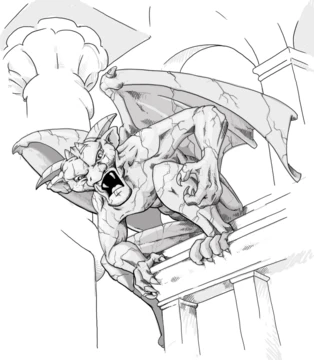
Gargoyle's Quest
A Game Boy spin-off starring the demon Firebrand.

Gargoyle's Quest, a platform game for the Game Boy, was created and released by Capcom in 1990. It serves as a spin-off from the Ghosts 'n Goblins series, putting players in control of Firebrand, a character who usually appears as an antagonist. A prequel for the NES, Gargoyle's Quest II, arrived in 1992, followed by a Super NES sequel, Demon's Crest, in 1994.
The gameplay splits into two styles. One half involves navigating an overhead view, either on a world map or inside towns. These sections are interrupted by action-platforming levels, some ending with a boss fight. While in the overhead view, players can talk to resident ghouls and, outside towns, face random battle encounters that must be won to return to the map. On the map, ghouls may challenge Firebrand for various reasons.
Firebrand can walk, jump (with height increasing over time), cling to walls with his claws, hover for a period (which also extends with time), and fire projectiles. The starting projectile is weak, but players gain new ones that offer more power and special abilities. Firebrand begins with two hit points, gaining more through items or blessings; enemies and objects drain varying amounts of health. Passive items boost Firebrand's abilities outright, and one item eventually allows unlimited hovering. A healing vial restores health. Each projectile has unique traits: the Blockbuster is stronger and can break special walls, while another covers sharp vertical surfaces to let Firebrand climb higher. These abilities keep older projectiles useful even after obtaining stronger ones. Players select projectiles or healing vials from a pause menu at any time.
In the game's lore, Firebrand is a gargoyle destined to become the Red Blaze, a powerful force that once fought the Destroyers. Following his destiny, he saves the Ghoul Realm from conquest by traveling through it, building his powers, and preparing to fight the Destroyers' king, Breager, to protect the realm again.
Development began as a spin-off to Ghosts 'n Goblins, focusing on the popular enemy demon Firebrand (Red Arremer in Japan). Capcom thought controlling a demon with his wide moveset would be interesting and unique. They chose the Game Boy to avoid overshadowing the Ghosts 'n Goblins series in arcades and on home consoles.
The game launched in Japan on May 2, 1990.
Quick Facts
- Title
- Gargoyle's Quest
- Developer
- Capcom
- Publisher
- JP/NA · Capcom · EU · Nintendo
- Producer
- Tokuro Fujiwara
- Designer
- Kenshi Naruse
- Composer
- Harumi Fujita / Yoko Shimomura
- Series
- Ghosts 'n Goblins
- Platforms
- Game Boy
- Genre
- Platformer
- Modes
- Single-player
Facts from the source article.
Lore & Background
The game consists of two gameplay styles: an overhead view on a world map or in towns, and action-platforming levels that sometimes feature a boss at the end. While in overhead sections, the player can talk with residential ghouls and is susceptible to random battle encounters. Firebrand can walk, jump, cling to walls, hover, and fire offensive projectiles. The player starts with a weak projectile but gains new ones with more power and special abilities, such as the Blockbuster which can destroy special walls. Firebrand starts with two hit points and gains more throughout the game based on items or blessings obtained.
Reader's Guide
Gargoyle's Quest was developed as a spin-off to the Ghosts 'n Goblins series to feature the popular enemy demon Firebrand. The team chose the Game Boy to avoid overshadowing the main series on arcades and home consoles. The game was released in Japan on May 2, 1990. Contemporary reviews praised its diversity of play, detailed graphics, and music, with GamePro calling it a potential system seller. Retrospective reviews highlighted its simplicity and depth, with Nintendo Life noting it as a reminder of how good games used to be. Allgame gave it four out of five stars, and Game Informer ranked it the 18th best Game Boy game. It was released on the Nintendo 3DS Virtual Console in 2011 and on the Nintendo Classics service in February 2023.
Did You Know?
- Gargoyle's Quest is a spin-off of the Ghosts 'n Goblins series, featuring the antagonist Firebrand as the main character.
- Firebrand can cling to walls using his claws and hover for a period that progressively lengthens with time.
- The Blockbuster projectile can destroy special walls blocking the player's path.
A Demon at the Helm: Development and Design Choices
Capcom conceived Gargoyle's Quest as a deliberate spin-off branching from their beloved Ghosts 'n Goblins franchise. Rather than centering the player on the series' heroic protagonist, the studio chose to spotlight Firebrand—a demon character who had originally appeared as an antagonist. Known as Red Arremer in Japanese markets, this figure had grown so popular among players that Capcom saw an opportunity to let audiences step into the shoes of a villain and explore his extensive moveset. The team made a strategic platform decision as well: by targeting the portable Game Boy, they ensured the spin-off would not overshadow the mainline Ghosts 'n Goblins titles competing in arcades and on home consoles. Released in Japan on May 2, 1990, the game positioned itself as a unique entry in Capcom's catalog, offering a fresh perspective on a well-established fantasy universe while occupying a distinct niche in the handheld market.
Dual-Mode Design and Progressive Power
Gargoyle's Quest weaves together two distinct gameplay modes that alternate throughout the experience. In the overhead sections, players navigate a world map or explore towns, conversing with resident ghouls and occasionally triggering random battle encounters when venturing outside settlements. Some ghouls even challenge Firebrand to combat for their own reasons. These exploration segments give way to individual action-platforming levels, several of which culminate in a boss confrontation. Firebrand's toolkit expands as the game progresses: his jump grows progressively higher, his wall-clinging uses his claws, and his hover ability lasts longer over time. He begins with a weak projectile and two hit points, but gradually acquires more powerful shots, each with unique traits. The Blockbuster can shatter special blocking walls, while another projectile temporarily coats sharp vertical surfaces to enable higher climbs. Passive items boost abilities outright, a healing vial restores lost health, and one item grants permanent hovering. All projectiles and vials are selectable from a pause menu at any moment.
Critical Acclaim and Enduring Legacy
From its launch, Gargoyle's Quest drew praise for pushing the Game Boy's creative boundaries. GamePro hailed it as an instant hit and a potential system seller, singeing its originality, diverse locales, detailed graphics, and memorable soundtrack. Critics at the time marveled at the 360-degree scrolling camera as a novel technical achievement for a handheld. Famitsu awarded it 25 out of 40. Decades later, the game's reputation only deepened. Nintendo Life's Kaes Delgrego called it beautiful in its simplicity yet satisfying in its depth, describing it as a painful reminder of how good games once were and a testament to the Game Boy's untapped potential. Allgame's Brett Alan Weiss gave it four of five stars, praising its ghoulishly entertaining yet undeniably challenging experience. Nintendo Power, reviewing the NES sequel in 1992, called the original one of the most original and challenging Game Boy titles. Game Informer ranked it the 18th best Game Boy game, and PC Magazine included it in their 2019 list of the ten best titles for the platform.
Narrative Roots and Series Longevity
Within the fictional lore of the Ghosts 'n Goblins universe, Firebrand is a gargoyle bound by prophecy to inherit the identity of the Red Blaze—a mighty force that once repelled the Destroyers in ancient times. His destiny drives the narrative: he must traverse the Ghoul Realm, steadily building his powers while preparing for a final confrontation with Breager, the Destroyers' king, to secure the realm's protection once more. Beyond its own story, Gargoyle's Quest became the seed for a broader franchise. Capcom followed the 1990 original with a prequel, Gargoyle's Quest II, on the NES in 1992, and a Super NES sequel titled Demon's Crest in 1994. The title's afterlife extended well into the modern era: it appeared on the Nintendo 3DS Virtual Console in 2011 and was later made available through the Nintendo Classics streaming service in February 2023, ensuring new generations of players could experience Capcom's ghoulish spin-off.
Gallery

Frequently Asked Questions
What is Gargoyle's Quest?
Gargoyle's Quest is a 1990 platformer released by Capcom for the Game Boy. It functions as a spin-off entry within the broader Ghosts 'n Goblins franchise, giving players a unique angle on that universe.
Who is the playable character in Gargoyle's Quest?
You take on the role of Firebrand, a demon who typically shows up as a villain in the main Ghosts 'n Goblins titles. Here, Capcom flips the script and lets you experience the series from the antagonist's perspective.
How does Gargoyle's Quest structure its gameplay?
The game alternates between overhead-view exploration across a world map and towns, and side-scrolling action-platforming stages. Those platforming sections often cap off with a boss encounter before you return to the map.
What other games belong to the Gargoyle's Quest line?
A prequel titled Gargoyle's Quest II appeared on the NES in 1992, and a Super NES sequel called Demon's Crest followed in 1994. Together, the three titles form a small standalone trilogy branching off the main series.
Why is Gargoyle's Quest considered a notable spin-off?
It was one of Capcom's earliest Game Boy titles and one of the first to let players control a franchise antagonist rather than the hero. That perspective shift, combined with its hybrid map-and-platforming design, set it apart from the rest of the Ghosts 'n Goblins lineup.
More in Gargoyles in popular culture 1-24
Spotted an error? Know more?
Reader corrections go straight into our review queue. Suggest an edit · How this site is sourced