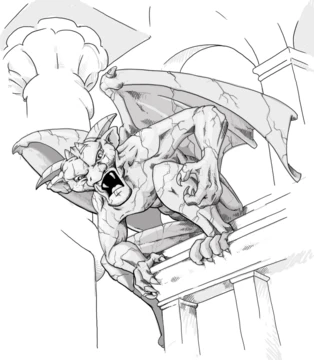
Demon's Crest
Third game starring Firebrand, a commercial failure for Capcom.

Jules Verne · Public domain
Demon's Crest, known in Japan as Demon's Blazon, is a 1994 platform game developed and published by Capcom for the Super Nintendo Entertainment System. It is the third video game starring Firebrand, an enemy character from the Ghosts 'n Goblins series, following Gargoyle's Quest (1990) and Gargoyle's Quest II (1992). The game was internally considered a commercial failure, which led Capcom to abandon plans for further entries in the series.
Quick Facts
- Title
- Demon's Crest
- Developer
- Capcom
- Director
- Ryo Miyazaki
- Producer
- Tokuro Fujiwara
- Designer
- Kenichi Iwao
- Composer
- Toshihiko Horiyama / [http: · vgmdb.net/album/3119 CPCA-10128~34
- Series
- Ghosts 'n Goblins
- Platforms
- Super Nintendo Entertainment System
- Released
- JP · October 21, 1994 · NA · November 1994 · PAL · March 1, 1995
- Modes
- Single-player
- Genre
- Platform
Facts from the source article.
Lore & Background
The story revolves around the Crests, six magical stones presiding over Fire, Earth, Water, Air, Time, and Heaven. When combined, they form the Crest of Infinity, granting infinite power. The demons of the Demon Realm have long fought for the Crests, and Firebrand holds five of them. After defeating a Demon Dragon for the Crest of Heaven, he is ambushed by the rival demon Phalanx, who takes all but the Fire Crest, which shatters into five shards. Firebrand escapes imprisonment and seeks revenge, regaining the Crests from Phalanx's general Arma. The game features three possible endings depending on player choices, with a fourth hidden ending accessible after completing the game with the third ending and using a special password.
Reader's Guide
Demon's Crest is a platform game with Metroidvania elements, requiring players to revisit levels with new Crests to access previously blocked areas, items, and boss fights. Firebrand's abilities include fire breath, wall-clinging claws, and hovering wings. Collecting Crests allows transformations into Ground Gargoyle, Aerial Gargoyle, Tidal Gargoyle, Legendary Gargoyle, and Ultimate Gargoyle. The game sold 26,245 copies in Japan and was considered a commercial failure internally at Capcom, with Nintendo Power reporting negative sales in one week. Despite this, it received generally favorable reception, holding an 87% rating on GameRankings based on five reviews. Critics praised its visuals and complex gameplay but noted repetitive music and enemy attack variety. In retrospectives, it has been listed among the best SNES games by IGN, GamesRadar, and Complex.
Did You Know?
- Demon's Crest is known in Japan as Demon's Blazon.
- The game sold 26,245 copies during its lifetime in Japan.
- Nintendo Power reported that the game suffered negative sales in one week, with more returns than purchases.
Gameplay & Progression Mechanics
Demon's Crest blends action platforming with light role-playing mechanics across six distinct areas that players can revisit multiple times. A defining feature is its Metroidvania structure: collecting new Crests unlocks previously inaccessible zones, items, and boss encounters, encouraging backtracking through the world. A navigable map helps players track their progress across these interconnected stages. Firebrand begins with a modest toolkit—fire breath, wall-clinging claws, and wings that allow hovering but not yet gaining altitude. As he gathers Crests, he can shift between five specialized Gargoyle forms: Ground, Aerial, Tidal, Legendary, and Ultimate. Each transformation tailors his combat and exploration capabilities to different challenges. Beyond the Crests, the game offers a steady stream of pickups: extra hit points, flasks and spell vellums for consumable magic, and talismans that enhance his base abilities. This layered progression system gives the platforming a sense of growing power that rewards thorough exploration.
Plot & Branching Endings
The narrative centers on six elemental Crests—Fire, Earth, Water, Air, Time, and Heaven—whose combination births the Crest of Infinity, a source of limitless power capable of conquering all realms. Centuries of demon warfare left five of these stones in the possession of Firebrand, who then defeated the Demon Dragon to claim the Crest of Heaven. Wounded from that victory, he was ambushed by his rival Phalanx, who seized every Crest except the Fire Crest, which shattered into five fragments. The game opens with Firebrand imprisoned in an amphitheater, forced to battle the zombified Somulo. After escaping, he journeys to reclaim the stolen Crests and exact revenge. Phalanx's general Arma repeatedly challenges him along the way, ultimately returning most of the Crests out of grudging respect for Firebrand's strength. The confrontation with Phalanx in his castle can resolve in three distinct ways, ranging from total anarchy to Firebrand rejecting conquest entirely. Achieving the third ending unlocks a special password granting the Ultimate Gargoyle form and access to a secret fourth ending, where Firebrand defeats a hidden foe called Dark Demon before casting aside the Crests in pride, seeking a new worthy adversary.
Commercial Performance & Critical Reception
Despite strong critical praise, Demon's Crest struggled commercially. Famitsu reported 24,427 copies sold in its first Japanese week and a lifetime total of 26,245, while Nintendo Power noted a week in which more copies were returned for refunds than newly purchased. Capcom internally classified the title as a commercial failure, a designation that later led the company to turn down a proposed Game Boy Advance port from a studio that would eventually become Renegade Kid. Critically, however, the game found strong support. GameRankings aggregated five reviews to an 87 percent score. Electronic Gaming Magazine's editors highlighted the beautiful visuals and complex gameplay, while GamePro's Captain Squideo praised the macabre art style and the depth of acquired abilities, even as he faulted the repetitive soundtrack and limited enemy variety. Nintendo Power lauded the audiovisual presentation, controls, and balance. In 1995, Total! placed the game at number 57 on its top-100 SNES list, and Super Famicom Magazine's readers gave it a 20.4 out of 30 in a poll. In later years, IGN, GamesRadar, and Complex have all included it among the best SNES titles.
Lineage & Digital Afterlife
Firebrand—known as Red Arremer in the Japanese version—originated as an enemy in Capcom's Ghosts 'n Goblins series before being given his own spotlight. Demon's Crest, released in Japan on October 21, 1994, and in North America the following month, serves as the third installment in that spin-off lineage, following Gargoyle's Quest (1990) and Gargoyle's Quest II (1992). Developed and published entirely by Capcom for the Super Nintendo Entertainment System, the title carried the weight of two predecessors while pushing the formula toward more open exploration. The game's post-launch life has been marked by repeated digital re-releases. In 2014, it returned to players through Nintendo's Virtual Console service. A 3DS Virtual Console edition followed in 2016, and the title is now accessible on the Nintendo Switch via the Nintendo Classics service. These re-releases have kept Demon's Crest in circulation for over three decades, ensuring that new generations can experience its Metroidvania-style platforming and branching narrative despite its modest original sales figures.
Gallery

Frequently Asked Questions
What is Demon's Crest?
Demon's Crest (titled Demon's Blazon in Japan) is a 1994 platformer for the Super Nintendo, developed and published by Capcom. It serves as the third standalone game centered on Firebrand, the gargoyle antagonist from the Ghosts 'n Goblins franchise.
Who is the main character in Demon's Crest?
The player controls Firebrand, the gargoyle enemy originally introduced in the Ghosts 'n Goblins series. This title follows Gargoyle's Quest (1990) and Gargoyle's Quest II (1992) as the third game to spotlight him.
When and where was Demon's Crest released?
Capcom launched the game in Japan on October 21, 1994, with a North American release following in November of that same year. It was exclusive to the Super Nintendo Entertainment System.
What genre does Demon's Crest fall under?
It is primarily a side-scrolling platform game that weaves in light role-playing elements. The structure involves navigating levels while collecting and upgrading abilities along the way.
Why was Demon's Crest the final Firebrand game?
Capcom internally regarded the title as a commercial disappointment, which led them to scrap any plans for a fourth entry in the Firebrand line. No further games in the series were produced after it.
More in Gargoyles in popular culture 1-24
Spotted an error? Know more?
Reader corrections go straight into our review queue. Suggest an edit · How this site is sourced