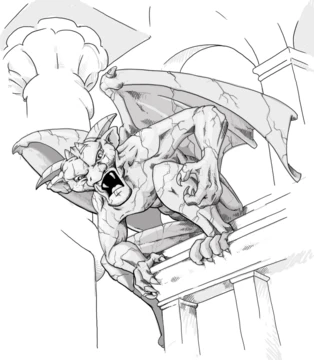
Gargoyle's Quest II
1992 prequel to Gargoyle's Quest in the Ghosts 'n Goblins series.

Gargoyle's Quest II: The Demon Darkness is a 1992 action-adventure platformer from Capcom for the NES. It takes place before the events of Gargoyle's Quest, which itself is part of the Ghosts 'n Goblins series. The game blends exploration and side-scrolling combat in a dark fantasy world. Its sequel, Demon's Crest, arrived on the SNES in 1994.
The game uses a password save system and splits its play into two parts: moving through the Ghoul Realm on an overhead map, and entering side-scrolling action areas like dungeons and pits. The action sections are broadly similar to the first Gargoyle's Quest, but add the Magic Tornado power-up. This lets the main character, Firebrand, rise vertically by standing on temporary platforms. As before, Firebrand can glide horizontally with his wings, shoot magic projectiles for attack or defense, and cling to walls to climb or descend slowly. He moves slower than most video game characters, which often forces direct confrontations with enemies. Some foes have much more health and must be defeated in small rooms to proceed.
On the overworld and in towns, Firebrand moves in four directions along semi-linear paths. Towns have ghoul residents who speak to him and stone buildings he can enter. As he progresses, Firebrand gains power through enchanted items that increase his glide time, jumping height, or stamina.
The story begins in the Ghoul Realm, where humans already exist. A young gargoyle warrior named Firebrand lives in the town of Etruria. While he trains in a small alternate dimension, The Black Light suddenly destroys his home. When he returns, a dying ghoul tells him to hurry to the local king before collapsing. Firebrand defeats Nagus (the monster with a spaulder seen on the European box art) and meets King Morock, who gives him the Spectre's Fingernail and sends him on a journey to uncover the mystery of The Black Light, fighting an invading army along the way.
The game was ported to the Game Boy in 1993 in Japan and China only, under the name Makaimura Gaiden: The Demon Darkness. This enhanced version adds two new action stages: a cave in the northern Sittem Desert and another cave in the desert where Dagon lives. Completing these stages unlocks abilities unique to the port: a homing upgrade for Firebrand's basic attack and an astral projection technique to briefly scout the area.
Quick Facts
- Title
- Gargoyle's Quest II: / The Demon Darkness
- Developer
- Capcom
- Producer
- Tokuro Fujiwara
- Designer
- Ryo Miyazaki
- Composer
- Yuki Iwai
- Series
- Ghosts 'n Goblins
- Platforms
- NES, Game Boy
- Released
- NES Game BoyJP · April 16, 1993
- Genre
- Action-adventure, platform
- Modes
- Single-player
Facts from the source article.
Lore & Background
The game's plot takes place in the Ghoul Realm, where humans already exist. A young gargoyle warrior named Firebrand, from the town of Etruria, returns from training in a small alternate dimension to find his home destroyed by The Black Light. A dying ghoul directs him to the local King, and after defeating the monster Nagus, Firebrand meets King Morock, who gives him the Spectre's Fingernail and sends him on a journey to unravel the mystery of The Black Light while facing an invading army.
Reader's Guide
Gargoyle's Quest II: The Demon Darkness is significant as a prequel that expands the Ghosts 'n Goblins universe with a mix of overhead map traversal and side-scrolling action. Its gameplay retains the wall-clinging, gliding, and projectile attacks of its predecessor while adding the Magic Tornado power-up for vertical movement. The game uses a password system and features towns where Firebrand can speak with ghoul denizens and enter buildings. A port to the Game Boy in 1993 (Japan and China only) added two new action stages and abilities, but a planned North American release was canceled. The NES version was later re-released on Virtual Console for Nintendo 3DS and Wii U in 2014. Reception from Famicom Hisshoubon, Nintendo Power, and Nintendo Life noted its high difficulty and originality, with IGN ranking it 63rd on its list of best North American NES games. The Virtual Console versions introduced a restore point save function, which reviewers considered an improvement over the password system.
Gameplay Architecture and Mechanical Identity
Capcom's 1992 NES title structures its experience around two distinct modes of play stitched together by a password system. The first is an overhead, map-based traversal of the Ghoul Realm, where Firebrand walks in four cardinal directions along semi-linear routes, visiting towns populated by talking ghoul denizens and entering stone buildings. The second mode drops the player into side-scrolling action sequences set in dungeons, across vast pits, and other macabre environments.
What sets the sequel apart from its predecessor is the Magic Tornado, a power-up that lets Firebrand rise vertically by standing on brief, temporary platforms. His signature wings still grant horizontal gliding, and he can hurl magic weapon projectiles at any moment for offense or defense. A defining mechanical quirk is his deliberate slowness—far slower than typical platforming heroes—which forces players into direct confrontations rather than letting them dash past threats. He can also cling to walls to scale cliffs, grab onto moving objects, and descend at a controlled pace. Progression comes from enchanted items that extend glide time, boost jump height, or increase stamina. Confined-room encounters against heavily armored foes serve as gatekeepers, demanding the player defeat them before advancing.
Narrative Framing and the Black Light
The story positions itself as a prequel to the original Gargoyle's Quest, retelling events from a time before humans ever set foot in the Ghoul Realm. The protagonist is Firebrand, a young gargoyle warrior hailing from the town of Etruria. His ordinary life—spending days training in a small, separate dimension—shatters when The Black Light materializes without warning and obliterates his home. A fellow ghoul, already dying, urges him to rush to the local King before collapsing.
Firebrand's path to the throne room is not unobstructed; he must first defeat Nagus, a spaulder-wearing monster, before gaining audience with King Morock. The King, himself on the verge of death, entrusts Firebrand with the Spectre's Fingernail and charges him with uncovering the truth behind The Black Light. What follows is a long journey across the realm, punctuated by clashes with an invading army. The story's tone is deliberately archaic and grim, fitting the macabre fantasy world Capcom had established across the Ghosts 'n Goblins franchise. Rather than a sprawling epic, the plot serves as a compact framing device for the game's challenging platforming and exploration loops.
The Game Boy Port and Virtual Console Revival
Beyond its 1992 NES debut, the title found a second life in a 1993 Game Boy port released exclusively in Japan and China under the name Makaimura Gaiden: The Demon Darkness. This handheld version was not a straight port but an enhanced build, adding two entirely new action stages: a cave in the northern reaches of the Sittem Desert and a second cave where the entity Dagon resides. Clearing both stages unlocked two abilities absent from the NES original—a homing upgrade for Firebrand's standard projectile and an astral projection technique that let him briefly scout his surroundings. A North American release was slated for July 1993 but was ultimately canceled, leaving the Game Boy version a regional curiosity.
Two decades later, the NES version returned via Virtual Console. Japanese players received it on the 3DS in March 2014 and on the Wii U in May of that year. North American and European rollouts followed in the fall of 2014. Notably, every Virtual Console edition carries an ESRB "E for Everyone" rating in North America, a first for the series, as all prior releases had gone unrated.
Critical Reception and Enduring Legacy
Critical response to the NES original was largely favorable, though difficulty was the most consistently cited talking point. Japan's Famicom Hisshoubon magazine awarded the game high marks from all three of its reviewers, with one going so far as to suggest the developers should have removed the level-selection option to push the challenge even further. In the West, Nintendo Power's George and Rob both praised the title; George highlighted its originality relative to the earlier Game Boy entry, while Rob cautioned that the difficulty ceiling might alienate casual players.
Decades later, the game's reputation has only solidified. Tim Latshaw of Nintendo Life described it as "a fine little gem" worthy of appreciation from players willing to meet its "tough but not impossible" design on its own terms. He expressed particular enthusiasm for the Virtual Console's restore-point save feature, which he felt rendered the archaic password system obsolete and made the modern ports the superior way to experience the game. IGN's placement of the NES version at number 63 on its all-time best North American NES games list further cements its standing as a respected, if punishing, entry in the library.
Frequently Asked Questions
What is Gargoyle's Quest II?
Gargoyle's Quest II: The Demon Darkness is a 1992 action-adventure platformer made by Capcom for the Nintendo Entertainment System. It functions as a prequel to the original Gargoyle's Quest and belongs to the wider Ghosts 'n Goblins franchise.
How does Gargoyle's Quest II's gameplay work?
The player alternates between traversing a top-down map of the Ghoul Realm and entering enclosed side-scrolling combat zones like dungeons and pits. Since the NES had no memory card, progress is preserved through a password system.
Where does Gargoyle's Quest II sit in the Ghosts 'n Goblins timeline?
The narrative unfolds before the events of the first Gargoyle's Quest, positioning it as a backstory entry in that sub-series. It was later succeeded by Demon's Crest, which appeared on the Super Nintendo in 1994.
What is the Ghoul Realm in Gargoyle's Quest II?
The Ghoul Realm is the dark-fantasy overworld that the player navigates on an overhead map between action segments. It serves as the connective tissue linking the various side-scrolling dungeons and pit areas scattered throughout the game.
Who developed and published Gargoyle's Quest II?
Capcom handled both the development and publishing of the title. It was released exclusively on the NES in 1992 as part of the company's Ghosts 'n Goblins lineup.
More in Gargoyles in popular culture 1-24
Spotted an error? Know more?
Reader corrections go straight into our review queue. Suggest an edit · How this site is sourced