Ocellated frogfish
Largest frogfish in the Western Atlantic, with three eye-like spots.

Nick Hobgood · CC BY-SA 3.0
The ocellated frogfish (*Fowlerichthys ocellatus*) is a marine ray-finned fish in the frogfish family Antennariidae, found in the Western Atlantic Ocean. It is the largest frogfish in that region, with a maximum recorded total length of 38 cm.
German naturalists Marcus Elieser Bloch and Johann Gottlob Theaenus Schneider first described it as *Lophius histrio ocellatus*, with the type specimen from Havana. It is most closely related to *F. senegalensis*. In the 5th edition of *Fishes of the World*, the genus *Fowlerichthys* sits within the family Antennariidae, suborder Antennarioidei, order Lophiiformes (the anglerfishes).
The genus name *Fowlerichthys* honors American ichthyologist Henry Weed Fowler (who gave the type specimen of the type species *F. floridanus* to Barbour) combined with *ichthys* (Greek for fish). The specific name *ocellatus* refers to the two or three eye-like spots (ocelli) on the fish.
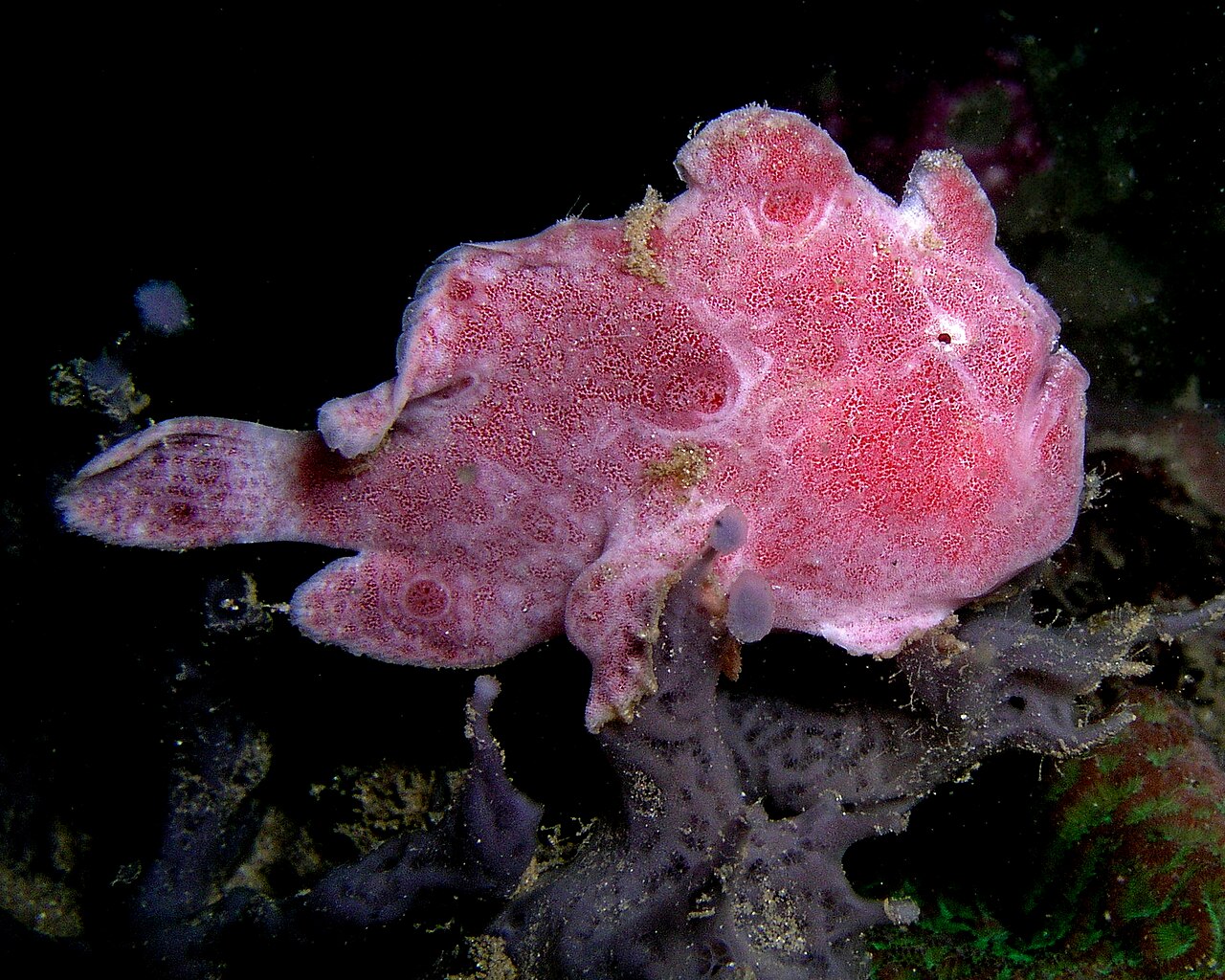
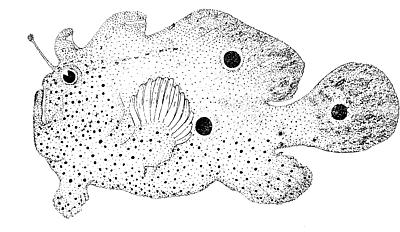
The body is somewhat compressed and globose, with eyes on the sides of the head and a large, upward-pointing mouth filled with many small teeth. Small gill openings sit behind and below the base of the limb-like pectoral fin, which has an elbow-like joint and a broad connection to the body. There are three dorsal spines and a dorsal fin with 13 soft rays. The first dorsal spine (the illicium) is about as long as the second, topped with an esca made of elongated filaments. The second dorsal spine is curved and connected to the head skin by a membrane; the third is movable and not connected. The anal fin has 8 soft rays, there is a caudal peduncle, and the rear edges of the dorsal and anal fins are not attached to the caudal fin. The skin is densely covered with bifurcated spicules. Color varies from orange to mottled yellow-brown, typically with three large conspicuous ocelli: one on the lower middle part of the dorsal fin, one directly below that spot, and one in the middle of the caudal fin. Many small dark spots appear on the lower head and body.
The ocellated frogfish ranges from North Carolina south through the Gulf of Mexico and the Caribbean to the northern coast of South America (Colombia and Venezuela). It lives on rock and coral reefs at depths of 1 to 150 m, usually between 20 and 50 m.
These fish are piscivorous predators, sedentary when not hunting.
Quick Facts
- Taxon
- Fowlerichthys ocellatus
Facts from the source article.
Lore & Background
The ocellated frogfish was first formally described as Lophius histrio ocellatus by the German naturalists Marcus Elieser Bloch and Johann Gottlob Theaenus Schneider, with its type locality given as Havana. This species is most closely related to F. senegalensis. The 5th edition of Fishes of the World classifies the genus Fowlerichthys in the family Antennariidae within the suborder Antennarioidei within the order Lophiiformes, the anglerfishes.
The genus name Fowlerichthys combines Fowler, honoring the American ichthyologist Henry Weed Fowler of the Academy of Natural Sciences of Philadelphia, with ichthys, meaning fish. The specific name ocellatus means having ocelli, a reference to the 2 or 3 eye-like spots possessed by this species. The fish has a somewhat compressed, globose body with eyes on the sides of the head, a large upwardly pointing mouth, and small gill openings located to the rear and below the base of the pectoral fin. The first dorsal spine (the illicium) is topped with an esca consisting of a cluster of elongated filaments. The skin has a dense covering of bifurcated spicules. Color varies from orange to mottled yellow-brown, typically with three large conspicuous ocelli: one on the lower middle part of the dorsal fin, one directly under that spot, and another in the middle of the caudal fin, plus many small dark spots on the lower head and body.
The ocellated frogfish is found in the Western Atlantic Ocean from North Carolina south through the Gulf of Mexico and the Caribbean to the northern coast of South America in Colombia and Venezuela. It inhabits rock and coral reefs at depths between 1 and 150 m, though typically between 20 and 50 m. It is a piscivorous predator that is sedentary when not hunting. The female's ovaries resemble tightly wound double scrolls, and when eggs are laid they are encased in a gelatinous mass that floats.
Reader's Guide
The ocellated frogfish is significant as the largest frogfish in the Western Atlantic, reaching a maximum total length of 38 cm. Its taxonomy places it within the genus Fowlerichthys, named in honor of American ichthyologist Henry Weed Fowler, and it is most closely related to F. senegalensis. The species is distinguished by its three conspicuous ocelli (eye-like spots) on the dorsal fin, body, and caudal fin, which give it its specific name ocellatus. Its distribution spans from North Carolina through the Gulf of Mexico and Caribbean to Colombia and Venezuela, occupying rock and coral reefs at depths typically between 20 and 50 m. As a piscivorous predator, it is sedentary when not hunting, and its reproductive biology involves eggs encased in a floating gelatinous mass. The species' variable coloration—from orange to mottled yellow-brown—and its dense covering of bifurcated spicules on the skin are key identifying features. Its legacy lies in being a well-documented example of a Western Atlantic frogfish, with its type locality in Havana and its description by Bloch and Schneider contributing to the historical understanding of anglerfish diversity.
Did You Know?
- The ocellated frogfish is the largest frogfish in the Western Atlantic, reaching 38 cm total length.
- Its specific name ocellatus means 'having ocelli,' referring to its 2 or 3 eye-like spots.
- The first dorsal spine (illicium) is topped with an esca that is a cluster of elongated filaments.
- The female's ovaries resemble tightly wound double scrolls, and eggs are laid in a floating gelatinous mass.
Gallery
Frequently Asked Questions
Who is Ocellated frogfish?
The ocellated frogfish (Fowlerichthys ocellatus) is a bottom-dwelling ambush predator in the frogfish family, native to the Western Atlantic. Bloch and Schneider first described it in the late 18th century, with the original specimen collected off Havana, Cuba.
What are Ocellated frogfish's key traits or 'powers'?
It is the largest frogfish in the Western Atlantic, topping out at 38 cm in total length, and it displays three prominent eye-like spots that help it vanish against reef and sandy backdrops. Most individuals are encountered between 20 and 50 meters, though the species can range from 1 to 150 meters deep.
Where does Ocellated frogfish live?
Its range is confined to the Western Atlantic Ocean, with the type locality being Havana, Cuba. It occupies a broad depth band but is most frequently seen in the 20-to-50-meter zone, favoring sandy or rubble substrates where its mottled coloration and ocelli provide near-perfect concealment.
Why is Ocellated frogfish important to the frogfish community?
As the biggest Antennariidae member in the Western Atlantic, it gives researchers a crucial benchmark for gauging size, morphology, and ecological role within the family. It is also the closest living relative of Fowlerichthys senegalensis, making it essential for tracing the evolutionary history of the genus.
How does Ocellated frogfish's taxonomic story play out?
Originally filed as a subspecies of Lophius histrio, it was later split into its own genus, Fowlerichthys, under the suborder Antennarioidei. The 5th edition of Fishes of the World confirms its placement in the family Antennariidae, cementing its status as a distinct lineage rather than a mere variant of the common frogfish.
More in Frogfish and Dragonets, Part 2 1-24
Spotted an error? Know more?
Reader corrections go straight into our review queue. Suggest an edit · How this site is sourced