
Antennarius scaber
A valid Western Atlantic frogfish with a two-lobed lure.

Pauline Walsh Jacobson · CC BY 4.0
Antennarius scaber, also called the splitlure frogfish or striated frogfish, is a marine ray-finned fish in the frogfish family Antennariidae. It lives in the Western Atlantic Ocean and was once thought to be the same species as Antennarius striatus, but genetic and physical evidence now shows it is a distinct species.
The French zoologist Georges Cuvier first described it in 1817, naming it *Chironectes scaber* with the type location given as Martinique. It belongs to the *striatus* species group within the genus *Antennarius*. In the 5th edition of *Fishes of the World*, the genus is placed in the family Antennariidae, suborder Antennarioidei, order Lophiiformes (the anglerfishes).
The genus name *Antennarius* comes from *antenna* plus the suffix *-ius*, referring to the first dorsal spine, which is modified into a snout tentacle used as a lure. The species name *scaber* means "rough," describing the fish's skin, which is covered in small spinules.
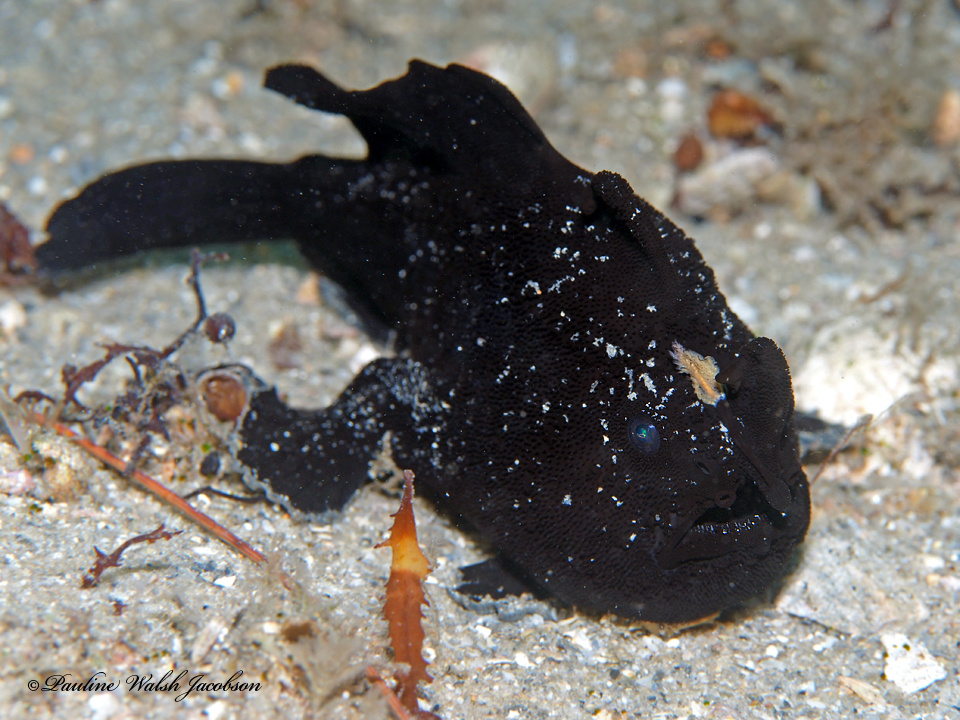
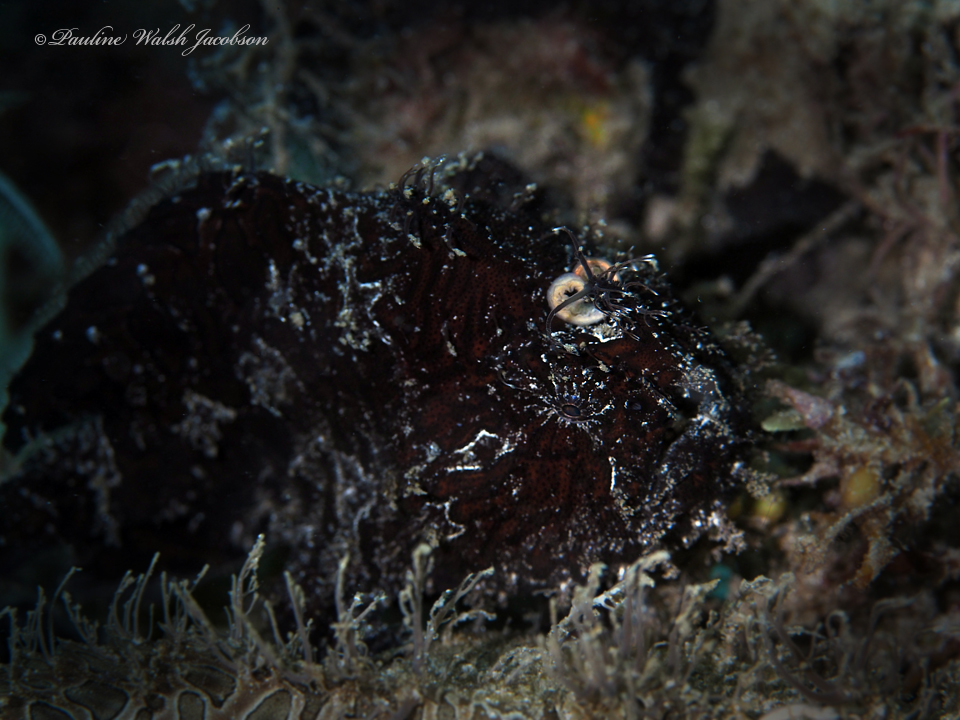
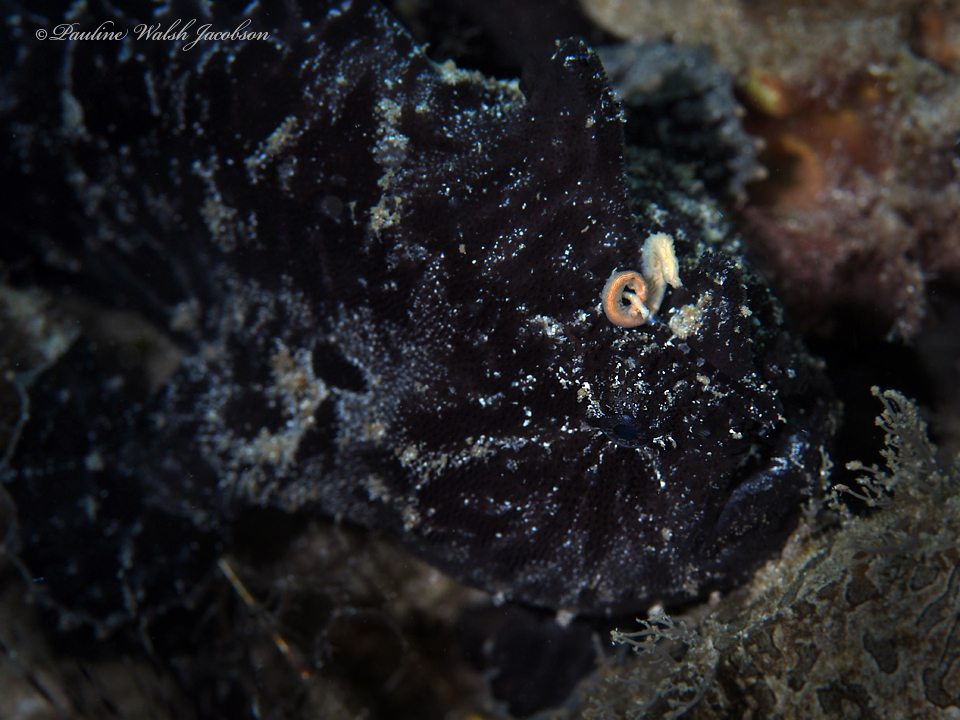
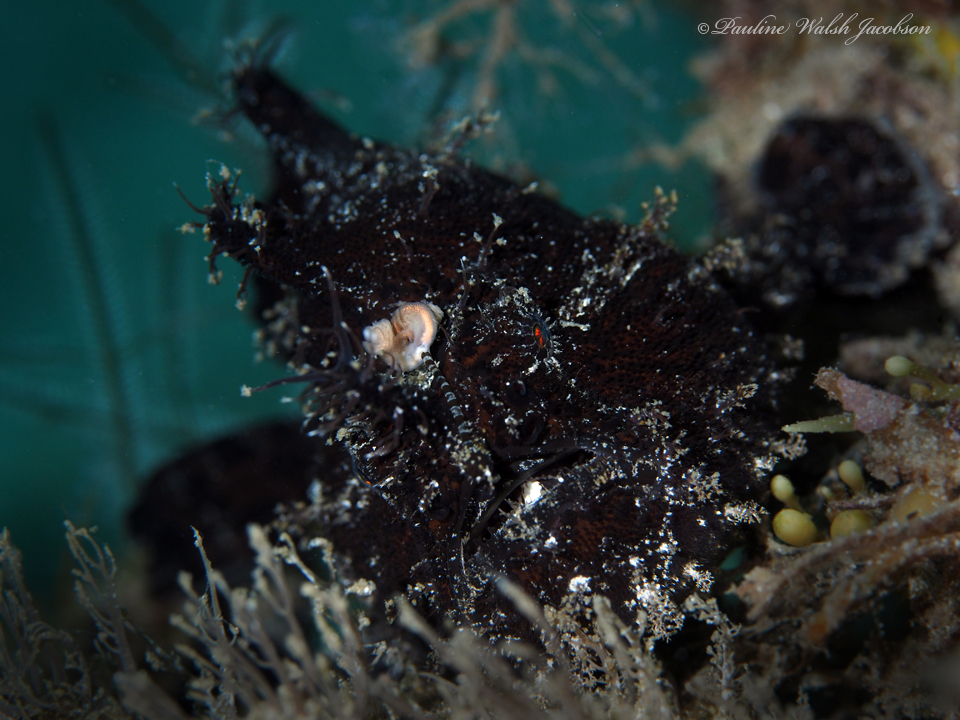
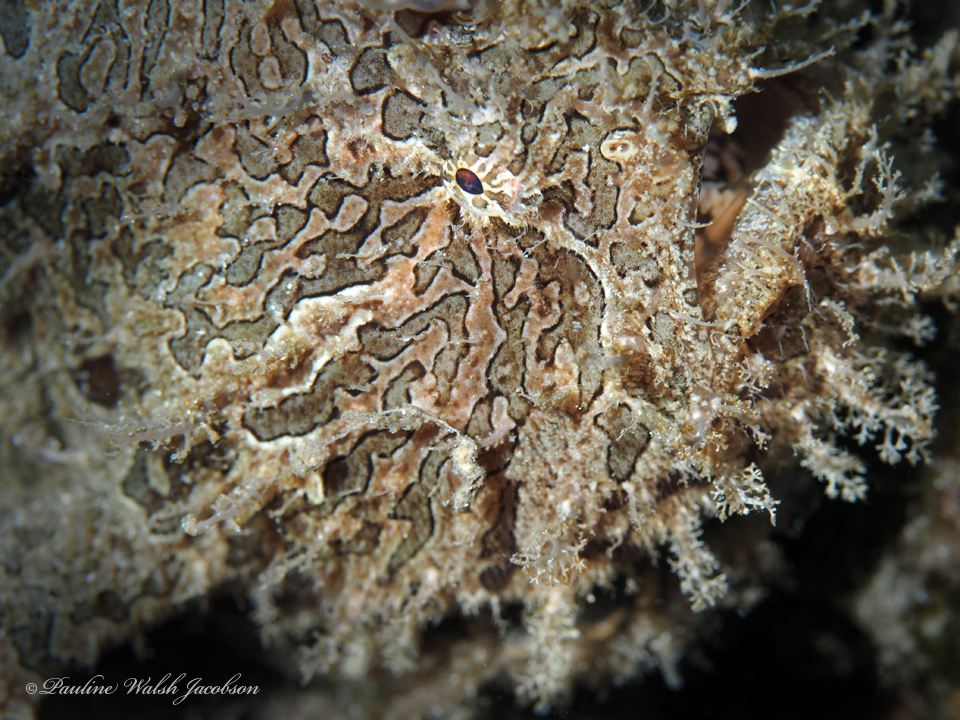
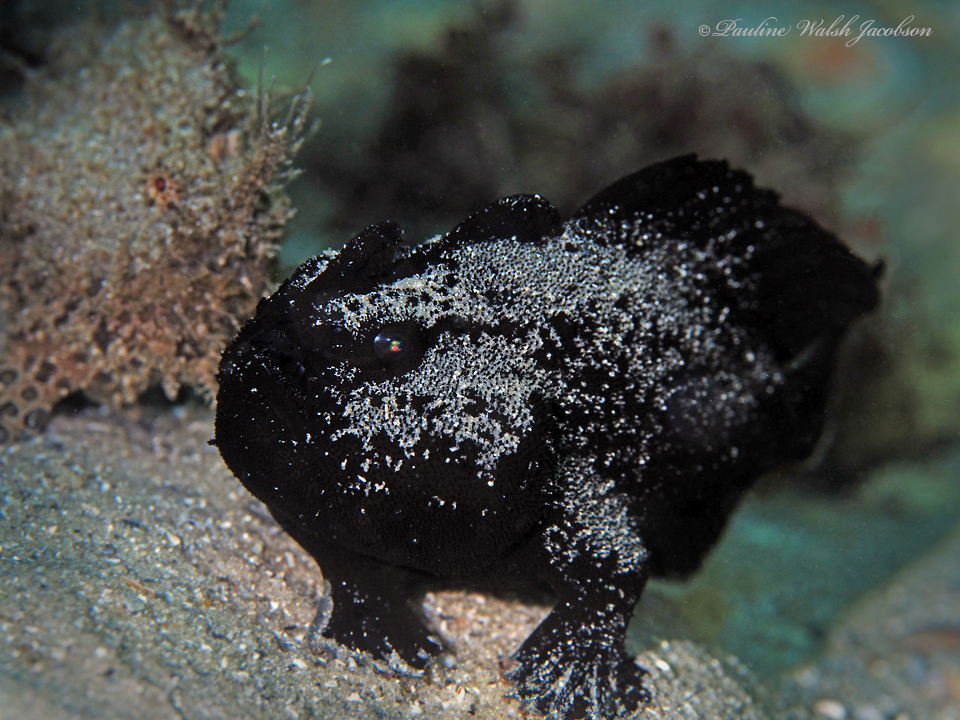
This frogfish has a rounded, somewhat compressed body with eyes on the sides of its head. Its mouth is very large and points upward, filled with many tiny teeth. The small, round gill opening sits below and behind the base of the pectoral fin. It has three dorsal spines: the first is the illicium, tipped with a lure (esca) made of two worm-like appendages; the second is roughly straight and attached to the head by a smooth membrane; the third is movable and not fixed to the skin. The limb-like pectoral fins have an elbow-like joint and are broadly attached to the body. The anal fin has 7 soft rays, and the dorsal fin has 12 soft rays. It has a caudal peduncle, and the dorsal and anal fins are not joined to the caudal fin. The rough skin is densely covered with forked spinules. Body color varies among yellow, orange, green, brown, gray, or nearly white, with irregular slender brown bars and spots on the head, body, and fins, plus dark broken lines radiating from the eye.
*Antennarius scaber* ranges in the western Atlantic from New Jersey and Bermuda south through the Bahamas, the Gulf of Mexico, and across Caribbean islands to the southern coast of Brazil. It is found from the surface down to 219 meters (719 feet), but typically lives shallower than 30 meters (98 feet) on reefs and over sandy or muddy bottoms.
Quick Facts
- Genus
- Antennarius
- Species
- scaber
Facts from the source article.
Lore & Background
Antennarius scaber was first formally described in 1817 as Chironectes scaber by French zoologist Georges Cuvier, with the type locality given as Martinique. It was long regarded as a synonym of the widespread Antennarius striatus, but molecular and morphological evidence has since confirmed A. scaber as a distinct species. Within the genus Antennarius, it belongs to the striatus species group. The 5th edition of Fishes of the World classifies the genus Antennarius in the family Antennariidae within the suborder Antennarioidei of the order Lophiiformes, the anglerfishes.
The genus name Antennarius alludes to the first dorsal spine being adapted into a tentacle on the snout used as a lure. The specific name scaber means 'rough', referring to the skin's covering of spinules. The fish has a globose, compressed body with a very large upward-pointing mouth and numerous small teeth. Its first dorsal spine (the illicium) is tipped with an esca made of two vermiform appendages. The second dorsal spine is straight and connected to the head by a smooth membrane; the third is movable and not fixed to the skin. The pectoral fins are limb-like with an elbow-like joint. The skin is rough with bifurcated spinules. Coloration varies through yellow, orange, green, brown, grey, or almost white, with irregular slender brown bars and spots and dark discontinuous lines radiating from the eye.
Reader's Guide
Antennarius scaber is notable for its long history of taxonomic confusion with Antennarius striatus, from which it was separated only through modern molecular and morphological analysis. This resolution underscores the importance of revisiting synonymized species with contemporary methods. The species is an ambush predator, using its illicium and esca to lure prey within striking distance. Like other frogfishes, it lays eggs in gelatinous masses called rafts or veils, which protect the eggs until hatching. Its distribution spans the Western Atlantic from New Jersey and Bermuda to southern Brazil, including the Gulf of Mexico and Caribbean islands, at depths from the surface to 219 m, typically shallower than 30 m on reefs and sandy or muddy substrates. The species' rough skin, variable coloration, and distinctive two-lobed lure are key identifying features. Its recognition as a valid species adds to the known diversity of Western Atlantic frogfishes and highlights the cryptic diversity within the Antennariidae family.
Did You Know?
- Antennarius scaber was originally described in 1817 as Chironectes scaber by Georges Cuvier.
- Its esca (lure) is made up of two vermiform appendages.
- The species was previously considered a synonym of Antennarius striatus.
- It is found at depths from the surface down to 219 m, but typically shallower than 30 m.
Gallery
Frequently Asked Questions
What is Antennarius scaber?
Antennarius scaber is a marine frogfish in the family Antennariidae, commonly known as the splitlure frogfish or striated frogfish. It is a ray-finned fish native to the Western Atlantic Ocean, found from New Jersey and Bermuda down to southern Brazil.
How is Antennarius scaber different from Antennarius striatus?
These two were long treated as a single species, but genetic and morphological comparisons have confirmed they are distinct. A. scaber is set apart in particular by its two-lobed illicial lure, a feature that distinguishes it from its close relative.
Where does Antennarius scaber live and at what depths?
Its range spans the Western Atlantic, stretching from the waters off New Jersey and Bermuda southward to southern Brazil. It has been recorded from the surface down to about 219 meters, though it is most often seen in shallower water under 30 meters.
Who first described Antennarius scaber and when?
French zoologist Georges Cuvier originally named the species Chironectes scaber in 1817, citing Martinique as the type locality. It was later transferred to the genus Antennarius and grouped within the striatus species complex.
What are the key physical traits of Antennarius scaber?
Like other members of its family, it has a heavily armored body and a modified first dorsal-fin ray that forms a two-lobed lure used to attract prey. It carries 12 soft dorsal rays and 7 soft anal rays, placing it squarely within the striatus species group of Antennarius.
More in Frogfish and Dragonets, Part 2 1-24
Spotted an error? Know more?
Reader corrections go straight into our review queue. Suggest an edit · How this site is sourced