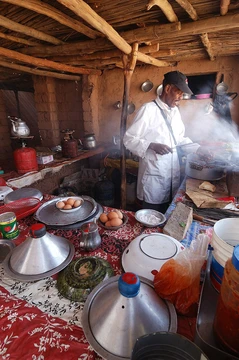
Spice
Last updated
A spice is a plant substance used for flavouring or colouring food, typically from seeds, fruits, roots, or bark.[1] Herbs are derived from leaves, flowers, or stems, which sets them apart from spices.[1]
Quick Facts
- Primary producer
- India (75% of global production)
Facts from the source article.
Key facts and history
Cloves were used in Mesopotamia by 1700 BCE.[2] The Republic of Venice held a monopoly on the spice trade with the Middle East from the 8th to the 15th century.[3] By 2000 BCE, cinnamon and black pepper were part of a spice trade that had developed across the Indian subcontinent and the Middle East.[4] The monsoon winds, discovered in 40 CE, were a crucial finding before the European spice trade, and sailing from Eastern cultivators to Western European consumers gradually replaced land routes.[5]
During the Middle Ages, black pepper, cinnamon, cumin, nutmeg, ginger, and cloves were among the most sought-after and costly products in Europe.[6] Global spice production is 75% contributed by India.[7]
What the cited sources add
The Mariners Weather Log notes that early explorers like Columbus sought spices from Asia, and that pepper was the most valuable spice to Europeans.[8] Columbus brought back allspice from the New World, which combines the fragrance of cinnamon, cloves, and nutmeg.[8] Vanilla originates from the tropical rainforests of Central America.[8] The Spices Board leads initiatives to ensure the quality of Indian spices, engaging all parts of the industry.[9]
References
- Wikipedia, "Spice" (CC BY-SA 4.0), which cites: "Spice and herb Types, Uses, & Facts Britannica", www.britannica.com, 2024-03-08; Ahmad, "Medicinal Plants of South Asia", 2020, p. 657–669 (we also read that source) en.wikipedia.org
- Wikipedia, "Spice" (CC BY-SA 4.0), which cites: Woodward, "Encyclopedia of Food and Culture", Charles Scribner's Sons, 2003, p. 187–195 (original not read by us) en.wikipedia.org
- Wikipedia, "Spice" (CC BY-SA 4.0), which cites: Adamson, Melitta Weiss, "Food in Medieval Times", Greenwood Press, 2004, p. 65 (we also read that source) en.wikipedia.org
- Wikipedia, "Spice" (CC BY-SA 4.0), which cites: Steven E. Sidebotham, "Berenike and the Ancient Maritime Spice Route", Univ of California Press, May 7, 2019 (original not read by us) en.wikipedia.org
- Wikipedia, "Spice" (CC BY-SA 4.0), which cites: Murdock, "A Busy Cook's Guide to Spices: How to Introduce New Flavors to Everyday Meals", Bellwether Books, 2001, p. 14 (we also read that source) en.wikipedia.org
- Wikipedia, "Spice" (CC BY-SA 4.0), which cites: Comme le précise l'historien français Jacques Heers, « contrairement à ce que disent nos livres, qui insistent tellement sur les condiments, [les] soieries vala (original not read by us) en.wikipedia.org
- Wikipedia, "Spice" (CC BY-SA 4.0), which cites: "Spices Board", www.indianspices.com (we also read that source) en.wikipedia.org
- "Mariners Weather Log Vol. 52, No. 3, December 2008", www.vos.noaa.gov. vos.noaa.gov
- "Spices Board", www.indianspices.com. indianspices.com
Each numbered sentence above was checked against the source it cites before publication. Sentences citing Wikipedia adapt text from the English Wikipedia article Spice (contributors), used under CC BY-SA 4.0; this entry is available under the same licence. Other sources were used for facts only.
More in Food & Cooking
Sources
Compiled from Wikipedia and the sources listed below. Text from Wikipedia is available under CC BY-SA 4.0; this entry is adapted from it.
- Wikipedia: Spice (CC BY-SA 4.0).
Spotted an error? Know more?
Reader corrections go straight into our review queue. Suggest an edit · How this site is sourced