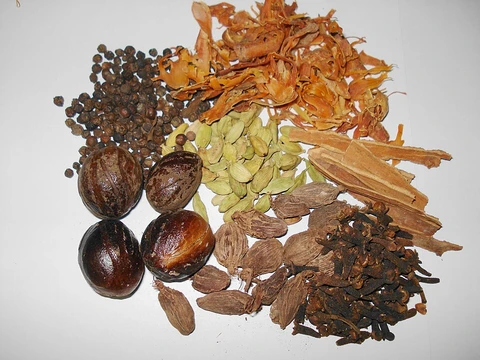
Clove
Aromatic flower buds native to the Moluccas, used worldwide as a spice and fragrance.
The aromatic flower buds of Syzygium aromaticum, a tree belonging to the Myrtaceae family, are known as cloves.[1] Indonesia's Maluku Islands (also called the Moluccas) are the native home of cloves, which find application as a spice, flavoring, or fragrance in items like toothpaste, soaps, and cosmetics.[1] Because different nations have varying harvest periods, freshly picked cloves can be obtained all year round.[1]
Quick Facts
- Genus
- Syzygium
- Species
- aromaticum
Facts from the source article.
Key facts and history
Cloves reached Rome by the first century AD.[2] During the Song Dynasty (960 to 1279 AD), cloves were primarily imported by private ventures called Merchant Shipping Offices.[3] In a fire-destroyed dwelling at Terqa, Syria, dating to 1720 BC under the kingdom of Ḫana, archaeologist Giorgio Buccellati discovered cloves.[2] This find, initially reported in 1978, provided the earliest indication that cloves were utilized in the West prior to the Roman era.[2]
Chinese merchants, during the Yuan dynasty (1271–1368 AD), started dispatching their own vessels straight to the Moluccas to acquire cloves.[3] From the wreck of the Danish-Norwegian flagship Gribshunden, which went down close to Ronneby, Sweden in June 1495, the oldest macro-botanical cloves ever found in northwest Europe were retrieved.[4] Although Indonesia leads the world in clove output, it exports merely 10–15% of its production.[5]
What the cited sources add
The Terqa archaeological narrative reports that a jar in the pantry of Puzurum contained a few kernels of cloves, reflecting the scope of Terqa's international trade connections.[6] A BBC article notes that a Han dynasty ruler from the 3rd century BC insisted that anyone addressing him chew cloves to sweeten their breath.[7] In 1770, a Frenchman named Poivre stole seedlings from the ancient clove tree Afo, taking them to France, the Seychelles, and eventually Zanzibar.[7] The Times of India article explains that "used cloves" refers to cloves from which the volatile oil has been extracted by distillation, and that adulterated cloves will float on the surface of water while unadulterated cloves settle at the bottom.[8]
The same article notes that any clove trees not under the control of the VOC were destroyed by uprooting and burning, and that the penalty for unauthorized growing or stealing of clove plants was execution.[7]
References
- Wikipedia, "Clove" (CC BY-SA 4.0), which cites: ; ; "Syzygium aromaticum (L.) Merr. and L.M. Perry", Kew Science, Plants of the World Online, 2021; "Clove", Drugs.com, 22 February 2024; Yun, "Tight Stocks of Quality Cloves Lead to a Price Surge", Tridge, 13 August 2018 (original not read by us) en.wikipedia.org
- Wikipedia, "Clove" (CC BY-SA 4.0), which cites: Buccellati, G., M. Kelly-Buccellati, The Terqa Archaeological Project: First Preliminary Report., Les Annales Archeologiques Arabes Syriennes 27–28, 1977–1978, ; Buccellati, G., M. Kelly-Buccellati, Terqa: The First Eight Seasons, Les Annales Archeologiques Arabes Syriennes 33(2), 1983, 47–67.; Terqa – A Narrative. terqa.org.; Smith, "Between Syria and the Highlands: Studies in Honor of Giorgio Buccellati & Marilyn Kelly-Buccellati", Arbor Sapientiae Editore, 2019, p. 373–377; Mahdi, "Archaeology and Language IV: Language Change and Cultural Tran en.wikipedia.org
- Wikipedia, "Clove" (CC BY-SA 4.0), which cites: Wang, "Earliest curry in Southeast Asia and the global spice trade 2000 years ago", Science Advances, 2023-07-21; Ptak, "China and the Trade in Cloves, Circa 960–1435", Journal of the American Oriental Society, January 1993, p. 1–13 (original not read by us) en.wikipedia.org
- Wikipedia, "Clove" (CC BY-SA 4.0), which cites: Larsson, "The king's spice cabinet–Plant remains from Gribshunden, a 15th century royal shipwreck in the Baltic Sea", PLOS ONE, 2023-01-26 (original not read by us) en.wikipedia.org
- Wikipedia, "Clove" (CC BY-SA 4.0), which cites: Pratama, "Indonesian Clove Competitiveness and Competitor Countries in International Market", Economics Development Analysis Journal, 2020-02-01, p. 39–54; Pratama, "Indonesian Clove Competitiveness and Competitor Countries in International Market", Economics Development Analysis Journal, 2020-02-01, p. 39–54; "OUTLOOK KOMODITAS PERKEBUNAN PUSAT DATA DAN SISTEM INFORMASI PERTANIAN SEKRETARIAT JENDERAL - KEMENTERIAN PERTANIAN TAHUN 2022 CENGKEH", Ministry of Agriculture (original not read by us) en.wikipedia.org
- Terqa – A Narrative. terqa.org.. facts only, no text reused. terqa.org
- Worrall, Simon, "The world's oldest clove tree", BBC News Magazine, 23 June 2012. facts only, no text reused. bbc.co.uk
- "Are your cloves adulterated with used cloves?", The Times of India, 2022-01-12. facts only, no text reused. timesofindia.indiatimes.com
Each numbered sentence above was checked against the source it cites before publication. Sentences citing Wikipedia adapt text from the English Wikipedia article Clove (contributors), used under CC BY-SA 4.0; this entry is available under the same licence. Other sources were used for facts only; no text or images are copied from them.
Spotted an error? Know more?
Reader corrections go straight into our review queue. Suggest an edit · How this site is sourced