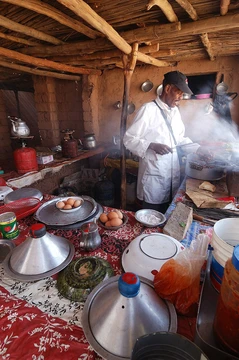
Meat
Animal tissue consumed as food, with cultural and environmental significance.
Last updated
Meat is animal tissue, mostly muscle, that is consumed as food. Humans have hunted and farmed animals for meat since prehistory, and the Neolithic Revolution enabled the domestication of vertebrates such as chickens, sheep, goats, pigs, horses, and cattle. Meat is economically and culturally significant worldwide, though its production and consumption carry health and environmental implications.
Quick Facts
- Composition
- Roughly 75% water
- 19% protein
- 2.5% intramuscular fat
- 1.2% carbohydrates
- 2.3% other soluble substances
- Domestication began
- Around 11,000 years ago
- Key domesticated species
- Chickens
- sheep
- goats
- pigs
- horses
- cattle
- Major health classification
- Processed meat classified as Group 1 carcinogen; red meat as Group 2A probable carcinogen
- Land use
- Nearly 40% of global land surface used for meat production
Facts from the source article.
Animal growth and development
Several factors influence the growth and development of meat animals. Economically important traits are partly heritable and can be selected through breeding; in cattle, recessive genes control features such as dwarfism and the doppelender condition, which causes muscle hypertrophy and increases commercial value. Genetic analysis continues to reveal endocrine mechanisms affecting meat growth and quality.
Genetic engineering can shorten breeding programs by identifying and isolating genes for desired traits and reincorporating them into the genome; genomes of many animals are being mapped. A recombinant bacterium has been developed to improve grass digestion in cattle rumen, and some muscle fiber features have been genetically altered. Experimental reproductive cloning of sheep, pigs, and cattle has succeeded, and asexual reproduction of animals with desirable traits is anticipated. Heat regulation in livestock is economically significant; low temperatures prolong development while high temperatures delay it.
Tolerance zones vary by size, shape, and insulation. Static magnetic fields retard development for unknown reasons. The plane of nutrition affects meat quality and quantity, though scientists disagree on how exactly it influences carcass composition.
Health effects
Consumption of red and processed meat is linked to increased risks of cancer, coronary heart disease, and diabetes. The 2015–2020 Dietary Guidelines for Americans recommended that men and teenage boys reduce intake of protein foods while increasing vegetables and other underconsumed foods. Toxic compounds such as heavy metals, mycotoxins, pesticide residues, dioxins, and polychlorinated biphenyls can contaminate meat; processed, smoked, and cooked meat may contain carcinogens like polycyclic aromatic hydrocarbons. Toxins may enter meat through feed, veterinary drug residues, or during processing and cooking, and are often metabolized into harmful by-products.
The International Agency for Research on Cancer classified processed meat as carcinogenic to humans (Group 1) based on sufficient evidence for colorectal cancer, and red meat as probably carcinogenic (Group 2A) based on limited evidence and strong mechanistic support. Cancer Research UK, the NHS, the National Cancer Institute, the American Cancer Society, and the Canadian Cancer Society have all stated that red and processed meat increases cancer risk. A 2021 review found an 11–51% increased risk of multiple cancer per 100g/d increment of red meat and an 8–72% increased risk per 50g/d increment of processed meat.
Environmental impact
Meat production causes serious negative environmental effects, including greenhouse gas emissions, fossil energy use, water use, water quality changes, and impacts on grazed ecosystems. University of Oxford researchers stated that a vegan diet is probably the single biggest way to reduce one's environmental impact, far larger than reducing flights or buying an electric car, though this is often ignored in public consciousness and climate crisis plans. The livestock sector may be the largest source of water pollution from animal wastes, fertilizers, and pesticides, and contributes to antibiotic resistance; it accounts for over 8% of global human water use. It drives biodiversity loss through deforestation, ocean dead zones, species extinction, land degradation, pollution, overfishing, and global warming.
Cattle farming was estimated responsible for 80% of Amazon deforestation in 2008 due to clearing for animal feed and ranching. Environmental effects vary among production systems; grazing can benefit some wildlife but not others, and targeted grazing is used as an alternative to herbicides. Meat production uses nearly 40% of global land surface; in the contiguous United States, 34% of land is pasture and rangeland for livestock, plus cropland for feed. Roughly 75% of deforested land globally is used for livestock pasture, releasing carbon and removing carbon sinks.
Cultural aspects
Meat is part of the human diet in most cultures and often carries symbolic meaning and social functions. Some people choose not to eat meat (vegetarianism) or any animal products (veganism) for ethical, health, environmental, or religious reasons. Ethical objections include killing animals for food or agricultural practices; some refuse certain meats for cultural or religious reasons.
Western philosophers disagreed on meat ethics: Plato's Socrates described the ideal state as vegetarian; Pythagoras and Plutarch disapproved of meat consumption, while Zeno and Epicurus were vegetarian but allowed meat-eating. Aristotle argued animals exist to serve humans as food, and Augustine used this to justify eating animals. Descartes viewed animals as machines, Kant as inferior means, while Voltaire and Rousseau disagreed; Rousseau argued meat-eating is social rather than natural.
Later philosophers examined modern detachment from animals as living beings: Norbert Elias noted that medieval tables featured whole cooked animals, but since the Renaissance only edible parts are served, no longer recognizably animal. Noëlie Vialles described an ellipsis between meat and dead animals. Fernand Braudel wrote that the heavy meat diet of 15th- and 16th-century Europe helped export meat-eating through colonialism.
Did You Know?
- The word 'meat' comes from Old English 'mete', meaning food in general.
- Paleontological evidence suggests meat was a substantial part of the earliest human diet.
- Intensive animal farming accounted for 30% of world meat production in 1990 and rose to 40% by 2005.
More in Food & Cooking
Sources
Compiled from Wikipedia and the sources listed below. Text from Wikipedia is available under CC BY-SA 4.0; this entry is adapted from it.
- Wikipedia: Meat (CC BY-SA 4.0).
- Word definitions: the Codexery glossary, each quoted from its Wikipedia article.
Spotted an error? Know more?
Reader corrections go straight into our review queue. Suggest an edit · How this site is sourced