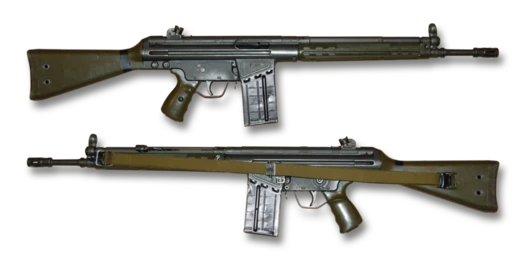
SIG MG 710-3
Swiss export GPMG using roller-delayed blowback action.
Last updated
The SIG MG 710-3 is a Swiss general-purpose machine gun chambered for the 7.62 mm cartridge. It was built by SIG, now known as Swiss Arms AG. The weapon was created as a commercial product aimed at foreign buyers. This was because the Swiss military had already chosen the 7.5 mm MG 51, a general-purpose machine gun made by the state-owned factory W+F.
Development
Work on the SIG MG 710-3 began in 1955 under the initial designation Model 55, changed in 1957 to SIG MG 710. Its design was influenced by the MG 45, a late World War II development of the German MG 42.
Earlier variants included the SIG MG 710-1 chambered in 6.5×55mm and the SIG MG 710-2 in 7.92×57mm Mauser. The prototype for the final production version, the SIG MG 710-3 chambered in 7.62×51mm NATO, was completed by the mid-1960s. As of 2010, the weapon was in use by the armed forces of Bolivia, Brunei, Chile and Liberia; the Swiss Army never adopted it.
Design details
The SIG MG 710-3 is a fully automatic, air-cooled machine gun that uses an open bolt and feeds from a belt. Its action relies on roller-delayed blowback, but the bolt assembly is a three-part design, unlike other roller-delayed systems from CETME or Heckler & Koch. This assembly includes a bolt head with two locking rollers, a striker sleeve, and a bolt carrier that connects telescopically to the bolt head. As a round is chambered, the return spring pushes the bolt and carrier forward.
The rollers then ride along camming surfaces, forcing them outward into recesses in the barrel extension. When the gun fires, the bolt carrier and striker sleeve recoil backward. The fixed camming surfaces push the rollers inward, unlocking the breech and making the striker sleeve withdraw faster than the bolt. The slower bolt continues rearward and hits the returning striker sleeve, which slows the bolt down.
The bolt houses a spring extractor, while a lever-style ejector sits at the base of the feed tray, pushing spent casings downward. The gun uses a striker firing mechanism, a trigger that only allows fully automatic fire, and a cross-bolt safety that, when set to safe, disables the bolt catch. Ammunition feeds from the left side, accepting either NATO standard disintegrating M13 links or continuous German DM1 belts, but swapping several parts in the feed block is required to switch between them.
In a light machine gun configuration, the belt is stored in a 50-round sheet metal container attached to the left side of the receiver. The feed system is similar to that of the MAG machine gun, using a feed arm driven by the striker sleeve’s movement to advance the belt in two stages, once during the bolt’s forward travel and once during its rearward travel. The barrel is quick-change, ends with a slotted flash suppressor, and has a fixed handle for removal. Three barrel profiles are available: a light profile, a heavy profile for sustained fire, and a special type for firing blank ammunition.
More in FN, Heckler & Koch, SIG and Mauser Firearms
Sources
Compiled from Wikipedia and the sources listed below. Text from Wikipedia is available under CC BY-SA 4.0; this entry is adapted from it.
- Wikipedia: SIG MG 710-3 (CC BY-SA 4.0).
- Word definitions: the Codexery glossary, each quoted from its Wikipedia article.
Spotted an error? Know more?
Reader corrections go straight into our review queue. Suggest an edit · How this site is sourced