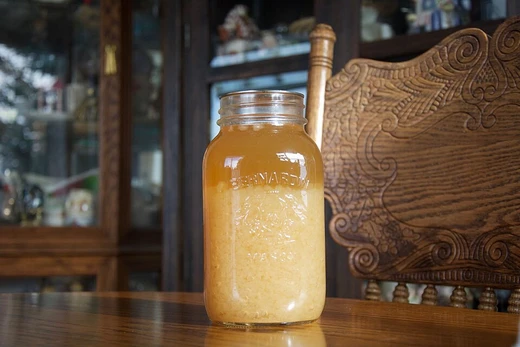
Gochujang
A fermented Korean chili paste used in stews, marinades, and condiments.

Wikipedia / Wikimedia Commons
Gochujang is a fermented Korean condiment known for its balance of savory, sweet, and spicy flavors. Its main ingredients are gochugaru (red chili powder), chapssal (glutinous rice), powdered meju (fermented soybeans), yeotgireum (barley malt powder), and salt. The sweetness develops naturally during fermentation, as enzymes break down the starches in the cooked glutinous rice. In traditional preparation, the paste was left to ferment for years in earthenware jars called jangdok, which were kept on an elevated stone platform known as jangdokdae in the backyard.
The earliest known record of a Korean pepper paste appears in the mid-9th-century Chinese text *Shiyi xinjian*, which calls it 苦椒醬 (kǔ jiāo jiàng, meaning “pepper paste”). Later mentions occur in the 1433 Korean book *Collected Prescriptions of Native Korean Medicines* and a 1445 medical encyclopedia, *Compendia of Medical Prescriptions*—though all these references predate the introduction of chili peppers to Korea. Chili peppers, native to the Americas, were brought to East Asia by Portuguese traders in the early 16th century. A type of chili pepper is noted in the 1614 encyclopedia *Collected Essays of Jibong*, and cultivation methods appear in the circa 1700 book *Farm Management*.
Sunchang gochujang has been a regional specialty since the 14th century, around the start of the Joseon Dynasty (1392–1910). According to tradition, Yi Seong-gye—who would become King Taejo, the dynasty’s founder—once ate barley bibimbap with gochujang at Manilsa Temple and found it unforgettable. After becoming king, he ordered it served to the royal family, cementing Sunchang gochujang’s reputation. In the 18th-century works *Somun saseol* and *Revised and Augmented Farm Management*, the condiment is written as gochojang using the hanja characters 苦椒醬 and 古椒醬, and Sunchang County is noted for its production. Notably, neither China nor Japan—Korea’s closest cultural and trade partners—include gochujang in their traditional cuisines.
Historical recipes vary. The *Jeungbo sallim gyeongje* calls for 18 liters of powdered, sieved meju, 540 milliliters of chili powder, 1.8 liters of glutinous rice flour, and soup soy sauce to adjust consistency. The 1809 cookbook *Gyuhap chongseo* uses powdered meju made from 18 liters of soybeans and 3.6 liters of glutinous rice, then adds 900 to 1,260 milliliters of chili powder and cooked glutinous rice (bap) made from another 3.6 liters of glutinous rice.
The primary ingredients are red chili powder, glutinous rice powder, powdered fermented soybeans, and salt. Korean chili peppers (*Capsicum annuum*) are both spicy and sweet, making them well-suited for gochujang. A typical formula uses 25% red pepper powder, 22.2% glutinous rice, 5.5% meju powder (60% cooked soybeans and 40% non-glutinous rice), 12.8% salt, 5% malt, and 29% water. Other recipes may include normal short-grain rice, barley, whole wheat kernels, jujubes, pumpkin, or sweet potato. A small amount of sugar, syrup, or honey is sometimes added. The finished paste is dark red, with a rich, pungent flavor.
Home production of gochujang began to decline when commercial manufacturing entered the mass market in the early 1970s. Today, most Koreans buy it at grocery stores or markets. It remains widely used in Korean cooking: to flavor stews like gochujang jjigae, to marinate meat such as in gochujang bulgogi, and as a condiment for naengmyeon and bibimbap. It also serves as a base for other condiments. Chogochujang is made by adding vinegar, sugar, and sesame seeds, and is commonly used with hoe (raw fish) and hoedeopbap. Ssamjang combines gochujang with doenjang, chopped onions, and other seasonings, and is popular with sangchussam (lettuce wraps).
The gochujang hot-taste unit (GHU) measures pungency based on gas chromatography and high-performance liquid chromatography of capsaicin and dihydrocapsaicin concentrations. Products are classified into five spiciness levels: Mild, Slight Hot, Medium Hot, Very Hot, and Extreme Hot.
Gochujang appears in dishes such as bibimbap, tteokbokki, salads, stews, soups, and marinated meats. Depending on the capsaicin content of the base chili, it can make dishes spicier, but it also adds sweetness and a smoky note.
A 2024 study of 35 traditional cottage-industry gochujang products found that 8 samples (57% of those tested) exceeded the recommended limit of 4 log CFU/g for *Bacillus cereus*, a spore-forming bacterium that can produce emetic and diarrheal toxins. The same study reported that 57% of products contained alcohol levels above 1%, which may matter for consumers following halal dietary guidelines. Commercial gochujang produced under standardized conditions generally shows lower contamination and alcohol levels. A 2015 survey of Korean fermented soybean products found that 13 of 23 gochujang samples tested positive for *Bacillus cereus*.
- Type
- Fermented condiment
- Primary ingredients
- Red chili powder, glutinous rice, fermented soybean powder, barley malt powder, salt
- Origin
- Korea
- First documented
- Mid-9th-century Chinese document Shiyi xinjian
- Spiciness measurement
- Gochujang hot-taste unit (GHU)
- Commercial production began
- Early 1970s
Lore & Background
The history of gochujang is documented as early as the mid-9th century in the Chinese text Shiyi xinjian, which recorded it as 苦椒醬 (pepper paste). Later Korean sources from 1433 and 1445 also mention pepper paste, though these predate the introduction of chili peppers to Korea. Chili peppers, native to the Americas, were brought to East Asia by Portuguese traders in the early 16th century, with a mention in the 1614 encyclopedia Collected Essays of Jibong and cultivation methods discussed in a book from around 1700.
Sunchang gochujang became a regional specialty dating back to the 14th century, at the start of the Joseon Dynasty. Founder Yi Seong-gye, after tasting barley bibimbap with gochujang during a trip to Manilsa Temple, ordered it served to the royal family. In 18th-century books Somun saseol and Revised and Augmented Farm Management, gochujang is written as gochojang, and Sunchang County was renowned for its production. China and Japan do not include gochujang in their traditional cuisines.
Historical recipes from Jeungbo sallim gyeongje and the 1809 cookbook Gyuhap chongseo specify ingredients such as powdered meju, chili powder, and glutinous rice flour. Modern recipes typically use 25% red pepper powder, 22.2% glutinous rice, 5.5% meju powder, 12.8% salt, 5% malt, and 29% water. Home production declined after commercial production entered the mass market in the early 1970s.
Reader's Guide
Gochujang is significant as a foundational ingredient in Korean cuisine, used to flavor stews (jjigae), marinate meat (as in gochujang bulgogi), and as a condiment for dishes like naengmyeon and bibimbap. It also serves as a base for other condiments such as chogochujang (with vinegar and seasonings) and ssamjang (mixed with doenjang). Its legacy includes a standardized spiciness measurement, the Gochujang hot-taste unit (GHU), which assigns products to five levels from Mild to Extreme Hot. Safety studies have noted potential contamination with Bacillus cereus and aflatoxin in traditional cottage industry products, though commercial production under standardized conditions shows lower levels. The condiment's global popularity has grown, with features in outlets such as BBC Travel. Gochujang remains a versatile element in Korean cooking, contributing spiciness, sweetness, and smokiness to a wide range of dishes.
Did You Know?
- Gochujang is made from gochugaru (red chili powder), chapssal (glutinous rice), meju (fermented soybean) powder, yeotgireum (barley malt powder), and salt.
- The second-oldest documentation of pepper paste is found in the 1433 Korean book Collected Prescriptions of Native Korean Medicines, before chili peppers were introduced to Korea.
- Sunchang gochujang became a regional specialty after founder Yi Seong-gye ordered it served to the royal family in the 14th century.
- A 2024 study found that 57% of traditional cottage industry gochujang products exceeded the recommended limit for Bacillus cereus.
Frequently Asked Questions
What is Gochujang?
Gochujang is a Korean fermented condiment that delivers a complex blend of savory, sweet, and spicy flavors. It functions as a foundational ingredient in stews, marinades, and dipping sauces throughout Korean cooking.
What are Gochujang's primary ingredients?
The paste is built from gochugaru (red chili powder), glutinous rice, meju (fermented soybean) powder, yeotgireum (barley malt powder), and salt. Its characteristic sweetness arises when saccharifying enzymes gradually break down the rice starch during the fermentation process.
How is Gochujang traditionally fermented?
In classic Korean practice, the mixture ferments naturally over the course of years inside jangdok (earthenware jars) set on a raised stone platform called a jangdokdae in a backyard. This slow, ambient-temperature method contrasts with the commercial production that only began in the early 1970s.
When was Gochujang first documented?
The earliest surviving written reference to Gochujang comes from a mid-9th-century Chinese text titled Shiyi xinjian. That places its recorded history roughly a millennium before it became a ubiquitous kitchen staple across Korea.
How is Gochujang's spiciness measured?
Instead of relying on the generic Scoville scale, Gochujang heat is expressed in a dedicated unit called the Gochujang Hot-taste Unit (GHU). This specialized metric better captures how the paste's spice interacts with its sweetness and umami depth.
More in Fermented Foods 1-17
Spotted an error? Know more?
This is a living reference — every entry is fact-audited, and reader corrections feed straight into our audit queue. Suggest an edit · See this site's audit record