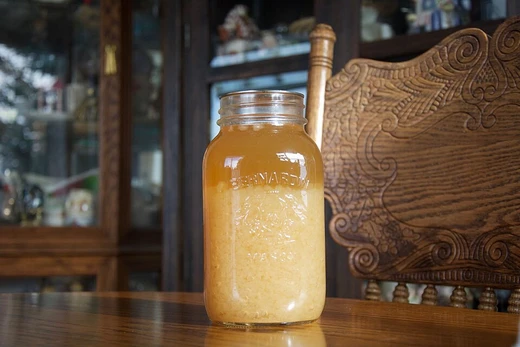
Soy sauce
A fermented Chinese condiment with saltiness and umami.

Wikipedia / Wikimedia Commons
Soy sauce, also known as soya sauce in British English, is a salty, umami-rich liquid condiment that originated in China. It is traditionally produced by fermenting a paste made from soybeans, roasted grain, brine, and a mold called *Aspergillus oryzae* or *Aspergillus sojae* (kōji). The sauce as we know it today was developed around 2,200 years ago during China’s Western Han dynasty. Since then, it has become a key ingredient in East and Southeast Asian cuisines and is now used worldwide as a condiment.
Soy sauce can be used directly on food, often as a dipping sauce or as a seasoning in cooking. It is commonly paired with rice, noodles, sushi, or sashimi, and sometimes mixed with ground wasabi for dipping. Bottles of soy sauce are frequently found on restaurant tables in many countries. The sauce is indefinitely shelf-stable.
In China, soy sauce (jiàngyóu) is nearly as old as soy paste, a fermented soybean product that appeared during the Western Han dynasty (206 BC – 220 AD) and was recorded on bamboo slips from the Mawangdui archaeological site. Early precursors include qingjiang (清醬), noted in AD 40 in the *Simin Yueling*, and later jiangqing, chizhi, and chiqing, documented in the *Qimin Yaoshu* in AD 540. By the Song dynasty (960–1279 AD), the term jiàng yóu became standard, appearing in the books *Shanjia Qinggong* and *Pujiang Wushi Zhongkuilu*. Originally, soy sauce helped stretch salt, which was historically expensive. During the Zhou dynasty, a fermented fish-and-salt condiment included soybeans; by the Han dynasty, this evolved into soy paste and its by-product soy sauce, with fish-based sauces developing separately into fish sauce. In the 19th century, Sinologist Samuel Wells Williams noted that the best Chinese soy sauce was made by boiling beans soft, adding an equal amount of wheat or barley, letting the mass ferment, then adding salt and three times as much water, and leaving the mixture for two to three months before pressing and straining.
In Japan, a fish sauce called gyoshō predated soy sauce. When Buddhist practitioners arrived from China in the 7th century, they introduced vegetarianism and soy-based products, including soy sauce, known as shōyu in Japan. The Dutch East India Company began exporting shoyu in 1647.
In Korea, soy sauce brewing likely started during the Three Kingdoms era. Jangdoks (fermentation pots) appear in 4th-century Goguryeo murals from Anak Tomb No. 3. The *Samguk sagi* records that ganjang (soy sauce) and doenjang (soybean paste), along with meju and jeotgal, were prepared for King Sinmun’s wedding in February 683. The *Sikhwaji* section of *Goryeosa* notes that ganjang and doenjang were included in relief supplies after a Khitan invasion in 1018 and during a famine in 1052. Joseon texts like *Guhwangchwaryo* and *Jeungbo sallim gyeongje* detail brewing procedures, while *Gyuhap chongseo* explains how to choose brewing dates and preserve the sauces.
In the Philippines, soy sauce was first recorded through the traditional dish adobo in a 1613 document by San Buenaventura. Food historian Raymond Sokolov suggested that ingredients like soy sauce were likely already present in native cuisine before colonial records.
In Europe, the Dutch East India Company listed soy sauce as a commodity in 1737, shipping seventy-five large barrels from Dejima, Japan, to Batavia (now Jakarta), with thirty-five barrels then sent to the Netherlands. In the 18th century, diplomat Isaac Titsingh published accounts of soy sauce brewing, focusing on the Japanese version. By the mid-19th century, Japanese soy sauce had largely disappeared from the European market, and the condiment became associated with Chinese products. Europeans could not produce soy sauce due to a lack of *Aspergillus oryzae*. Instead, European cookbooks from the late 18th century included recipes using ingredients like portobello mushrooms. A Swedish recipe for "Soija" appeared in the 1770 edition of Cajsa Warg's *Hjelpreda i Hushållningen för Unga Fruentimber*, flavored with allspice and mace.
In the United States, soy sauce production began in the Territory of Hawaii in 1905 with Yamajo Soy Co, which became the Hawaiian Soy Company Ltd in 1909. La Choy introduced hydrolyzed vegetable protein–based soy sauce in 1933. Until authentic Chinese cuisine gained popularity in the 1970s, some Americans pejoratively called the sauce "beetle juice," a slur that had heavily declined by 1976.
Soy sauce is produced either through fermentation or chemical hydrolysis, and some commercial sauces combine both methods.
- origin
- China
- created
- about 2,200 years ago (Western Han dynasty)
- field
- Condiment
- known_for
- Saltiness and pronounced umami taste
- key_ingredients
- Soybeans, roasted grain, brine, Aspergillus oryzae or Aspergillus sojae molds
Lore & Background
Soy sauce is considered almost as old as soy paste, a type of fermented paste from soybeans that appeared during the Western Han dynasty (206 BC – 220 AD) and was listed in bamboo slips found at the archaeological site Mawangdui. The oldest precursor, qingjiang, appeared in AD 40 and was listed in Simin Yueling. Other precursors include jiangqing, chizhi, and chiqing, recorded in the Qimin Yaoshu in AD 540. By the Song dynasty (960–1279 AD), the term jiàng yóu had become the accepted name, documented in two books: Shanjia Qinggong and Pujiang Wushi Zhongkuilu. During the Zhou dynasty, fermented fish with salt was used as a condiment with soybeans included; by the Han dynasty, this was replaced with soy paste and its by-product soy sauce, with fish-based sauces developing separately into fish sauce.
Reader's Guide
Soy sauce is made either by fermentation or by hydrolysis, with some commercial sauces using both methods. Traditional production involves soaking and cooking soybeans, roasting and crushing wheat, then culturing the mixture with Aspergillus spores (koji). The cultured grain is mixed with salt brine and left to brew, during which the mold breaks down proteins and starches. Lactic acid bacteria and yeast produce additional flavor compounds. After pressing and pasteurization, the liquid soy sauce is ready. Variation arises from different methods and durations of fermentation, ratios of ingredients, or addition of other components. Soy sauce is indefinitely shelf-stable and is used directly as a dipping sauce or seasoning in cooking, commonly with rice, noodles, sushi, or sashimi. It spread from China to Japan, Korea, the Philippines, Europe, and the United States, with records of Dutch East India Company shipments in 1737 and production in Hawaii beginning in 1905.
Did You Know?
- Soy sauce was created in its current form about 2,200 years ago during the Western Han dynasty of ancient China.
- The term jiàng yóu became the accepted name for soy sauce during the Song dynasty (960–1279 AD).
- Japanese shoyu exportation began in 1647 by the Dutch East India Company.
- Soy sauce production in the United States began in the Territory of Hawaii in 1905 by Yamajo Soy Co.
Frequently Asked Questions
Who is Soy sauce?
Soy sauce is a liquid condiment that originated in China roughly 2,200 years ago during the Western Han dynasty. It is produced by fermenting a paste of soybeans, roasted grain, and brine with Aspergillus oryzae or Aspergillus sojae molds, and British English speakers often call it "soya sauce."
What are Soy sauce's powers/role?
Soy sauce is prized for delivering a strong salty punch alongside a deep, savory umami flavor that lifts the taste of a dish. In the kitchen it serves as a versatile seasoning and flavor-building agent across East and Southeast Asian cuisines.
How does Soy sauce's story end?
Soy sauce has no real ending—it has remained a staple ingredient for over two millennia and is still a household condiment worldwide today. Its story continues to evolve as new regional varieties and modern culinary applications keep appearing.
Why is Soy sauce important?
It is a foundational ingredient in East and Southeast Asian cooking, supplying both salt and umami in a single liquid. Its spread far beyond China has made it one of the most widely recognized condiments on the global table.
What is Soy sauce's origin story and key ingredients?
Soy sauce was first created in its recognizable form around 2,200 years ago in ancient China during the Western Han dynasty. Its core recipe depends on soybeans, roasted grain, brine, and the kōji molds Aspergillus oryzae or Aspergillus sojae to drive the fermentation process.
More in Fermented Foods 1-17
Spotted an error? Know more?
This is a living reference — every entry is fact-audited, and reader corrections feed straight into our audit queue. Suggest an edit · See this site's audit record