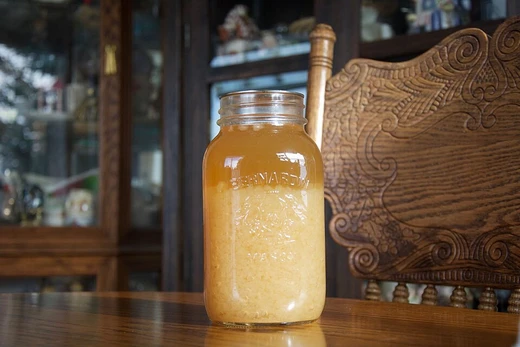
Sauerkraut
Fermented cabbage with ancient Roman and European roots.

Wikipedia / Wikimedia Commons
Sauerkraut is made from finely shredded raw white cabbage that has undergone fermentation by various lactic acid bacteria. The sour taste and long storage life come from the lactic acid produced as these bacteria break down the sugars in the cabbage leaves.
The English term comes from the German *Sauerkraut*, meaning "sour cabbage," but the dish itself did not originate in Germany. Roman writers like Cato and Columella described preserving cabbage and turnips with salt, and Pliny the Elder, in the first century AD, is credited with the first written account of making sauerkraut—what the Romans called "salt cabbage"—stored in earthen vessels. A popular legend claims that the Golden Horde’s trade networks introduced sauerkraut to Europe, but there is no evidence for this, nor for an East Asian origin. Instead, evidence shows sauerkraut production in Europe dating back to the early Western Roman Empire. Before refrigeration, freezing, and cheap transport from warmer regions were common in Northern, Central, and Eastern Europe, sauerkraut provided essential nutrients like vitamin C during winter. Captain James Cook carried it on his voyages to prevent scurvy.
Fermented cabbage, known as *suan cai*, may have been made in China during the building of the Great Wall, but the Romans are the more likely source of modern European sauerkraut. It became popular in Central and Eastern European cuisines, including the Netherlands (where it is called *zuurkool*) and France (*choucroute*). According to Mack and Surina, Slavic peoples likely developed fermented cabbage independently. Many Slavic and other languages have names with similar meanings to the German word, such as *kiseli kupus* in Serbo-Croatian, *kysané zelí* in Czech, and *kvašenaja kapusta* in Russian. The word *Kraut*, derived from this food, became a derogatory term for Germans. During World War I, American sauerkraut makers relabeled it as "liberty cabbage" to avoid public rejection of a German-sounding name.
Production involves lactic acid fermentation, similar to traditional pickled cucumbers or kimchi. The cabbage is finely shredded, layered with salt, and left to ferment. Fully cured sauerkraut can be stored for several months in an airtight container at 15°C (60°F) or below, allowing it to last through winter and early spring without refrigeration or pasteurization, though these treatments extend its shelf life. Naturally occurring airborne lactobacilli on the raw cabbage leaves drive the fermentation. Yeasts are also present and can cause soft, poor-flavored sauerkraut if the temperature is too high. The process has three phases, sometimes called population dynamics. First, anaerobic bacteria like *Klebsiella* and *Enterobacter* begin fermentation, creating an acidic environment. Second, as acidity rises, *Leuconostoc mesenteroides* and other *Leuconostoc* species take over. Third, *Lactobacillus* species, including *L. brevis* and *L. plantarum*, ferment remaining sugars, further lowering the pH. Properly cured sauerkraut is acidic enough to prevent *Clostridium botulinum* growth, which causes botulism. A 2004 genomic study revealed greater diversity of lactic acid bacteria than previously thought, with *Weissella* dominating the initial heterofermentative stage up to day 7, and *Lactobacillus brevis* and *Pediococcus pentosaceus* being less abundant in the first 14 days than earlier studies indicated. The Dutch sauerkraut industry found that mixing a new batch with an old one—called "backslopping" or "inoculum enrichment"—produced an extremely sour product, as it bypasses the first two phases of population dynamics due to the early dominance of *L. plantarum*.
Regional varieties vary. In Armenian, Belarusian, Estonian, Latvian, Lithuanian, Czech, Slovak, Polish, Russian, and Ukrainian cuisines, chopped cabbage is often pickled with shredded carrots. Other possible additions include caraway seeds, whole or quartered apples for flavor, or cranberries, whose benzoic acid acts as a preservative. Bell peppers and beets are also sometimes added.
- type
- fermented food
- main_ingredient
- white cabbage
- fermentation_agents
- lactic acid bacteria (e.g., Leuconostoc, Lactobacillus)
- known_for
- long shelf life, sour flavor, source of vitamin C
- historical_use
- prevented scurvy on Captain James Cook's voyages
Lore & Background
Fermented foods have a long history in many cultures. Roman writers Cato and Columella mentioned preserving cabbages and turnips with salt. Cato the Elder, writing around 160 BC in 'De Agri Cultura,' is the first known writer to describe preserving cabbage with salt, predating Pliny the Elder. Pliny, writing in the first century AD, later described what Romans called salt cabbage, but these were salted preserves, not true lacto-fermented sauerkraut. Popular folklore has imagined sauerkraut was introduced to Europe by the Golden Horde, but there is no evidence for this theory, nor any evidence that fermented cabbage arrived from an East Asian source. The earliest clear evidence of true lacto-fermented sauerkraut in Europe dates from the 16th century, not from the Roman era.
Before frozen foods and refrigeration, sauerkraut provided a source of certain nutrients, such as vitamin C, during winter in Northern, Central, and Eastern Europe. Captain James Cook took sauerkraut on his sea voyages to prevent scurvy. The dish became popular in Central and Eastern European cuisines, and countries including the Netherlands and France. According to Mack and Surina, Slavic peoples likely discovered fermented cabbage on their own.
Reader's Guide
Sauerkraut is made by lactic acid fermentation, analogous to traditional pickled cucumbers and kimchi. The cabbage is finely shredded, layered with salt, and left to ferment. Fully cured sauerkraut keeps for several months in an airtight container stored at 15 °C or below, allowing storage over winter. Neither refrigeration nor pasteurization is required, though they prolong storage life. Fermentation by lactobacilli is introduced naturally from airborne bacteria on raw cabbage leaves. The process has three phases: first, anaerobic bacteria like Klebsiella and Enterobacter begin producing an acidic environment; second, Leuconostoc mesenteroides takes dominance; third, Lactobacillus species ferment remaining sugars, lowering pH. Properly cured sauerkraut is sufficiently acidic to prevent growth of Clostridium botulinum. A 2004 genomic study found an unexpectedly large diversity of lactic acid bacteria, with Weissella being a major organism in the initial stage. The Dutch sauerkraut industry found that combining a new batch with an old batch (backslopping) results in an exceedingly sour product, bypassing first- and second-stage population dynamics due to greater initial activity of L. plantarum.
Did You Know?
- During World War I, American sauerkraut makers relabeled their product as 'liberty cabbage' due to anti-German sentiment.
- The word 'Kraut' derived from sauerkraut is a derogatory term for the German people.
- Captain James Cook took sauerkraut on his sea voyages to prevent scurvy.
Frequently Asked Questions
Who is Sauerkraut?
Sauerkraut is a fermented food made by shredding raw white cabbage and letting lactic acid bacteria break down its natural sugars over time. Its name is borrowed from German for 'sour cabbage,' though the dish itself predates modern Germany, with preparation roots stretching back to ancient Rome and across Europe.
What are Sauerkraut's powers/role?
Its signature sour tang and remarkably long shelf life both come from the lactic acid produced during fermentation. It also serves as a natural source of vitamin C, which made it a practical staple for long sea voyages.
How does Sauerkraut's story end?
Unlike most fresh produce, Sauerkraut doesn't spoil quickly—the lactic acid it generates keeps it stable for months when stored properly. Its 'ending' is really just a slow, tangy preserved state that can persist a very long time.
Why is Sauerkraut important?
During Captain James Cook's voyages, crews relied on fermented cabbage to ward off scurvy, a disease that had killed countless sailors before. It also carries a lineage of preparation going back to ancient Roman kitchens, making it one of the oldest preserved foods in the Western tradition.
What are Sauerkraut's key relationships?
The main cast of microorganisms doing the work includes lactic acid bacteria such as Leuconostoc and Lactobacillus, which convert the cabbage's sugars into the acid that defines its flavor. Without these tiny partners, you'd just have plain shredded cabbage.
More in Fermented Foods 1-17
Spotted an error? Know more?
This is a living reference — every entry is fact-audited, and reader corrections feed straight into our audit queue. Suggest an edit · See this site's audit record