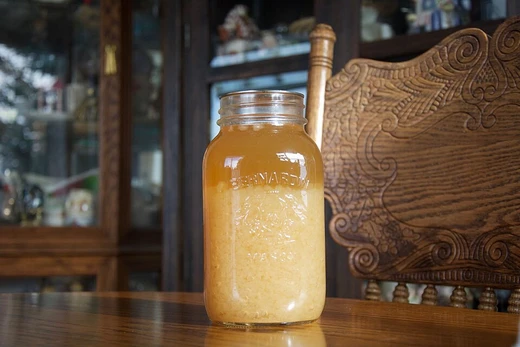
Miso
Traditional Japanese fermented soybean paste used in cooking.

Wikipedia / Wikimedia Commons
Miso is a thick, fermented paste that serves as a traditional Japanese seasoning. It is made by fermenting soybeans with salt and kōji—the fungus *Aspergillus oryzae*—and often includes ingredients like rice, barley, or seaweed. This paste is used in sauces, spreads, and pickling, and is a key component of miso soup, a staple dish in Japanese cuisine. Rich in protein and minerals, miso was an important source of nutrition in feudal Japan.
The exact origins of miso in Japan are unclear. During the Neolithic Jōmon period (14,000–300 BC), grain and fish-based misos, known as jōmon miso, were already being made. A similar fermented soy product likely came from China around the third century BC, and fermented soy foods such as *hishio* probably arrived in Japan with Buddhism in the sixth century AD. By the Nara period (710–794), a precursor called *mishō* or *mishou* existed, and the word is thought to have evolved from *misho* to *miso*. In the Kamakura period (1185–1333), a typical meal included rice, dried fish, miso, and a fresh vegetable. Until the Muromachi period (1337–1573), miso was made without grinding the soybeans, resembling nattō. Buddhist monks then discovered that grinding soybeans into a paste allowed new ways to flavor other foods. Homemade miso, or *temaemiso*, became common, and during the Sengoku period, it was used as military provisions, with daimyōs treating miso production as an important economic activity. In the Edo period (1603–1868), miso was also called *hishio* and *kuki*, and regional varieties emerged. Today, most miso is industrially produced, and traditional homemade versions are rare. New types have appeared, including those with added soup stocks, calcium, non-soy beans, or reduced salt.
Miso can be made from a mix of soybeans, barley, rice, buckwheat, millet, rye, wheat, hemp seed, or cycad. Producers outside Japan now also use chickpeas, corn, azuki beans, amaranth, and quinoa. Fermentation times range from five days to several years. Japanese miso is commonly classified by grain type, color, taste, and background. Varieties include *mugi* (barley), *tsubu* (whole wheat or barley), *genmai* (brown rice), *moromi* (chunky with unblended kōji), *nanban* (with hot chili pepper), *taima* (hemp seed), *sobamugi* (buckwheat), *hadakamugi* (highland barley), *nari* (cycad pulp, used in Buddhist temple diets), and *gokoku* (five-grain: soy, wheat, barley, proso millet, and foxtail millet). Many regions have their own variations; for instance, Sendai miso uses coarsely mashed soybeans. Rice-based misos like *shinshu miso* and *shiro miso* are called *kome miso*.
Miso’s taste, aroma, texture, and appearance vary by region and season, influenced by temperature, fermentation time, salt content, kōji variety, and the fermenting vessel. The most common flavor categories are *shiromiso* (white miso), *akamiso* (red miso), and *awasemiso* (mixed miso). In eastern Japan’s Kantō region, darker akamiso is popular, while in western Kansai (Osaka, Kyoto, Kobe), lighter shiromiso is preferred. *Kome miso* (rice miso) can be yellow, yellowish white, or red; whitish versions use boiled soybeans, reddish ones use steamed soybeans. It is more common in eastern Japan, Hokuriku, and Kinki. *Mugi miso* (barley miso) is whitish and produced in Kyushu, western Chugoku, and Shikoku, with a reddish variant in northern Kanto; it has a distinct smell. *Mame miso* (soybean miso) is darker reddish-brown, less sweet, with astringency and strong umami, and requires long maturing. It is mainly consumed in Aichi, Gifu, and Mie prefectures. Grain-free *hatchō miso*, an Okazaki specialty, is made using large wooden barrels and stones on the lid, a method unchanged since the Sengoku period. *Chōgō* or *awase miso* (mixed miso) combines different varieties to improve weaknesses—for example, blending salty mame miso with kome miso yields a milder result.
- Origin
- Japan (predecessor from China, third century BC)
- Type
- Fermented soybean paste
- Key Ingredient
- Soybeans, salt, kōji (Aspergillus oryzae)
- Common Varieties
- Shiromiso (white), Akamiso (red), Awasemiso (mixed)
- Primary Use
- Seasoning, miso soup, pickling, sauces
- Historical Role
- Nutritional staple in feudal Japan
Lore & Background
The origin of miso in Japan is not completely clear. While fermented fish and grain pastes existed in ancient Japan, the soybean-based miso we know today emerged much later, as soybeans were introduced to Japan during the Yayoi period. Hishio and other fermented soy-based foods are generally believed to have been introduced earlier, during the Yayoi or Kofun periods. The beginning of the current origin of miso is mishō or mishou, a term that appears in Heian period texts (794–1185). In the Kamakura period (1185–1333), a common meal was made up of a bowl of rice, some dried fish, a serving of miso, and a fresh vegetable. By the Kamakura period, soybeans were already being ground for miso, a practice that continued into the Muromachi period (1337 to 1573). In the Muromachi era, Buddhist monks refined the fermentation process, creating smoother pastes that could be used to flavor other foods—though grinding soybeans into paste was already known in China and earlier Japanese methods. Miso was used as military provisions during the Sengoku period, and making miso was an important economic activity for daimyōs of that era.
Reader's Guide
Miso's significance lies in its role as a foundational element of Japanese cuisine and its historical nutritional importance, especially in feudal Japan. The variety of miso is difficult to classify but is commonly done by grain type, color, taste, and background. Common types include kome miso (rice miso), mugi miso (barley miso), and mame miso (soybean miso), each with regional preferences—for example, darker akamiso is popular in the eastern Kantō region, while lighter shiromiso is preferred in the western Kansai region. Miso's flavor and aroma depend on ingredients and fermentation process, with the Maillard reaction producing volatile compounds that give miso its characteristic flavor. Fermentation time ranges from as little as five days to several years. Today, miso is produced industrially in large quantities, and traditional homemade miso has become a rarity. As of 2018, miso had been gaining worldwide interest, and producers in other countries have begun selling miso made from chickpeas, corn, azuki beans, amaranth, and quinoa.
Did You Know?
- Soybeans were introduced to Japan during the Yayoi period, and while grain and fish pastes like hishio existed before that, they were not miso.
- Miso was used as military provisions during the Sengoku period.
- Hatchō miso is an Okazaki, Aichi specialty with origins in Mikawa Province during the Sengoku period.
- The unique aroma of miso is partly due to furanone compounds like HEMF, which gives a sweet aroma to rice miso.
Frequently Asked Questions
What is Miso?
Miso is a thick, fermented paste that originated in Japan, created by combining soybeans with salt and kōji (the mold Aspergillus oryzae) and letting the mixture ferment over time. Depending on the recipe, rice, barley, or seaweed may also be folded in.
What are Miso's core ingredients?
The essential trio is soybeans, salt, and kōji (Aspergillus oryzae). Some preparations additionally incorporate rice, barley, or other ingredients to shift the flavor profile.
How is Miso used in everyday cooking?
Its most iconic role is as the base for miso soup, where it is whisked into dashi stock. Beyond soup, it functions as a general seasoning, a sauce or spread, and a pickling medium for vegetables, fish, and meats.
What are the main varieties of Miso?
The three most widely recognized types are shiromiso (a lighter, sweeter white miso), akamiso (a deeper, saltier red miso), and awasemiso (a blend of the two). They differ primarily in fermentation length, color, and umami intensity.
Why is Miso historically significant?
Miso's lineage stretches back to a Chinese precursor from the third century BC, and it became a daily nutritional pillar in feudal Japan thanks to its high protein and mineral density. It effectively served as a reliable source of essential nutrients for the general population.
More in Fermented Foods 1-17
Spotted an error? Know more?
This is a living reference — every entry is fact-audited, and reader corrections feed straight into our audit queue. Suggest an edit · See this site's audit record