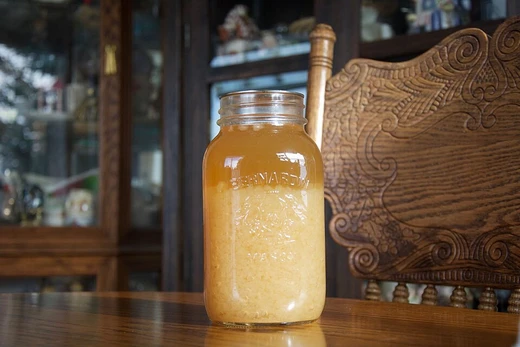
Fish sauce
Fermented fish condiment used globally for umami flavor.

Wikipedia / Wikimedia Commons
Fish sauce is a salty, savory liquid seasoning created by coating fish or krill in salt and letting it ferment for as long as two years. It serves as a kitchen staple across East and Southeast Asia, especially in Myanmar, Cambodia, Laos, the Philippines, Thailand, and Vietnam, and a version of it has been used in Western cooking since ancient Roman times.
Because it adds a rich umami taste—thanks to its natural glutamate content—chefs and home cooks around the world now use it. It can be added during cooking, used as a finishing touch, or made into dipping sauces. In the West, some people treat soy sauce as a vegetarian substitute, though the two have very different flavors.
**History**
*Asia*: Over 2,300 years ago in China, records describe sauces made from fermented fish parts mixed with ingredients like meat and soybeans. During the Zhou dynasty, fish was fermented with soybeans and salt as a condiment. By the Han dynasty, soybeans were fermented alone to create soy paste and soy sauce, while fish-based sauces evolved separately into fish sauce. A Hokkien Chinese term, *kôechiap*, may have been the forerunner of ketchup; that word survives in Malay as *kecap* or *kicap*, though today those words usually mean "soy sauce," while fish sauce is called *kicap ikan* ("fish kicap"). By 50–100 BC, demand for fish sauces and pastes in China had dropped sharply as fermented bean products became major trade goods. Fish sauce then grew hugely popular in Southeast Asia. Food scholars often divide East Asia into two condiment regions: Southeast Asia (Vietnam, Thailand, Cambodia) using fermented fish, and Northeast Asia (China, Korea, Japan) using fermented beans. Fish sauce re-entered China in the 17th and 18th centuries, brought from Vietnam and Cambodia by Chinese traders along the coasts of Guangdong and Fujian.
*Europe*: Fish sauces were common in ancient Mediterranean cooking. The earliest known production dates to the 4th–3rd century BC, when Ancient Greeks fermented fish scraps into a sauce called *garos*, likely with less salt than modern versions. The Romans made a similar condiment called *garum* or *liquamen*. Pliny the Elder described it as made from fish guts and other waste, calling it "the liquor from putrefaction." Roman garum was produced in Spain, almost always from mackerel, by salting fish innards and sun-fermenting them for months until the flesh broke down. The brown liquid was strained, bottled, and sold. Remains of Roman fish-salting facilities survive in Algeciras, Spain, and near Setúbal, Portugal. The process continued until the 16th century, when makers switched to anchovies and removed the innards. Garum was widely used in Roman cooking: mixed with wine it became *oenogarum*, with vinegar *oxygarum*, and with honey *meligarum*. It was a trade specialty of Hispania Baetica. Often described as foul-smelling or rotten, it is considered similar to modern *colatura di alici*, a fish sauce in Neapolitan cuisine. In English, garum was once translated as "fish pickle." Worcestershire sauce is a related product because it is fermented and contains anchovies.
**Difference from oyster sauce**: Fish sauce and oyster sauce are both briny but distinct. Fish sauce is watery, clear, and salty; oyster sauce is made by reducing oyster extracts, making it sweeter, slightly salty, and less pungent.
**Ingredients and manufacture**: Historically, fish sauces were made from various fish and shellfish, using whole fish, blood, or viscera. Most modern versions contain only fish and salt, typically from anchovy, shrimp, mackerel, or other strong-flavored, oily fish. Some add herbs and spices. The fish or shellfish are mixed with salt at 10% to 30% concentration and sealed in a container for up to two years. After the first extraction, some sauces are produced by re-extracting the fish mass through boiling. These second-pass sauces often include caramel, molasses, or roasted rice for color and flavor; they are thinner and cheaper. Some manufacturers also water down a first-press to increase volume. Briefly fermented fish sauce tastes strongly fishy; longer fermentation gives it a nuttier, richer, more savory flavor. An 18th-century article in Diderot and d'Alembert's *Encyclopédie* noted that Europeans could become accustomed to this sauce.
**Regional variations**: Fish sauce is a fundamental seasoning across Southeast Asia. Thai and Cambodian versions are generally milder and less pungent than Vietnamese ones.
*Myanmar*: Called *ngan bya yay* (ငါးငံပြာရည်), it is often a by-product of *Hmyin ngapi*, a Burmese fish paste made from small fish, anchovies, krill, and shrimp.
*Cambodia*: Known as *tik trei* (ទឹកត្រី), it is believed to date back to the pre-Angkor period, much like the fish paste *prahok*.
- type
- Condiment
- origin
- East Asia and Southeast Asia
- key_ingredients
- Fish or krill, salt
- fermentation_time
- Up to two years
- known_for
- Adding savory umami flavor due to glutamate content
Lore & Background
Fish sauce has ancient roots. In China, sauces with fermented fish parts and other ingredients like meat and soybean were recorded 2300 years ago. During the Zhou dynasty, fish fermented with soybeans and salt was used as a condiment. By the Han dynasty, soybeans were fermented without fish into soy paste and soy sauce, while fish-based sauces developed separately. A Hokkien Chinese term, kôechiap, may be the precursor of ketchup, and survives in Malay as kecap or kicap, though these now usually mean soy sauce.
In Europe, fish sauces were widely used in ancient Mediterranean cuisine. The earliest recorded production was between the 4th–3rd century BC by the Ancient Greeks, who fermented fish scraps into garos. The Romans made garum or liquamen, described by Pliny the Elder as the liquor from putrefaction of fish guts. Garum was made in Roman outposts of Spain from mackerel, salted and sun-fermented for months. The process lasted until the 16th century, when makers switched to anchovy and removed the innards. Garum was ubiquitous in Roman cooking, mixed with wine (oenogarum), vinegar (oxygarum), or honey (meligarum). It was often maligned as smelling bad and is said to be similar to modern colatura di alici.
In Southeast Asia, fish sauce developed massive popularity. Thai and Cambodian fish sauces are generally milder and less pungent than Vietnamese ones. In Myanmar, it is called ngan bya yay, often a by-product of fish paste. In Cambodia, tik trei is produced by fermenting anchovies in large wooden vats for six to eight months, distilled five times, then sun-fermented. The most famous comes from Kampot Province. In Laos, it is nam pa, with a chunkier version called padaek. The Philippine patis is a by-product of bagoong production, skimmed from the upper layers of fermenting bagoong and not pressed. In Thailand, nam pla is used in cooking and as a table condiment, often mixed with lime juice and chilies as phrik nam pla.
Reader's Guide
Fish sauce's significance lies in its role as a fundamental seasoning across multiple cuisines, providing a savory umami flavor due to its glutamate content. It is used during or after cooking and as a base in dipping sauces. The condiment has been embraced globally by chefs and home cooks. Historically, fish sauce re-entered China in the 17th and 18th centuries, brought from Vietnam and Cambodia by Chinese traders. Food scholars traditionally divide East Asia into two condiment regions: Southeast Asia using fermented fish, and Northeast Asia using fermented beans. Fish sauce differs from oyster sauce, which is sweeter and less aromatic. Modern production typically uses anchovy, shrimp, or mackerel mixed with 10% to 30% salt, sealed for up to two years. Extended fermentation reduces fishy taste, yielding a nuttier, richer flavor. Second-pass sauces may add caramel, molasses, or roasted rice. The legacy of fish sauce includes its ancient Roman use and its connection to Worcestershire sauce, which is fermented and contains anchovies. Soy sauce is regarded by some in the West as a vegetarian alternative, though flavors differ greatly.
Did You Know?
- Fish sauce has been used in the West since Roman times, where it was called garum or liquamen.
- The Hokkien Chinese term kôechiap for fish sauce may be the precursor of the word ketchup.
- In the Philippines, patis is a by-product of bagoong production and is nearly always cooked before consumption.
- Extended fermentation of fish sauce reduces fishy taste and gives a nuttier, richer, more savory flavor.
Frequently Asked Questions
What is Fish sauce?
Fish sauce is a liquid condiment produced by coating fish or krill in salt and allowing the mixture to ferment for as long as two years. It serves as a cornerstone seasoning across East and Southeast Asian cooking traditions.
What are Fish sauce's key ingredients and how is it made?
The process involves layering fish or krill with salt and letting the mixture ferment over a period that can stretch up to two years. The resulting liquid is rich in glutamate, which is responsible for its deep savory punch.
Where does Fish sauce come from?
It originated in East and Southeast Asia and remains a daily staple in the kitchens of Myanmar, Cambodia, Laos, the Philippines, Thailand, and Vietnam. Western cooks have also been incorporating it into their recipes since Roman times.
What role does Fish sauce play in cooking?
Its primary job is to deliver a strong umami flavor that deepens and rounds out a dish's overall taste profile. It is the go-to seasoning for adding savory depth across a wide range of Asian recipes.
Why is Fish sauce important in the fermented foods canon?
It stands as one of the most widely used fermented condiments in the world, bridging centuries of culinary history from ancient Rome to modern kitchens. Its simple two-ingredient recipe and long fermentation make it a foundational example of how time and salt transform raw ingredients into something entirely new.
More in Fermented Foods 1-17
Spotted an error? Know more?
This is a living reference — every entry is fact-audited, and reader corrections feed straight into our audit queue. Suggest an edit · See this site's audit record