Vasco da Gama
The Portuguese explorer who opened the sea route to India
Last updated

Diego Delso · CC BY-SA 4.0
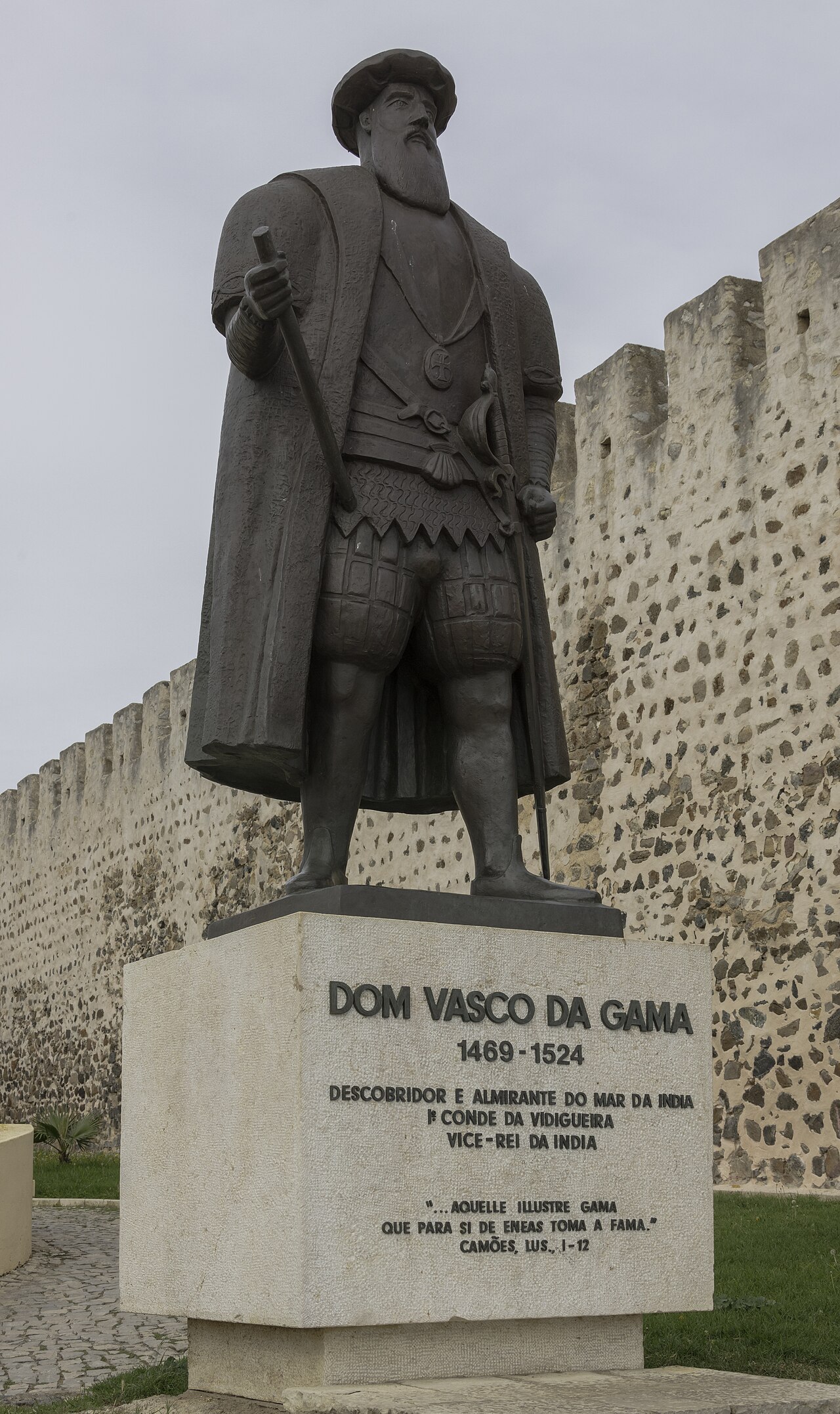
Vasco da Gama was a Portuguese mariner and nobleman born in the 1460s in Sines, Portugal.[1][2] Da Gama's 1497-1499 expedition was the first to connect Europe and Asia by rounding the southern tip of Africa, reaching Kozhikode on 20 May 1498.[3][4]
Life and work
Vasco da Gama was the third of five sons of Estêvão da Gama and Isabel Sodré.[5] Around 1480 he joined the Order of Santiago, whose master was Prince John, later King John II.[6] In 1492 John II sent da Gama to seize French ships in retaliation for attacks on Portuguese shipping.[7] On 8 July 1497 da Gama led a fleet of four ships with 170 men from Lisbon.[8]
The expedition followed the African coast, then crossed the South Atlantic for over three months without landfall.[9][10] After hostile encounters in Mozambique and Mombasa, da Gama secured a pilot in Malindi who guided the fleet to Kozhikode, India.[11][12][13] The return voyage cost over half the crew and two ships, but the spices brought back demonstrated future profit potential.[14][15] King Manuel I granted da Gama the town of Sines as a hereditary fief in December 1499, and later, on 30 January 1502, awarded him the title "Admiral of the Seas of Arabia, Persia, India and all the Orient."[16][17]
What the cited sources add
The 1898 Hakluyt Society journal of the first voyage records that the expedition resorted to piracy, looting unarmed Arab merchant ships near modern Kenya.[18][12] Ghazanfar's 2018 paper states that da Gama's voyage was driven by religious and commercial objectives under the Doctrine of Discovery.[19][20]
References
- Wikipedia, "Vasco da Gama" (CC BY-SA 4.0), which cites: Domingues, "Vasco da Gama's Voyage: Myths and Realities in Maritime History", Portuguese Studies, 2003, p. 1–8; "Vasco da Gama" (original not read by us) en.wikipedia.org
- Wikipedia, "Vasco da Gama" (CC BY-SA 4.0), which cites: Jayne, 1910, p. 34.; Subrahmanyam, 1997, pp. 61–62.; Subrahmanyam, 1997, p. 58. (original not read by us) en.wikipedia.org
- Wikipedia, "Vasco da Gama" (CC BY-SA 4.0), which cites: McNabb, "Children of the Seven Sands", Motivate Media Group, 2025, p. 112 (original not read by us) en.wikipedia.org
- Wikipedia, "Vasco da Gama" (CC BY-SA 4.0) en.wikipedia.org
- Wikipedia, "Vasco da Gama" (CC BY-SA 4.0), which cites: Subrahmanyam, 1997, p. 61. (original not read by us) en.wikipedia.org
- Wikipedia, "Vasco da Gama" (CC BY-SA 4.0), which cites: Subrahmanyam, 1997, pp. 60–61. (original not read by us) en.wikipedia.org
- Wikipedia, "Vasco da Gama" (CC BY-SA 4.0), which cites: Subrahmanyam, 1997, p. 63. (original not read by us) en.wikipedia.org
- Wikipedia, "Vasco da Gama" (CC BY-SA 4.0), which cites: Diffie, "Foundations of the Portuguese Empire, 1415–1850", 1977, p. 176–177 (we also read that source) en.wikipedia.org
- Wikipedia, "Vasco da Gama" (CC BY-SA 4.0), which cites: Gago Coutinho, C.V. (1951–52) A Nautica dos Descobrimentos: os descobrimentos maritimos visitos por um navegador, Lisbon: Agencia Geral do Ultramar; pp. 319–363 (original not read by us) en.wikipedia.org
- Wikipedia, "Vasco da Gama" (CC BY-SA 4.0), which cites: Diffie, "Foundations of the Portuguese Empire, 1415–1850", 1977, p. 176–177; Fernandez-Armesto, "Pathfinders: A Global History of Exploration", W. W. Norton & Company, 2006, p. 177–178 (we also read that source) en.wikipedia.org
- Wikipedia, "Vasco da Gama" (CC BY-SA 4.0), which cites: "Vasco da Gamma Seeks Sea Route to India" , Old News Publishing, Retrieved 8 July 2006. (original not read by us) en.wikipedia.org
- Wikipedia, "Vasco da Gama" (CC BY-SA 4.0), which cites: Velho, "A journal of the first voyage of Vasco da Gama, 1497-1499", London : Printed for the Hakluyt Society, 1898 (we also read that source) en.wikipedia.org
- Wikipedia, "Vasco da Gama" (CC BY-SA 4.0), which cites: McNabb, "Children of the Seven Sands", Motivate Media Group, 2025, p. 114; Fernandez-Armesto, "Pathfinders: A Global History of Exploration", W.W. Norton & Company, 2006, p. 178–179; McNabb, "Children of the Seven Sands", Motivate Media Group, 2025, p. 114; Subrahmanyam 1997, p. 79-80 (original not read by us) en.wikipedia.org
- Wikipedia, "Vasco da Gama" (CC BY-SA 4.0), which cites: Eric Axelson (1981). 'Prince Henry the Navigator and the discovery of the sea route to India', The Geographical Journal, 137, pp. 153–154. (original not read by us) en.wikipedia.org
- Wikipedia, "Vasco da Gama" (CC BY-SA 4.0), which cites: Diffie & Winius, 1977, p. 185. (original not read by us) en.wikipedia.org
- Wikipedia, "Vasco da Gama" (CC BY-SA 4.0), which cites: Subrahmanyam, 1997, p. 168. (original not read by us) en.wikipedia.org
- Wikipedia, "Vasco da Gama" (CC BY-SA 4.0), which cites: João de Barros (1552, pp. 23–24) dates this appointment in January 1502, just before da Gama's departure on his second voyage. But Subrahmanyan (1997, p. 169), (original not read by us) en.wikipedia.org
- Velho, "A journal of the first voyage of Vasco da Gama, 1497-1499", London : Printed for the Hakluyt Society, 1898. facts only, no text reused. archive.org
- S. M. Ghazanfar, "Vasco da Gama’s Voyages to India: Messianism, Mercantilism, and Sacred Exploits", Journal of Global Initiatives (2018), doi:10.32727/11.2018.234. OpenAlex metadata CC0; paper not read. doi.org
- Wikipedia, "Vasco da Gama" (CC BY-SA 4.0), which cites: Ghazanfar, "Vasco da Gama’s Voyages to India: Messianism, Mercantilism, and Sacred Exploits", Journal of Global Initiatives: Policy, Pedagogy, Perspective, 2018-12-01; Pope, "Bullarium patronatus Portugalliae regum in ecclesiis Africae, Asiae atque Oceaniae: bullas, brevia, epistolas, decreta actaque Sanctae Sedis ab Alexandro III ad hoc usque tempus amplectens", Ex Typographia nationa (we also read that source) en.wikipedia.org
Each numbered sentence above was checked against the source it cites before publication. Sentences citing Wikipedia adapt text from the English Wikipedia article Vasco da Gama (contributors), used under CC BY-SA 4.0; this entry is available under the same licence. Other sources were used for facts only; no text or images are copied from them.
Also in the Codexery
More in Great Explorers
Sources
Compiled from Wikipedia and the sources listed below. Text from Wikipedia is available under CC BY-SA 4.0; this entry is adapted from it.
- Wikipedia: Vasco da Gama (CC BY-SA 4.0).
Spotted an error? Know more?
Reader corrections go straight into our review queue. Suggest an edit · How this site is sourced